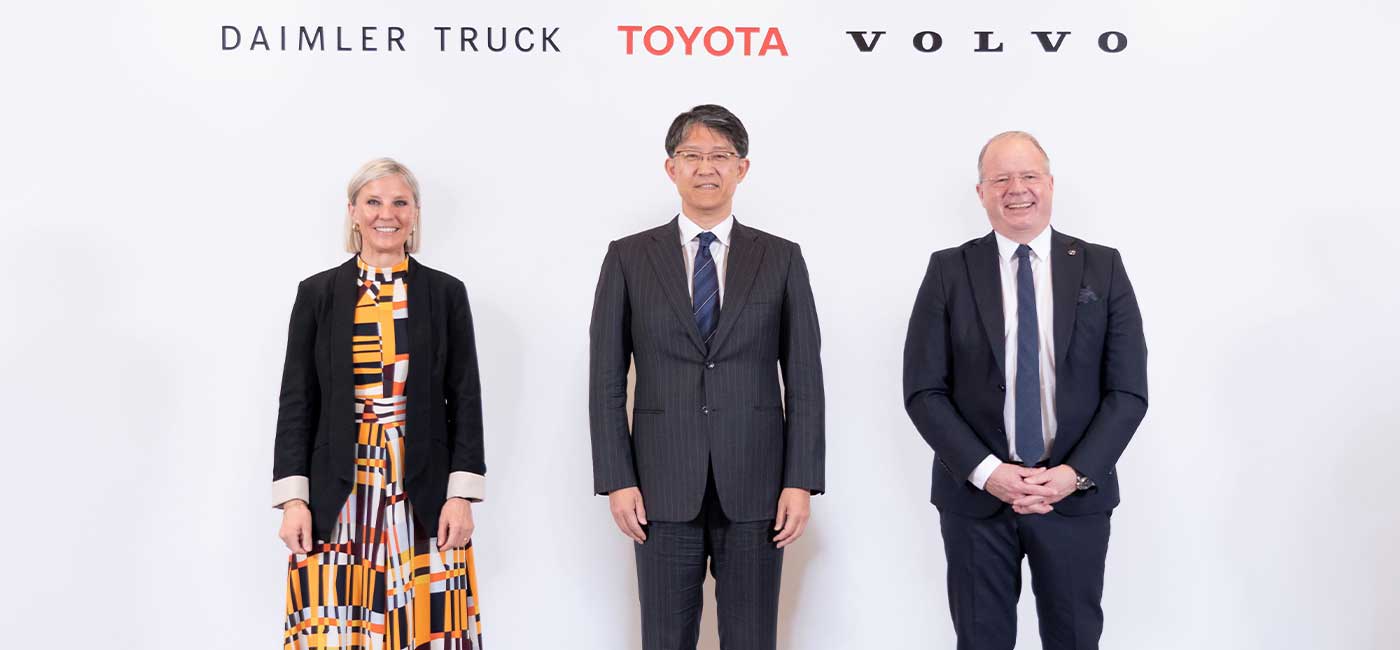

Daimler Truck, the Volvo Group and Toyota Motor Corporation have agreed to explore a three‑way partnership to accelerate the development of hydrogen fuel cell systems for heavy‑duty vehicles, in a move that underscores growing industry collaboration to decarbonise transport.
The three companies signed a non‑binding agreement for Toyota to join fuel‑cell specialist Cell Centric — a venture originally launched by Daimler Truck and Volvo — as an equal shareholder. The aim is to combine European commercial‑vehicle expertise with Japanese fuel‑cell know‑how and scale technology for heavy‑duty applications beyond trucking alone.
For Joachim Ladra, Head of Sales, Marketing and Communications at Cell Centric, the challenge is no longer about whether fuel cells can work, but whether the industry can orchestrate the entire hydrogen ecosystem to make them commercially viable.
“Cell Centric is a fuel cell company. Our task is to make fuel cells a technically and commercially viable alternative to diesel engines in heavy‑duty applications, predominantly trucks. But we’re not stopping there,” Ladra says in an exclusive interview with Automation News.
The proposed partnership with Toyota reflects exactly that breadth. Ladra argues that Cell Centric, positioned as an independent tier‑one supplier, wants to do for hydrogen what Cummins has done for diesel: provide systems not just to its owners but across global markets and applications.
“We’re looking at the entire off‑highway market — buses and coaches, rail and marine, stationary power generation, mining equipment — basically everywhere you would find a diesel engine today,” he says.
Much of the industry focus remains on infrastructure, which Ladra describes as the “big challenge” facing hydrogen adoption. “Fuel cells aren’t useful without hydrogen refuelling stations. You can drive a diesel truck anywhere, but try finding hydrogen stations — it’s a different story,” he says. “Heavy‑duty vehicles are tools. They earn money. Nobody will accept a 50 per cent surcharge for the same performance just because it has zero CO₂ emissions. We need technical parity and commercial viability — and that includes infrastructure.”
That sentiment echoes the rationale behind the three‑way collaboration. By bringing Toyota into Cell Centric, Daimler Truck and Volvo hope to accelerate development, share risk and create a stronger market signal to partners across the hydrogen value chain — from suppliers to policymakers to infrastructure investors.
Karin Rådström, Chief Executive of Daimler Truck, said Toyota’s planned entry would help “strengthen development and further scale hydrogen technology”.
Martin Lundstedt, Chief Executive of Volvo, said the move could “create critical mass for hydrogen applications”. Toyota’s president Koji Sato said combining the partners’ experience could deliver “one of the world‑leading fuel cell systems for heavy commercial vehicles”.
Ladra notes that legislative tailwinds, such as the EU’s Alternative Fuel Infrastructure Regulation, are finally creating clearer milestones for hydrogen refuelling rollout, but he stresses industry must drive much of the progress itself.
“Everybody needs to come to the table and orchestrate the ramp‑up,” he says. “If we all do it on our own, not a lot will happen — because no one wants to be the first to invest without a guaranteed payoff.”
While the technology is increasingly mature — Ladra notes the next generation of Cell Centric’s fuel cells will be 20 per cent more efficient and fit within the packaging of an 11‑litre diesel engine — commercial production remains constrained by limited hydrogen availability and infrastructure.
“Hydrogen, regardless of colour, is still scarce globally,” he says. “A lot of money has been spent and technology has been driven forward, but we are struggling to put all the pieces together.”
Despite the hurdles, the potential prize is clear. With heavy‑duty transport accounting for a significant share of emissions, hydrogen fuel cells are seen by many manufacturers as a necessary complement to battery‑electric solutions, particularly for long‑haul and high utilisation applications where weight and refuelling speed matter.
“The technology side is not the bottle,” Ladra says. “Trucks we have today can match diesel performance in payload and range — and refuel in 10 minutes. The question is whether the ecosystem can keep pace.”