


Humanoid robots could be working alongside human colleagues at car plants around the world within the next two years.
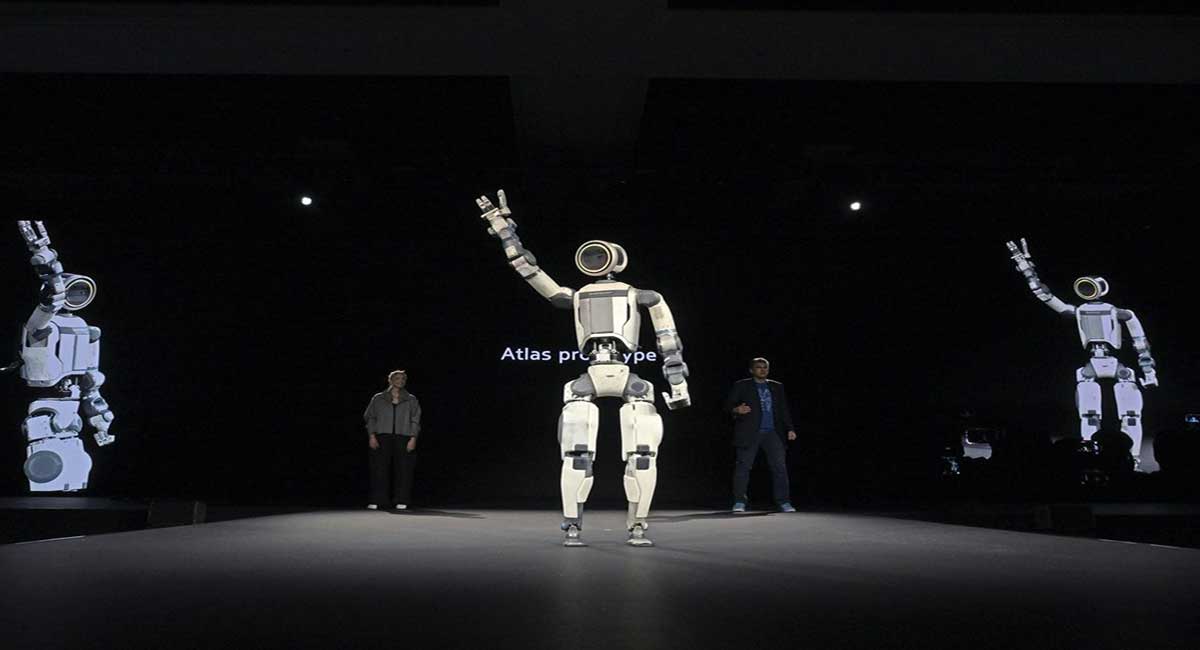
That was the vision unveiled by Hyundai Motor Group when at a glitzy CES 2026 announcement, featuring Spot robots performing a K-Pop dance routine, the Korean conglomerate unveiled plans to introduce Atlas humanoid robots into its car factories from 2028, signalling a major step in industrial automation while also preparing to manufacture the robots at scale.
Hyundai and Boston Dynamics, the US robotics firm it owns, gave their first public demonstration of Atlas, which, after may years in development, is now in production.
Hyundai said that as well as agreeing to acquire the entire 2026 supply of Atlas robots produced by Boston Dynamics at its US facility, the Korean conglomerate plans to build a new factory capable of producing 30,000 humanoid robots annually, marking the company’s entry into robot manufacturing in earnest.

The Korean conglomerate said that it plans to introduce Atlas robots across plants including its HMGMA plant in Georgia, USA, from 2028, initially handling simple tasks such as parts sequencing. But, it said that by 2030 it expected to extend Atlas’ workload to include to car assembly and other complex operations.
“At Hyundai Motor Group, we have a unique advantage, we connect mobility, logistics and robotics into one integrated loop,” said Woong Jae Lee, Vice President of Hyundai’s Manufacturing Solutions Division. “This holistic modelling of cross-domain data is changing everything, even factories. We are shifting from hardware driven plants to the software defined factory.”
The company said it planned to invest KW125.2 trillion ($86.5 billion) in South Korea over the next five years, focusing on AI-powered robotics and green energy. And in the US it planned to spend a further $26 billion on the project.
Zachary Jackowski, Vice President and General Manager of Atlas at Boston Dynamics, said that the company’s updated version of Atlas is equipped with 56 degrees of freedom, human-scale hands, and tactile sensing, allowing it to navigate complex industrial sites, perform repetitive tasks, and autonomously learn new roles. It can lift 50 kg, operate in temperatures from -4°C to 40°C, reach up to 7.5 feet, and automatically recharge its batteries. Its cameras provide 360-degree vision to detect human presence, and most tasks can be trained within a day.

He said that although the company had been developing Atlas for well over a decade, advances in technology meant that the machine was now capable of being deployed at scale in manufacturing.
“I’ve been designing, programming and building robots for my entire career and I’ve never been more excited about what’s next than I am now,” he said. “We’re on the cusp of a transformational shift that will be as impactful as the smartphone.”
Hyundai said that later this year it planned to open what it called a Robot Metaplant Application Centre (RMAC) in the US where it will train its robots to work with people.
The company added that the project was part of a wider push towards “Physical AI” which leverages real-world data from production, logistics, and sales to enable autonomous decision-making and continuous improvement. It said ts first software designed factory was already operating in Singapore where it was optimised to improve collaboration between humans and robots
Hyundai said its AI Robotics strategy rests on three pillars: deploying co-working robots for hazardous or repetitive tasks, combining Boston Dynamics’ expertise with Hyundai’s global manufacturing scale, and collaborating with AI innovators including Google DeepMind to advance humanoid capabilities.

Boston Dynamics’ Spot and Stretch robots are already deployed globally for warehouse automation, safety monitoring, and data collection, with Hyundai planning to extend these deployments to logistics, energy, construction, and facility management.
Hyundai said its centralised AI Robotics network will train Atlas through iterative learning cycles using real-world and simulated data. A collaboration with NVIDIA will accelerate AI development and integration into smart factories.
The move is the latest push by car companies into the field of humanoid robotics. EV makers Tesla and BYD have invested heavily in humanoid robot while BMW has recently trialled two manufactured by California-based Figure at its Spartanburg plant in Germany. Chinese firms Unitree, UBTech and XPeng Robotics are also competing for supremacy in what promises to be a lucrative market.
In November, robotics analyst Yole Group said that it expects the global humanoid robot market to be worth $6 billion in 2030 and to grow rapidly to $51 billion by 2035, with shipments rising from 136,000 units to more than two million. Industrial adoption is expected to lead, gradually expanding into consumer and medical markets.


