Electric vehicle battery packs are evolving from modular to cell-to-pack and cell-to-chassis designs, driving innovations like adhesive-free Cell Contacting Systems for efficiency, sustainability, and scalability, writes Till Wagner, Product Manager, Energy Systems, ENNOVI.
As the electric vehicle (EV) industry matures, the design and manufacturing of battery packs have become central to achieving higher performance, lower costs and improved sustainability. At the heart of every battery pack lies the cell contacting system (CCS); the critical assembly that electrically connects individual cells, aggregates current and ensures safe, reliable operation. The evolution of CCS technologies reflects the broader shift in battery architecture, moving from modular designs to highly integrated cell-to-pack (CTP) and cell-to-chassis (CTC) systems. This article explores the progression of CCS solutions, the limitations of traditional adhesive-based lamination, and the transformative impact of ENNOVI’s adhesive-free lamination technology on performance, sustainability and future scalability.
What is a Battery Cell Contacting System?
A battery CCS is the structural and electrical backbone of a battery pack. It comprises conductive elements, such as foils or plates, insulation layers, mechanical supports and signal lines for monitoring. The CCS is responsible for aggregating electrical current from each cell, providing low-resistance pathways for power delivery, enabling cell balancing and integrating with the battery management system (BMS) for safety and performance monitoring. In addition to its electrical function, the CCS must maintain the mechanical integrity of the pack, ensuring that cells remain securely positioned and protected from vibration, shock and thermal stress.
Evolution of CCS: From Modular Designs to CTP and CTC Architectures

Historically, EV battery packs were constructed from smaller modules, each containing a subset of cells (Figure 1). These modules were then assembled into the final pack. In such designs, the CCS often relied on plastic carrier trays to hold and align cells, with metal busbars or foils providing electrical connections. This modular approach offered simplicity and ease of assembly but introduced significant limitations in terms of weight, volume and scalability.
The Evolution of EV battery packs
The industry’s pursuit of higher energy density and lower costs has driven the adoption of cell-to-pack (CTP) and cell-to-chassis (CTC) architectures. These approaches eliminate intermediate modules, integrating cells directly into the pack or even the vehicle chassis. The result is a more compact, lighter and energy-efficient battery system. However, this shift places new demands on the CCS, which must now accommodate larger, thinner and more complex cell arrays while maintaining precise tolerances and robust performance.
The progression of CCS technologies: plastic carrier tray, hot lamination, and cold lamination
While the earliest CCS designs were effective for small or moderate-sized packs, plastic trays are inherently bulky, adding unnecessary weight and thickness (Figure 2). Their scalability is limited, making them unsuitable for the large, thin battery arrays required by modern CTP and CTC systems. Additionally, the tolerance limitations of plastic molding can compromise the precision required for high-density cell arrangements.
CCS assembly methodologies
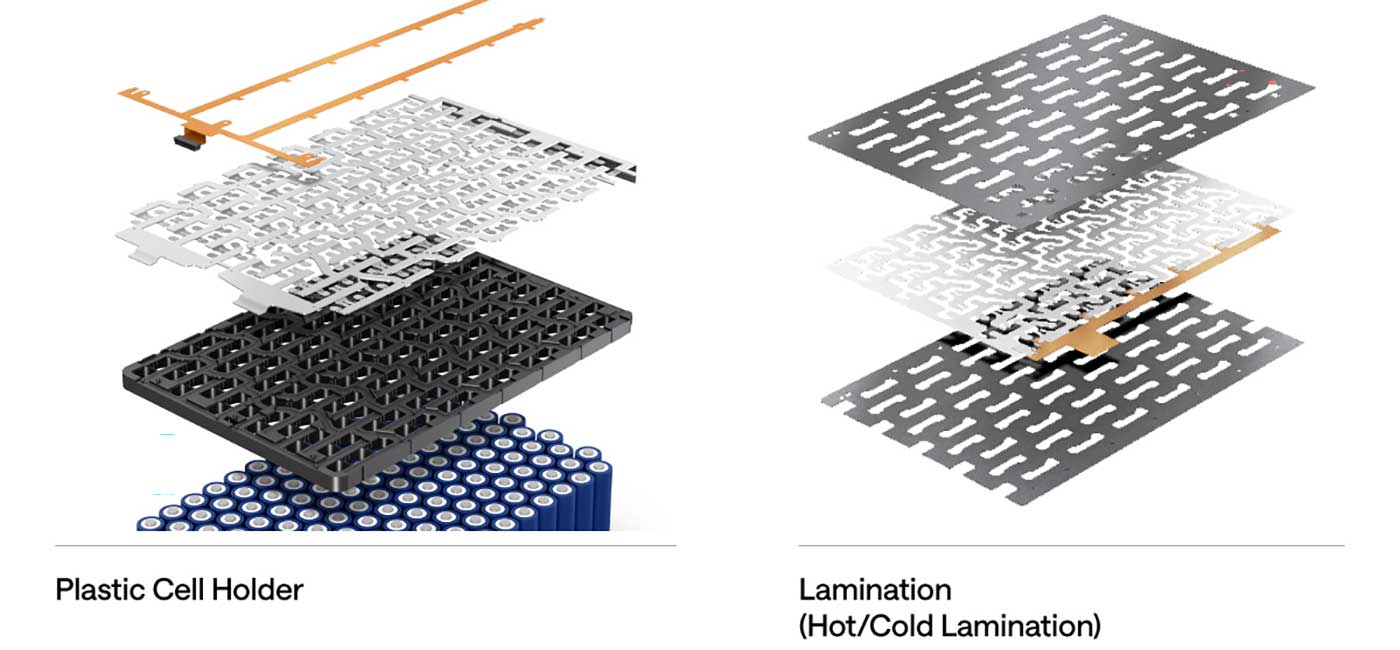
To address these challenges, the industry transitioned to hot lamination. In this process, layers of conductive foil and insulation are bonded together using heat and pressure, with adhesives serving as the joining agent. Hot lamination enables the creation of thinner, lighter CCS assemblies that can accommodate larger and more complex pack configurations. The process provides robust bonding and insulation, supporting the demands of high-performance EV batteries. However, hot lamination is energy-intensive, requiring significant heating and extended cycle times.
Cold lamination emerged as a response to the drawbacks of hot lamination. This method relies solely on pressure to bond the layers, typically using pressure-sensitive adhesives (PSA). Cold lamination involves lower energy consumption, shorter cycle times and lower production costs than hot lamination. Nevertheless, as with hot lamination, cold lamination still relies on adhesives.
Limitations of traditional adhesive-based lamination
Adhesive-based lamination, whether hot or cold, presents several significant limitations in EV battery manufacturing. Firstly, the use of adhesives can degrade the properties of insulation and conductive materials, especially the less stable adhesives used for cold lamination. This degradation can affect the long-term reliability and safety of the battery pack.
Secondly, open glue surfaces introduce a risk to manufacturing and functionality as they can catch and trap particles that may influence insulation behaviour. Special measures have to be applied to deal with the effects and guarantee the technical cleanliness requirements.
Thirdly, adhesives are often derived from petroleum-based chemicals, making them non-renewable and non-recyclable. Their production and disposal can release harmful substances, contributing to the environmental footprint of battery manufacturing. During the manufacturing process, adhesive curing increases cycle times and energy consumption, reducing overall production efficiency.
Furthermore, adhesives complicate end-of-life disassembly and material recovery. When a battery pack reaches the end of its service life, the presence of adhesives makes it difficult to separate and recycle the constituent materials. This not only increases waste but also undermines the EV industry’s sustainability goals.
Finally, adhesives increase material costs and require additional process steps, further affecting the economics of battery production.
Adhesive-free lamination: a breakthrough in CCS technology

ENNOVI has pioneered an adhesive-free lamination technology that overcomes the limitations of traditional methods. This innovative process leverages the company’s expertise in laser welding, lamination and CCS design to achieve reliable bonding and insulation performance without the use of adhesives or heat. In the adhesive-free process, the current collector is positioned between two foils, which are then sealed together around the collector to form a tight, insulated pocket (see Figure 3). This proprietary method delivers mechanical and electrical performance on par with — or superior to — conventional hot lamination, but without the associated drawbacks.
Adhesive-free lamination technology
The adhesive-free process maintains structural integrity through patent-pending clamping features and precision manufacturing. The result is a CCS that is robust, durable and capable of withstanding the rigors of automotive environments throughout the battery’s service life.
Environmental and sustainability benefits
Eliminating adhesives from the lamination process yields substantial environmental benefits across the entire manufacturing lifecycle. At the materials sourcing stage, the absence of adhesives reduces the need for petroleum-based chemicals and hazardous substances. During manufacturing, the adhesive-free process consumes significantly less energy required for hot lamination, as it does not require heating or adhesive curing. This reduction in energy use translates directly into lower greenhouse gas emissions and a smaller carbon footprint.
In terms of product use, the absence of adhesives eliminates the risk of adhesive degradation, which can otherwise compromise battery safety and performance over time. At end-of-life, adhesive-free CCS assemblies are far easier to disassemble and recycle. The foils and collectors can be separated and processed without contamination, facilitating the recovery of valuable materials and reducing waste. Overall, the adhesive-free approach supports a circular economy model and aligns with the sustainability objectives of the EV industry.
Measurable improvements in manufacturing efficiency
ENNOVI’s adhesive-free lamination technology delivers quantifiable improvements in energy consumption, process time and material usage compared to conventional hot lamination. The process uses less than 5% of the energy required for hot lamination, resulting in significant cost and environmental savings. Cycle times are up to 80% faster, enabling higher throughput and more responsive manufacturing operations. Material usage is also optimized, with insulation material costs reduced by 50% and overall space savings of 25% due to the thinner, adhesive-free layers. These improvements translate into a 50% reduction in insulation layer cost compared to hot lamination, making the technology highly attractive for large-scale EV battery production.
Future impact: design flexibility and scalability
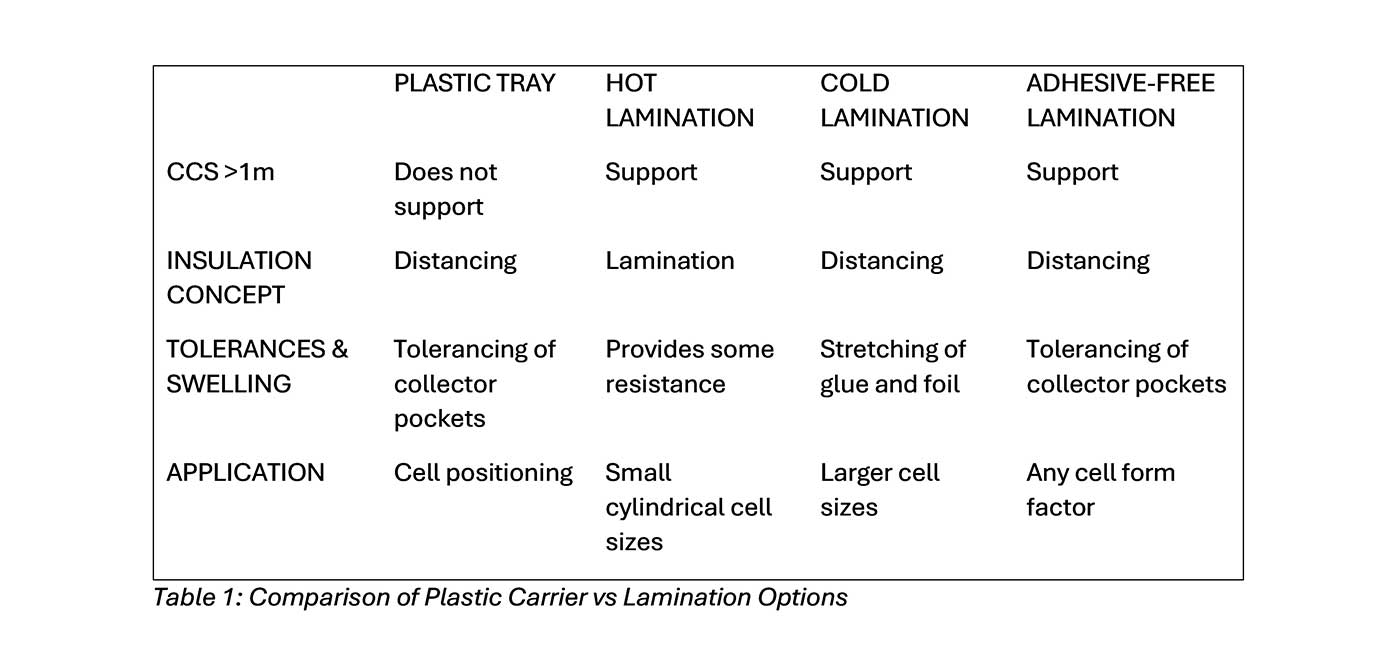
Looking ahead, adhesive-free lamination is poised to have a profound impact on the design flexibility and scalability of future EV battery architectures. The process supports all major cell types – prismatic, pouch and cylindrical – and accommodates a wide range of form factors and sizes, including large-format arrays up to 2,500mm in length (see Table 1). This flexibility enables manufacturers to tailor battery designs to specific vehicle requirements, optimize energy density and leverage high-volume gigafactory production.
The streamlined, modular nature of adhesive-free lamination accelerates development cycles, allowing for rapid prototyping, testing and deployment of new battery designs. The technology’s inherent sustainability and recyclability further enhance its appeal, supporting the industry’s transition to greener manufacturing practices. As battery technology continues to evolve, adhesive-free lamination provides a robust platform for integrating emerging innovations, such as solid-state electrolytes and self-healing materials.
Conclusion
The evolution of battery CCS design reflects the broader transformation of EV battery architecture, from modular designs to highly integrated CTP and CTC systems. While traditional plastic trays and adhesive-based lamination methods have served the industry well, their limitations in scalability, efficiency and sustainability have become increasingly apparent. ENNOVI’s adhesive-free lamination technology represents a significant leap forward, delivering robust, scalable and environmentally responsible CCS solutions that meet the demands of next-generation EVs. By reducing energy consumption, process time and material usage, while enabling greater design flexibility and recyclability, adhesive-free lamination is set to play a key role in the future of electric mobility.
Author biography:

Till Wagner is a product manager specialising in battery interconnects at ENNOVI, with more than 10 years of experience in the automotive and electrification industry. Throughout his career, he has led the development of advanced lamination technologies for cell contacting systems, playing a key role in pioneering adhesive-free lamination processes that enhance battery performance and manufacturing efficiency. His expertise spans the design and implementation of innovative solutions tailored to various battery form factors, including cylindrical, prismatic, and pouch cells.
Till holds a bachelor’s degree in industrial engineering, which has provided him with a strong foundation in developing high-performance, scalable battery solutions. Committed to driving sustainable practices in the electrification industry, his work focuses on reducing production costs, conserving energy and accelerating time-to-market for cutting-edge battery technologies. His dedication to innovation and practical problem-solving has made him a sought-after expert in the field.