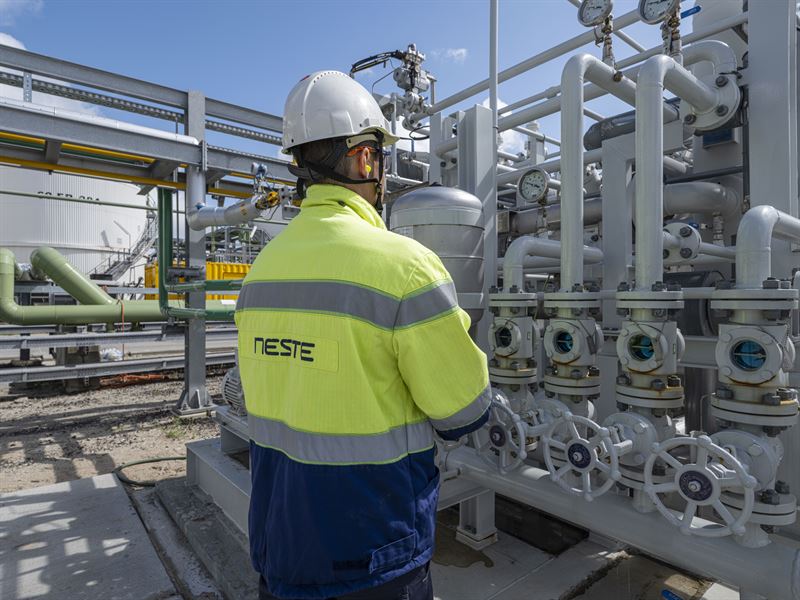

Finnish energy company Neste has begun operating what it says is the world’s largest multi-megawatt high-temperature electrolyser, marking a significant milestone for renewable hydrogen production in the refining industry.
The installation, located at the company’s renewable products refinery in Rotterdam, is part of the EU-funded MultiPLHY demonstration project. The initiative brings together a consortium including Neste, German electrolyser manufacturer Sunfire, French research organisation CEA, and energy company ENGIE.
The 2.6-megawatt solid oxide electrolysis cell (SOEC) unit, developed by Sunfire, consists of twelve modules operating at temperatures of around 850°C. By using waste heat from industrial processes, the system can produce more than 60 kg of renewable hydrogen per hour while consuming significantly less electricity than conventional low-temperature electrolysis systems.
The project aims to demonstrate how renewable hydrogen can replace hydrogen produced using fossil fuels in refining processes—an essential step towards cutting greenhouse gas emissions from fuel production. Neste is responsible for integrating the system into its refinery operations and will lead the next phase of testing to assess the technology’s performance and scalability.
“The MultiPLHY project has given Neste valuable insights and experience in integrating industrial-scale renewable hydrogen production into our refinery,” said Jukka Kanerva, Senior Vice-President for Renewable Refining at Neste. “We remain committed to exploring different pathways to replace fossil-based hydrogen and reduce emissions in our operations.”
Sunfire’s Chief Executive, Nils Aldag, said the project demonstrated the potential of high-temperature electrolysis to deliver efficiency gains where waste heat is available. “Our SOEC electrolyser technology can now be integrated into industrial environments at a large scale,” he said.
Pierre Olivier, Head of Hydrogen Lab at ENGIE, described the Rotterdam launch as “a big step in making green hydrogen competitive,” while Mirela Atanasiu, Head of Unit Operations and Communication at the Clean Hydrogen Partnership, called it “a significant milestone for both the technology and the clean hydrogen sector.”
The MultiPLHY project, which is coordinated by CEA, is expected to provide key data for future commercial deployment of high-temperature electrolysis across Europe’s industrial sectors.