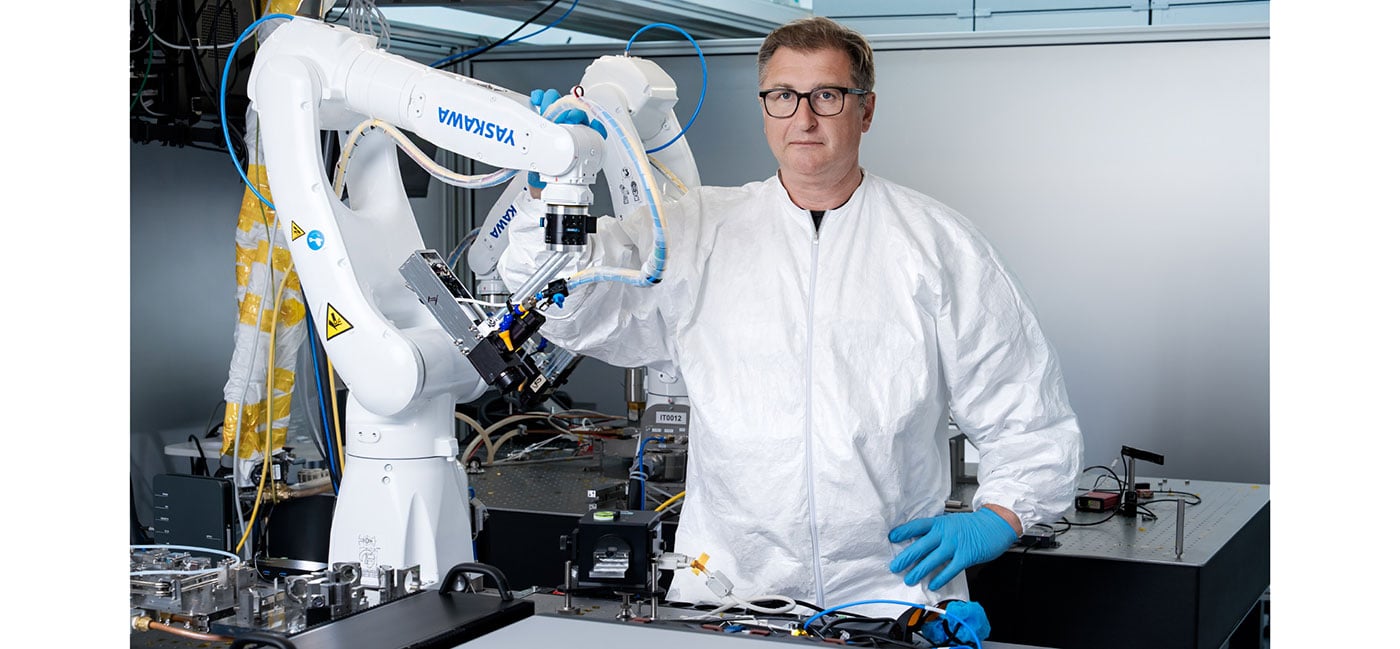

Shrinking populations across Europe are putting pressure on businesses that are looking for ways to stay competitive with fewer workers. According to experts at femtosecond laser manufacturer LITILIT, in the laser industry, automation doesn’t just offset labour shortages – it also boosts productivity.
An August report by the International Federation of Robotics found that automation can help smaller manufacturers reach productivity levels and competitive advantages that were previously available mainly to larger industrial companies.
According to Nikolajus Gavrilinas, Co-Founder and CEO of LITILIT, which recently started building a large-scale femtosecond laser facility in Vilnius, the laser industry is a clear example of how automation can help smaller businesses to scale. For LITILIT, it will allow the company to manufacture up to 3,000 femtosecond lasers a year, one of the highest capacities in the world, with just around 150 employees.
“Typically, building a femtosecond laser required highly trained specialists, because these advanced lasers evolved from scientific systems. While they deliver strong performance, they are notoriously difficult to produce at scale. We build ours on a patented, purpose-built architecture with fewer components, allowing us to significantly speed up production and reduce headcount,” Gavrilinas says.
Another advantage of automation is making precision repeatable at scale. Femtosecond lasers require tiny optical components to be aligned with extreme accuracy, work traditionally done by highly trained specialists one unit at a time. Automation allows manufacturers to maintain that same level of precision across thousands of lasers while reducing variation between units.
Gavrilinas notes that automated manufacturing will also help LITILIT advance its goal of making femtosecond lasers scalable. The company is on track to finish its Vilnius factory this October and immediately begin production, gradually increasing capacity.
“Femtosecond lasers are used in fast-developing fields, from manufacturing the latest generation of semiconductors and data centre equipment to performing complex eye surgeries. As demand for these advanced lasers grows, it would be very difficult to meet it using traditional methods, where complex assembly makes it difficult to scale output,” Gavrilinas explains.
LITILIT builds lasers based on a few patented inventions (patent 1, patent 2), made by LITILIT co-founders Kęstutis Regelskis, Nerijus Rusteika, and Gavrilinas, in close collaboration with the Center for Physical Sciences and Technology (FTMC) in Vilnius.
After finishing the Vilnius factory this October, the company plans to replicate the factory model in other regions together with international partners.