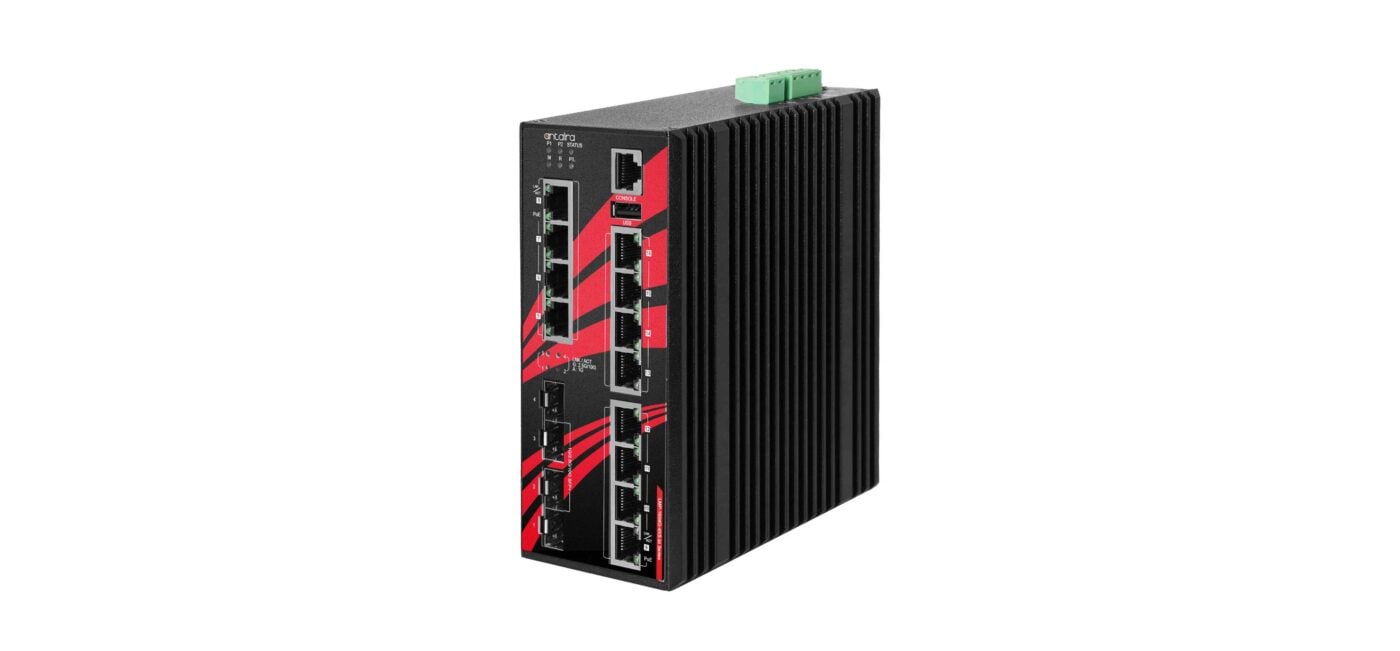

Industrial Ethernet switches are designed to operate reliably in conditions that are often unsuitable for commercial networking equipment.
Here, Joe Cook, General Manager at Antaira Technologies, outlines 10 key capabilities commonly used to differentiate industrial-grade Ethernet switches from commercial alternatives
1. Interconnectivity of devices and networks
At its core, an industrial Ethernet switch bridges every device on the plant floor — PLCs, sensors, cameras, HMIs — into a unified, communicating network. Multi-port architectures support simultaneous connections at scale, and managed variants enable remote configuration, so operators can monitor and adjust without stepping foot on the floor.
2. Long distance operation
Where commercial switches top out at 100 meters, fibre-optic-enabled industrial switches extend connectivity to several miles. Remote assets, outlying substations, and geographically distributed facilities can be unified into a single manageable network without signal degradation or repeater chains.
3. Noise immunity and EMI resistance
Variable-frequency drives, motors, and high-voltage lines generate electromagnetic interference that corrupts data on copper runs. Industrial switches feature hardened EMI shielding and support fibre optic cabling, an inherently immune medium, helping maintain data integrity in the electrically noisy environments.
4. Extreme temperature operation
Standard commercial hardware fails below 0°C or above 50°C. Industrial-grade switches operate reliably across -10°C to 70°C standard ranges, with extended-temperature models rated from -40°C to 75°C, engineered for foundries, cold-storage logistics, outdoor substations, and arctic deployments alike.
5. Corrosion protection
Chemical plants, wastewater treatment facilities, and marine installations expose equipment to corrosive agents that eat through standard enclosures. Industrial switches are available with IPC-A-610-compliant conformal coating, sealing internal circuitry against moisture, salt fog, and chemical exposure before corrosion can cause downtime.
6. Vibration and shock resistance
Heavy machinery, compressors, and transportation platforms generate constant mechanical stress. Industrial switches are designed to MIL-STD vibration and shock specifications, with DIN-rail mountings and solid-state construction that maintain secure connections and uninterrupted data flow in high-vibration environments.
7. IP-rated rugged housing
Dust ingress and moisture infiltration destroy unprotected electronics. Industrial switches are housed in hardened metal enclosures rated to IP30, IP40, or IP67 depending on the application, keeping internal components clean and dry whether deployed in a dusty quarry, a humid greenhouse, or an outdoor junction box.
8. Power over Ethernet (PoE) capability
PoE-capable switches deliver both data and power over a single Ethernet cable, eliminating separate power runs to IP cameras, wireless access points, VoIP phones, and smart sensors. The result: faster deployment, reduced cabling costs, and centralised power management with per-port control from the switch.
9. Unmanaged switches: plug-and-play simplicity
For straightforward point-to-point connectivity where traffic management is not required, unmanaged industrial switches offer immediate, zero-configuration operation. Cost-effective and widely deployed in industrial environments, they are often used for isolated machine networks, legacy equipment integration, and budget-conscious deployments that still demand industrial-grade durability.
10. Managed switches: full network control
Managed industrial Ethernet switches deliver VLAN segmentation, QoS prioritisation, SNMP monitoring, RSTP/ring redundancy, and remote CLI or web-GUI configuration. Used in complex OT architectures, they allow engineers to isolate traffic, enforce security policies, and achieve sub-50ms network recovery, all from a central console.
Correct switch specification is critical in industrial environments, where environmental stress, network complexity, and uptime requirements are significantly higher than in commercial deployments.
Author biography:
Joe Cook is General Manager at Antaira Technologies, based in Las Vegas, Nevada.