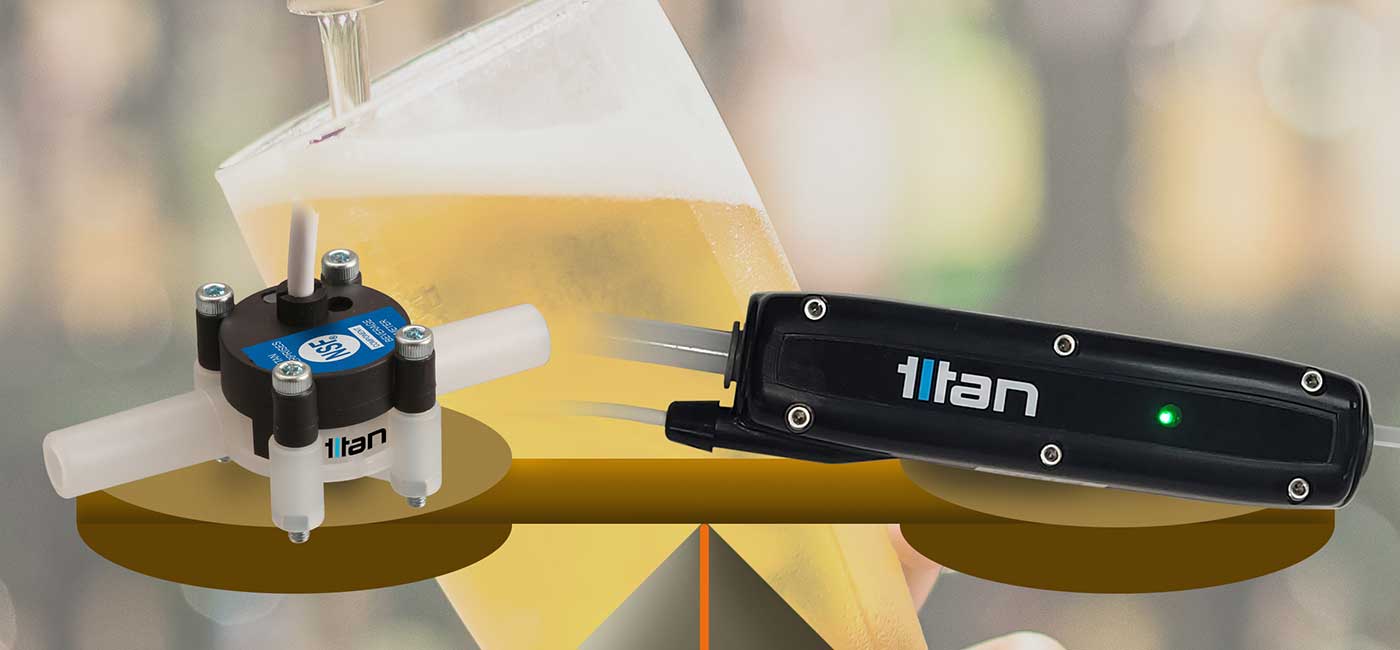

Titan Enterprises has launched an ultrasonic beverage flowmeter aimed at operators seeking greater hygiene and precision in drinks dispensing, setting up a clear choice between the newcomer and the company’s long-established Beverage Turbine Meter.
The two devices employ distinct measurement technologies that lead to differences in accuracy, maintenance demands, and suitability for particular temperature ranges. The turbine model relies on a mechanical Pelton wheel design running on sapphire bearings. Although this introduces moving parts, it delivers strong repeatability and an accuracy of 1.5% of full scale.
The ultrasonic meter, by contrast, uses a time-of-flight technique to measure flow through a straight, unobstructed 6 mm bore. With no internal components that can wear or harbour contaminants, it offers accuracy better than 2% of reading and can be cleaned using sponge balls.
Material choices also mark out the two meters. The turbine unit is produced from PVDF with Viton seals, and has already secured NSF approval under the organisation’s standard 169. Titan expects to pursue NSF approval for the ultrasonic model, which is made from an ABS/PC polymer blend and uses food-approved components under FDA and EU rules, once full commercialisation is reached.
Performance differences are most evident at low flow rates. The ultrasonic meter provides 5,000 pulses per litre, compared with the turbine’s 1,400 pulses, and is capable of measuring down to 0.2 litres per minute. The turbine meter’s range begins higher, at 0.6 litres per minute. Both devices share a 10 litres per minute upper limit. Repeatability and linearity vary, with the turbine model offering tighter repeatability at ±0.1%, while the ultrasonic version remains stable at ±0.5%.
However, the ultrasonic system’s advantages are offset by a much narrower operating temperature band of 3–15 °C, restricting it mainly to chilled drinks. The turbine meter, with a 0–125 °C tolerance, remains the suitable option for hot drink dispensers or mixed-temperature systems.
Installation requirements remain similar across the two product lines, including the use of 3/8-inch push-fit connectors. Power specifications diverge slightly, with the turbine model running at 5–24 VDC and the ultrasonic meter requiring 7–24 VDC.
Price differences are significant. The turbine meter remains the economical choice and is described by Titan as a robust, repeatable solution that can withstand heavy use. The ultrasonic model carries a premium of almost five times the cost but may appeal to operators looking for hygienic design, minimal maintenance, and higher-resolution monitoring across variable flow rates.
Titan said the ultrasonic device is particularly suited to beer systems that use sponge balls for cleaning, with its straight-bore architecture designed to allow unobstructed passage. The company argues that its improved accuracy across the full measurement range will benefit operators managing flow conditions that fluctuate.
The decision between the two meters, Titan maintains, hinges on whether buyers prioritise cost and temperature versatility or favour hygienic operation and precision, particularly at low flows.