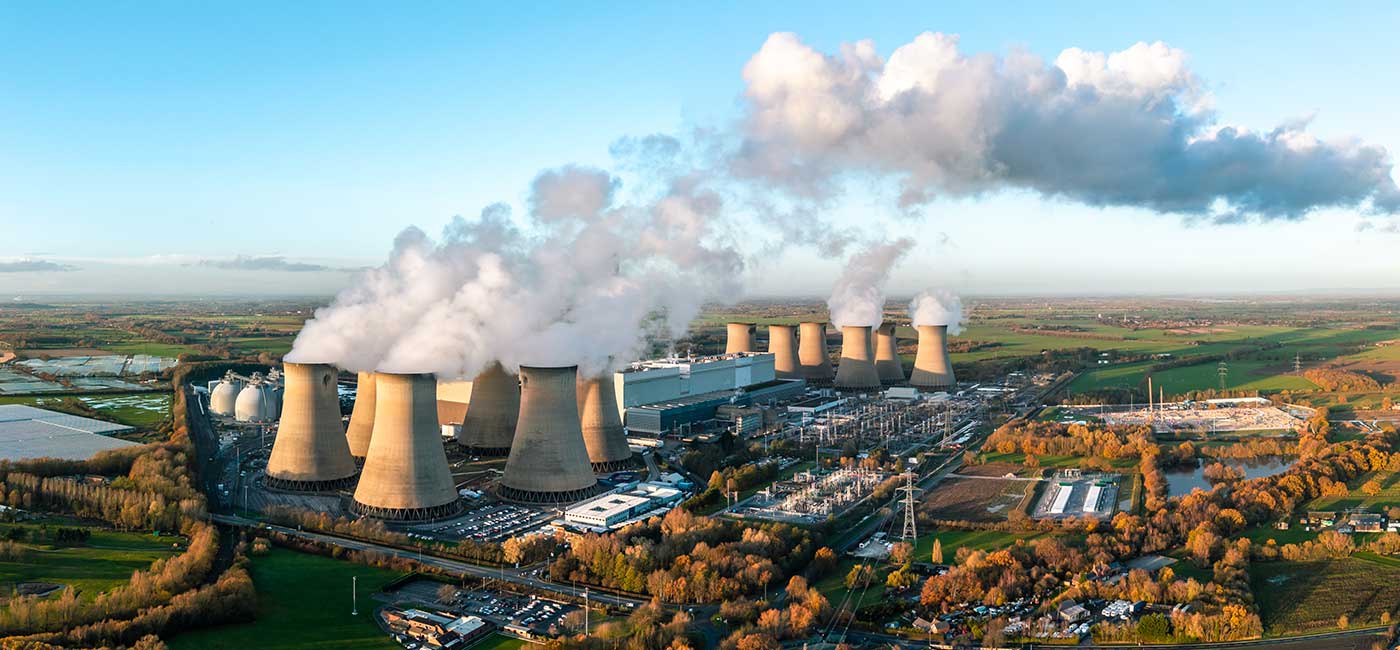

Once a familiar sight across the British countryside, power station cooling towers have been fast disappearing.
For anyone used to taking trains through the country’s industrial heartland, their absence can be striking.
According to the Twentieth Century Society, from a peak of 240 towers in the 1960s, just 37 remain — and all but one are in the process of decommissioning or demolition.
Yet across the UK, a quiet transformation is underway. The hulking silhouettes of decommissioned coal, gas, and oil-fired power stations, once symbols of the industrial age, are being reborn as AI data centres.
Take the former Didcot A Power Station, for example. Commissioned in 1964 by the Central Electricity Generating Board, it closed in 2013. Following demolition, its final iconic towers were taken down in 2019. German power producer RWE sold the site for around $260 million to US tech giant Amazon, which is now planning four data centre buildings, a gatehouse, and supporting infrastructure.
And Didcot is far from alone. Microsoft is planning an AI data centre on 48 acres of the former Skelton Grange coal-fired power station near Leeds. Drax Group is exploring conversion of part of its former coal-fired facilities in Yorkshire into a 100 MW data centre, with the potential to expand beyond 1 GW after 2031. Meanwhile, Holtec International, EDF UK, and Tritax Management have announced plans to build advanced data centres on the 900-acre former Cottam coal-fired power station in Nottinghamshire, powered in part by a small modular nuclear reactor.
It is not just UK sites undergoing transformation. RWE is considering redeveloping 10 more of its European sites for data centre use following the Didcot deal. In the US, former coal plants such as Quindaro (Kansas City), Cheswick (Pennsylvania), and Homer City (Pennsylvania) are being redeveloped or proposed for data-centre campuses..
For operators, the strategy is simple. The AI boom is driving exponential growth in demand for both computing and power, and new greenfield developments often face years-long delays to secure grid connections. Former power stations, with their existing high-capacity electrical infrastructure and water-cooling systems, offer a shortcut.
“Europe’s old coal and gas plants aren’t dying — they’re being reborn,” says Shane McArdle, CEO of Kongsberg Digital. “Energy giants are turning decommissioned sites into AI data centres. Why? Because they already have what AI craves: grid connections, cooling infrastructure, and speed to deploy. This is the past enabling the future.”
Utilities also benefit. Leasing land or developing data centres directly allows them to recoup decommissioning costs, generate new revenue streams, and enter long-term power agreements with technology companies. For tech firms, rapid access to electricity and cooling reduces construction timelines and accelerates AI deployments.
Data centres are essentially industrial plants, consuming enormous power, generating heat, and requiring high reliability. The same disciplines used in turbines and boilers — PLCs, SCADA, distributed control, predictive maintenance, and safety instrumentation — are now being deployed to orchestrate servers, cooling systems, and electrical distribution.
Thermal management, in particular, is critical. Unlike a coal plant, where heat was a by-product, a data centre must control temperature and humidity precisely. Variable-speed drives, adaptive cooling loops, and automated dampers respond dynamically to load. Increasingly, operators are deploying digital twins to model airflow and heat distribution before commissioning, improving efficiency and reducing risk.
Safety systems are also reimagined. Redundant networks, zoned fire suppression, and industrial safety PLCs ensure that critical IT infrastructure remains protected. Automation engineers with experience in high-reliability process control are finding their skills directly transferable.
Some sites, like Cottam, are pairing data centres with small modular nuclear reactors (SMRs). SMRs promise consistent, low-carbon baseload power, complementing renewable energy sources and legacy infrastructure. While SMRs are still emerging in commercial deployment, industry momentum is strong in Europe and the US.
Chris McClean, a partner at Buro Happold in Los Angeles, says SMRs could provide a useful power source for High Performance Computing facilities, such as next-generation data centres in the 20–300 MWe range.
“They’re not meant to replace a full-sized power station, but they could provide a resilient, readily deployable power source where conventional sources are not available,” McClean says. While having a nuclear reactor in your back garden may seem outlandish, if regulatory issues are resolved and the cost challenges for SMRs are overcome, it could ultimately be more attractive.”