

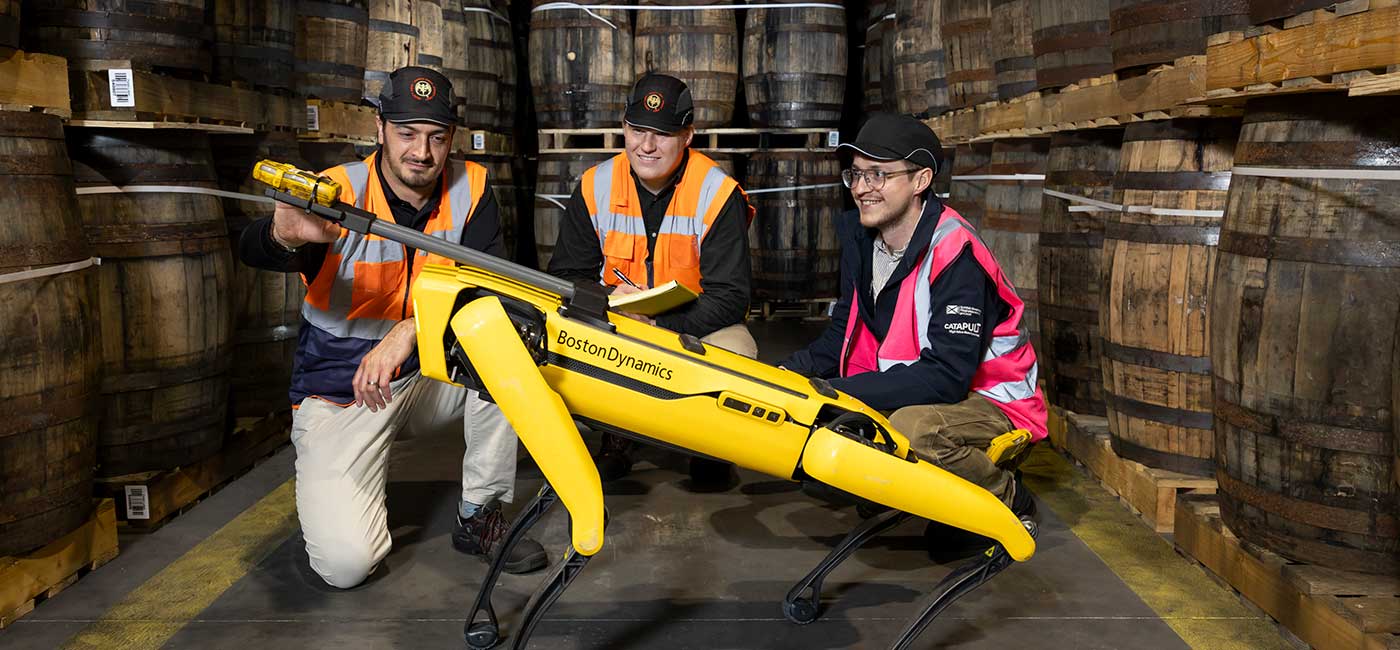

A robot dog is being tested in Scotland’s whisky warehouses as part of an early experiment to automate the detection of ethanol leaks, a potentially costly problem for distillers.
In a first for the Scotch whisky industry, the National Manufacturing Institute Scotland is trialling a robotic sensing system mounted on a Spot robot made by Boston Dynamics at a Bacardi-owned John Dewar & Sons maturation site near Glasgow. The project is supported by the Scotch Whisky Research Institute.
The trial is designed to assess whether robotics could provide a more consistent and data-driven way to monitor ethanol vapour levels in large warehouses filled with ageing casks. The sensing kit, developed by NMIS at its Digital Process Manufacturing Centre in Irvine, is attached to the robot via a 3D-printed arm and follows a predefined route through the warehouse.
Ethanol evaporation is an unavoidable part of whisky maturation, which must last at least three years before a spirit can be sold as Scotch whisky. Known as the “angel’s share”, the loss needs to be carefully managed, both to protect product value and to maintain safety standards in enclosed storage environments.
Inspection is traditionally carried out by workers relying on visual checks and manual handling, a process that can be time consuming and inconsistent. NMIS says autonomous inspection could offer a repeatable alternative, though it stresses the current work is a proof of concept rather than a system ready for daily operations.
Bacardi helped design the experiment and carried out baseline testing ahead of the trial. While the immediate focus is whisky warehousing, the partners say similar sensing approaches could be applied to other sectors, including chemicals and energy, where routine inspection is critical.
The next phase of the work could involve embedding the sensor directly into a robot, rather than mounting it externally, to improve reliability and functionality.
Angus Holmes, Whisky Category Director at Bacardi, said the company saw technology as a way to support a traditionally craft-led industry. He said automation could help whisky production become more efficient and data-driven, while preserving heritage.
Andrew Hamilton, Head of the Digital Process Manufacturing Centre, said early results suggested robots could take on inspection tasks that are currently labour intensive. He added that the project demonstrated how manufacturing technologies developed in Scotland could be applied across multiple industries.
The Digital Process Manufacturing Centre, officially opened earlier in 2025, is based in North Ayrshire and focuses on next-generation technologies for process manufacturing. It is part-funded through the £251 million Ayrshire Growth Deal and is operated by NMIS, which is run by the University of Strathclyde and forms part of the High Value Manufacturing Catapult.


