
On its sprawling campus outside the small German town of Blomberg, electrical components manufacturer Phoenix Contact is quietly rethinking one of the most fundamental assumptions of modern industry: how factories are powered.
At its new €35 million “all-electric society factory” building, the company is piloting a direct current (DC) energy system designed to integrate renewables, storage, and industrial loads into a single, highly efficient network.
Known as Building 60, the 18,500 square metre site houses around 400 employees and serves as both a production facility and a live demonstration of how Phoenix Contact thinks future industrial energy will work.
At the heart of this vision is a shift away from alternating current, which has dominated power systems since the late 19th century following the War of the Currents between Thomas Edison and Nikola Tesla. While AC won out due to its ease of transmission over long distances, Phoenix Contact is betting that, within the confines of a factory, DC offers compelling advantages.
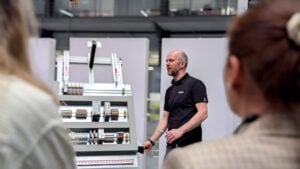
“DC is a real key enabler for the all-electric society,” said Martin Wetter, Executive Vice President for Innovation at Phoenix Contact at a press tour of the facility.
Inside Building 60, those ideas are already being put into practice. The facility combines a conventional AC supply with a 650 volt DC grid, fed by bi-directional converters, photovoltaic systems, and battery storage. Around 110 kilowatts of solar capacity is connected directly into the DC network, while additional generation feeds into the AC side due to regulatory constraints.
Wetter says that this hybrid architecture allows energy to move flexibly across the system. Electric vehicles can be charged during the day and discharged at night, batteries store excess solar power, and production processes can draw from multiple sources depending on demand.
The efficiency gains are not just theoretical. According to Wetter, switching from AC to DC in factory environments can deliver energy savings of 8-12%, largely by eliminating repeated conversion losses. Material savings are also significant, with copper usage reduced by up to 50% due to lower cabling requirements, and electronic components cut by around 25%.
Perhaps more importantly, DC systems enable new forms of energy recovery. In industrial environments where loads are constantly accelerating and decelerating – such as robotics or logistics systems – energy generated during braking can be fed directly back into the system.
“In logistics, you’re lifting loads up and lowering them down at the same time,” Wetter says. “If designed correctly, it becomes almost a zero-sum game.”
Peak load management is another key benefit. In some applications, Phoenix Contact estimates that DC systems can reduce peak demand by as much as 60-80%, easing strain on both internal infrastructure and the external grid.
Yet these advantages come with technical challenges. Unlike AC systems, which pass through zero voltage 50 times per second in Europe, DC maintains a constant voltage. This makes faults more dangerous and requires extremely fast protection systems.
“I have been a big enemy of DC systems for many years. That’s because if you cut a live 40-volt AC wire there is a big flash of light and a loud noise. If you do the same on a 650-volt DC line, you are dead. It fries you,” said the company’s Chief Operating Officer Ulrich Leidecker.

“AC naturally goes to zero voltage every few milliseconds, but DC does not. You need protection that turns off in microseconds, not milliseconds. This is something we’ve built and are introducing into the industry.”
To manage stability, the factory relies on voltage-based control rather than frequency – a fundamental shift from traditional grid management. Phoenix Contact has implemented both local device-level controls and a centralised master controller, enabling intelligent energy management across the site.
This software-driven approach allows the system to prioritise renewable energy, optimise charging cycles, and dynamically balance loads.
“You can implement anything you like in this control unit,” Wetter said. “It’s very flexible, and very intelligent.”
Flexible and intelligent it may be, but Phoenix Contact continues to take a cautious approach when rolling out the changes. On the factory tour, Automation News noted that only one of the 12 or so huge strip lights illuminating the factory runs on direct current. The company says that gaining regulatory approval for DC-powered facilities within the factory continues to be challenging.
Nonetheless, energy integration at the site extends beyond electricity. One of the more unusual features is a large-scale ice storage system used for heating and cooling.
Beneath the factory sits a 19-metre-wide tank containing 1.5 million litres of water. By freezing the water in winter, the system extracts thermal energy for heating; in warmer months, the stored ice enables highly efficient cooling.
“It’s fascinating technology,” Wetter said. “Freezing water releases a huge amount of energy without changing temperature.”
Alongside heat pumps and a campus-wide heat network, the system forms part of a broader effort to reduce the company’s carbon footprint.
Separately on its Blomberg campus, the company has also built a showroom highlighting the various technologies manufacturers are using to transition from fossil fuels which is open to visitors and school parties.
But Phoenix Contact’s ambitions at Blomberg are not limited to energy systems. Part of the factory has been dedicated to rethinking another bottleneck in industrial electrification: the production of control cabinets.
As electrification accelerates globally – with millions of wind turbines, solar installations, and kilometres of grid infrastructure required – the demand for control cabinets is rising sharply. These systems, which house the components that control electrical processes, are becoming increasingly critical.
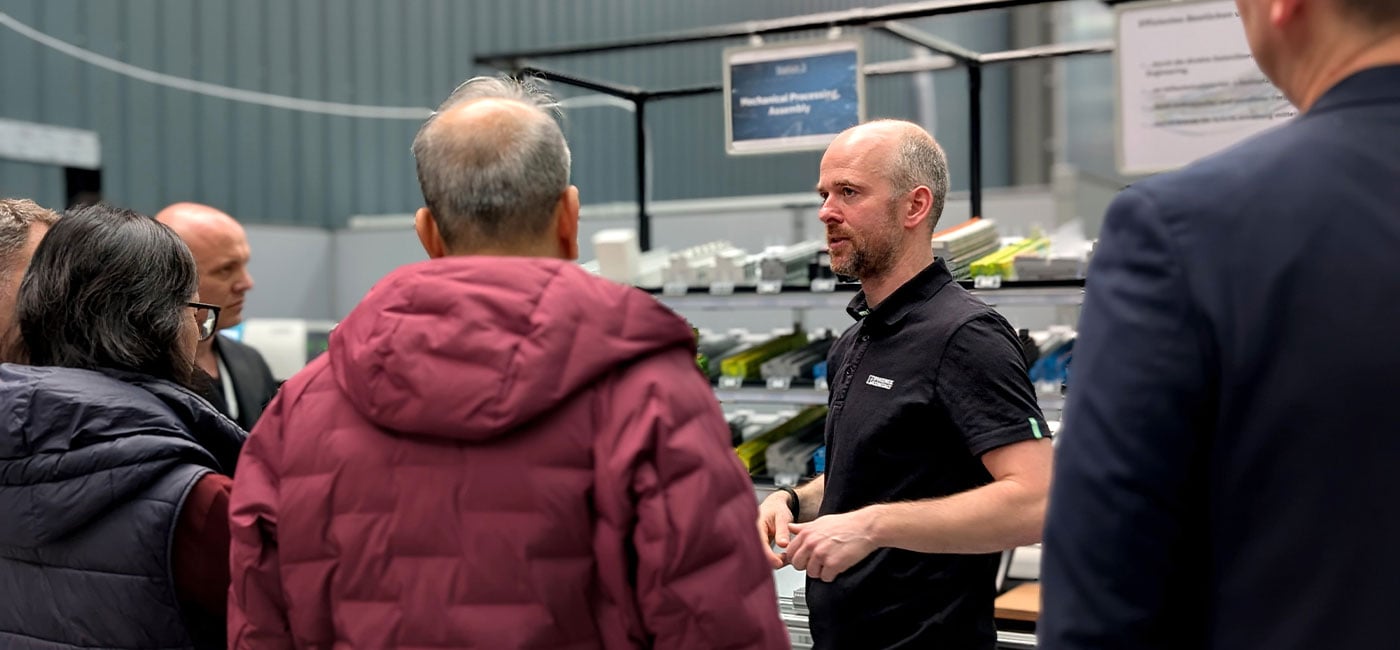
To address this, the company has created an application centre – an industrial “shop floor” environment within Building 60, where customers can work alongside Phoenix Contact engineers to develop and test solutions.
Looking a bit like an Ikea Kitchen Design Station, Phoenix Contact’s new division can provide anything from assisted manual workstations to fully automated production systems, all linked by digital workflows.
“We’ve designed specialised workstations that guide workers step by step, using digital data from engineering. This allows even semi-skilled staff to assemble control cabinets efficiently and accurately,” says Andreas Schreiber, the company’s Vice President for Industrial Cabinet Solutions.
One of the key challenges identified by Phoenix Contact is a shortage of skilled workers. Internal research conducted with industry partners found that nearly 90% of control cabinet builders see labour shortages as a major constraint, even as demand continues to grow.
The company’s response is to embed digitalisation directly into the production process. Worker assistance systems guide operators step-by-step using data from engineering software, enabling even less experienced staff to contribute effectively.
At the same time, automation is being deployed where standardisation allows. Machines capable of assembling terminal blocks onto rails and marking them using laser systems can produce components rapidly and with minimal error, using data directly from digital design tools.
“Digitalisation is key – without a digital twin of the product, even the best physical component is only half as valuable in production,” Schreiber adds.
New connection technologies are also being introduced to streamline assembly. Phoenix Contact’s push-in wiring systems, for example, eliminate the need for screws or ferrules, allowing wires to be inserted quickly and securely, and reducing both labour time and complexity.
Together, these initiatives point to a broader transformation. The factory is not just demonstrating new energy infrastructure, but also new ways of designing, building, and operating the electrical systems that underpin modern industry.
“DC is a real key enabler for the all-electric society,” adds Wetter. “Here at Blomberg, we are showing that it’s not just a vision – it can work in daily industrial operations, efficiently, sustainably, and safely.”
This article originally appeared in the April 2026 magazine issue of Automation News.