
Each year, dairies flush as much organic pollution as the entire annual sewage output of the Netherlands. According to new calculations by deeptech Collo, the 2.5% of milk lost in legacy production processes carries with it over 24 million tonnes of waste, putting pressure on local municipal treatment systems across the globe.
At the same time, a fundamental data and measurement problem is blocking the food and beverage industries from leveraging the AI boom to optimise production and eliminate waste.
The AI integration gap in heavy manufacturing
While trillions are flowing into generative AI software, physical food production environments are still waiting for their AI leap. According to new data from KPMG, 68% of manufacturing executives expect to deploy AI at scale within the next 12 months. However, 76% still cite unreliable data as a top AI risk.
Through its work with dairy and beverage manufacturers to improve their liquid process intelligence/sensing, Collo sees these limitations first-hand in its daily work.
“In a factory setting, the stakes of AI integration are incredibly high: a mere 1% error margin can ruin a multi-million-dollar batch, waste precious resources, or create serious food safety risks. Because industrial processes are unique and non-stationary, an AI model that works flawlessly in one plant often degrades significantly when moved to another. Cutting-edge algorithms remain virtually useless because they are being paired with poor-quality data from legacy sensors,” Collo CEO Jani Puroranta explains.
The economic and environmental cost of structural blindness
This widespread data problem leaves factories suffering from a form of structural blindness. Currently, many plants rely heavily on legacy sensors and manual timers to assess product pushout and cleaning cycles. Globally, this results in a staggering €15 billion ($17.1 billion) annual loss for the dairy sector alone – comprising €11.4 billion ($13 billion) in lost product and nearly €3.6 billion ($4.1 billion) in extra effluent-treatment costs that dairies must pay to dispose of what they spill.
“At a time when we’re facing global water scarcity, intensifying weather events and droughts, and many municipal treatment plants are already running dangerously close to their wastewater permit limits, we can’t afford to continue with these wasteful and inefficient practices,” Puroranta continues.
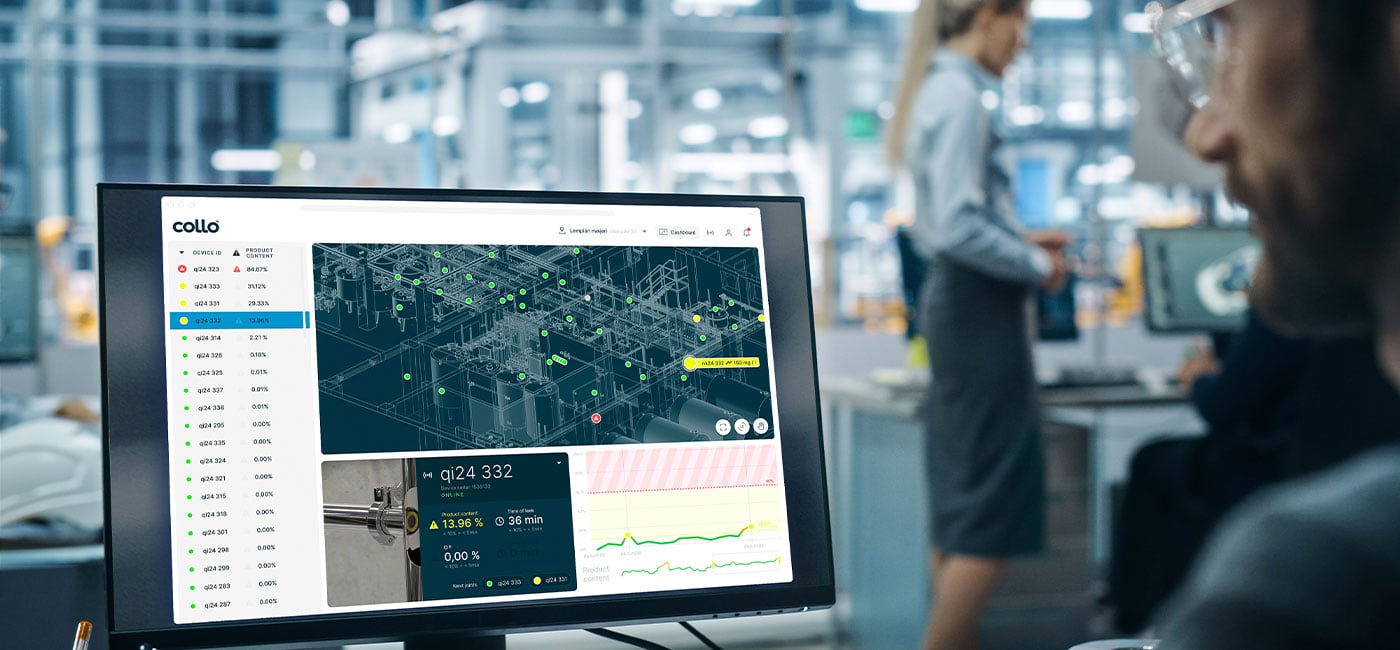
To address this challenge across the broader dairy and beverage sectors, Collo has developed a breakthrough liquid process intelligence technology. By implementing a specialised sensing and AI layer, Collo allows manufacturers to measure complex liquid properties in real time – data points that are impossible for legacy sensors to detect. Collo is already working with global dairy and beverage leaders like Danone, PepsiCo, Carlsberg, and Valio to limit material and environmental losses while adhering to the strictest food safety and hygiene standards.
“Industrial AI cannot rely on statistical guessing,” Puroranta sums. “By giving manufacturers real-time visibility into their liquids, we are fixing the data problem at its root. At a time when so much food innovation is focused on new flavours, formats and protein-packed versions of existing products, what more important use case could there be for AI than making global food production safer, cleaner and more efficient? We can stop millions of tonnes of valuable food from being flushed down the drain, protect our scarce water systems, and finally allow the food industry to take its AI leap safely.”