
Manufacturers already collect enormous volumes of operational data, but much of it is still used to optimise throughput rather than emissions. As sustainability targets become business-critical, the factories making the fastest progress towards net zero are those treating carbon as another operational metric alongside quality, energy use and productivity, argues Prashanth Mysore, Senior Director for Strategic Business Development at DELMIA,
Three years ago, sustainability lived on a slide near the back of the annual report. Now it shows up in the first ten minutes of the board meeting, usually as a question about compliance risk, and usually from a director who’s genuinely worried.
Here’s why that shift happened: sustainability stopped being voluntary. Europe’s reporting directive, the EU’s carbon border tax and a wave of disclosure mandates in the United States have turned a reputational nicety into a reporting obligation with real financial teeth. California’s SB 253 alone now carries penalties of up to $500,000 a year for non-compliance.
Carbon must become an operational metric
The pattern repeats everywhere. A manufacturer commits to a public net zero target with a date attached. Marketing is happy. The CEO gets a nice quote in a trade publication. Then someone in operations is handed the target and quickly realizes the company has no idea where its emissions actually come from.
That’s the true starting point for most firms. Not a lack of ambition. A lack of data.
You can’t reduce what you can’t measure. Yet most manufacturers measure carbon the way a child measures height—standing against a wall once a year and hoping for the best. Annual estimates built from utility bills are fine for a glossy report. They’re useless for running a decarbonization program, because they tell you nothing about which machine, line, shift or supplier is driving the number.
The companies winning here treat emissions data the way they treat quality or throughput data: continuous, granular and tied to the physical process. That shift, from annual estimate to operational signal, is the whole game.
Regulations are increasing pressure
For most manufacturers, 70–90% of emissions sit in Scope 3, covering suppliers and product use. Those emissions are harder to control, but Scopes 1 and 2 remain significant opportunities because manufacturers have direct authority over energy use, production schedules and equipment. The challenge is understanding where emissions originate before deciding where to act. While Scope 3 dominates, manufacturers have the greatest immediate control over Scopes 1 and 2 through their own operations.
Regulations including the EU’s Carbon Border Adjustment Mechanism (CBAM), the Corporate Sustainability Reporting Directive (CSRD) and California’s SB253 mean manufacturers increasingly need reliable emissions data, not simply annual estimates.
Four practical steps
Most roadmaps are just a list of nouns with arrows between them. Here’s something more specific, drawn from programmes that succeeded and a few that didn’t.
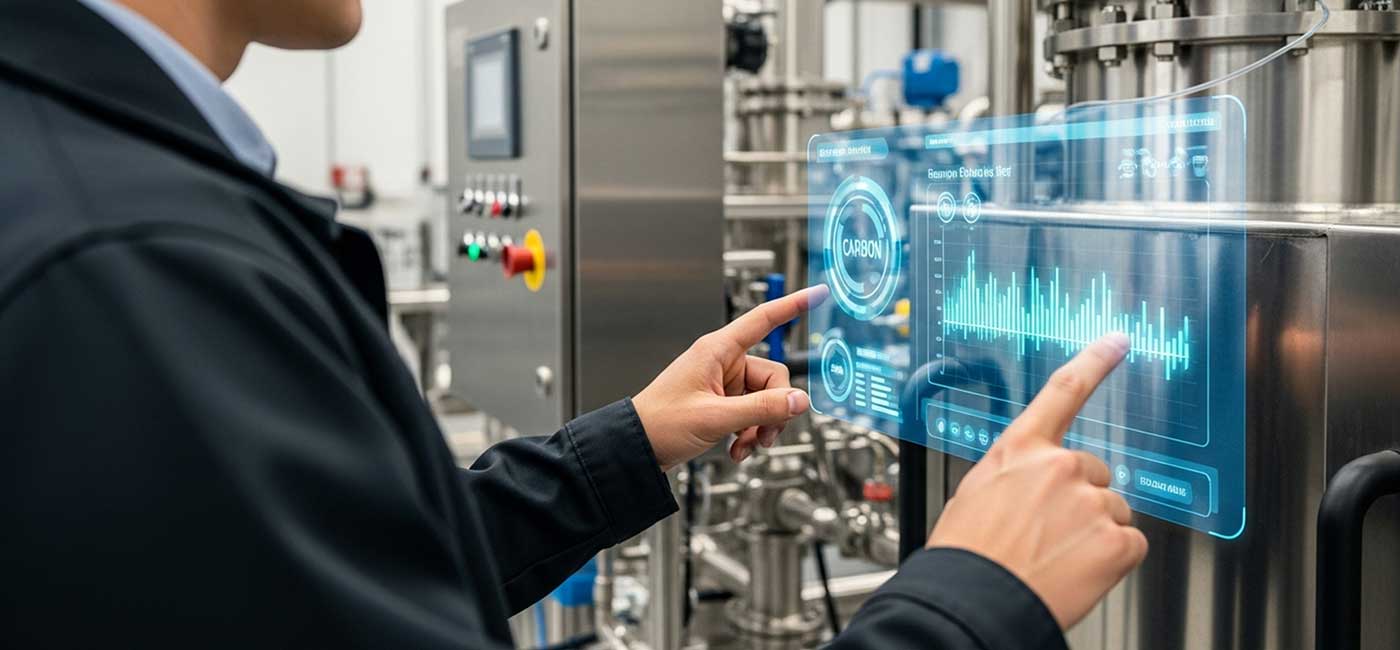
1. Start by measuring the real thing. Before you set a single target, connect to your machines, your meters and your manufacturing execution systems—not your accounting ledger. Know your footprint at the process level, in close to real time. When emissions appear on the same screen as cycle time and scrap rate, sustainability stops being a separate workstream and becomes part of how you run the plant.
2. Model before you build. The most expensive way to decarbonize is to rebuild the physical plant and discover afterward that the change didn’t pay off. Simulate it first. Prove the change in software, then build it once.
3. Treat the supply chain as part of your factory. Because most of your emissions are upstream, your suppliers are effectively part of your production system. Yet only about 15% of corporates have set a supply-chain emissions target—which tells you how much advantage is still available to those who move. Share data with key suppliers, design products with carbon intensity as a stated requirement and put emissions right next to price and lead time.
4. Tie it to the money. A plan that doesn’t connect to the P&L will lose every budget fight it enters. The good news: a lot of carbon reduction pays for itself, because energy you don’t consume is energy you don’t buy. McKinsey found that by 2030 companies can, on average, cut 20 to 40% of emissions while also reducing production costs. Lead with the projects that cut cost and carbon together, then use the savings to fund the harder ones.
Why digital twins, AI and operational data matter
Process engineering: design the carbon out before the line exists. Most of a process’s lifetime energy is locked in the moment it’s engineered. When you define equipment, cycle times and material flows, you’re setting the energy bill for years. If carbon is a visible variable at that stage—sitting beside cost and throughput—engineers design more efficient processes almost as a matter of course.
The virtual factory: test the change in software first. Build a virtual model of the line, run the proposed change inside it and watch what happens to energy, throughput and cost together. You can test an electrified process, a new layout or a different schedule without touching a single bolt on the floor. In one documented case, a company cut energy costs by more than $100 million a year and emissions by 200,000 metric tons. A digital model also solves a problem the regulations are about to create: the same product built at two plants has two different footprints. A virtual factory lets you account for that honestly, plant by plant, and keep the numbers current as the real operation changes. That’s the difference between a footprint you can defend to an auditor and one you can’t.
Industrial AI: turn the data into decisions. Instrumenting a plant produces more data than any person can watch. AI models can predict high-consumption events, shift energy-intensive operations into cleaner windows and flag equipment drift before it shows up on the bill. The IEA estimates widespread AI adoption could deliver around 8% energy savings in light industry by 2035, with plant-level case studies running higher. AI works best when it sits on top of the digital model, closing the loop between what you planned, what the plant is doing and what you do next.
These three reinforce each other. Process engineering decides what to build, the virtual factory tests it before you commit and industrial AI runs it well once it exists. And what used to be a toolkit for only the largest manufacturers is fast becoming accessible to the mid-market. If you assumed this was out of reach, it’s worth checking that assumption again.
Author biography:

Prashanth Mysore is Senior Director for Strategic Business Development at DELMIA,