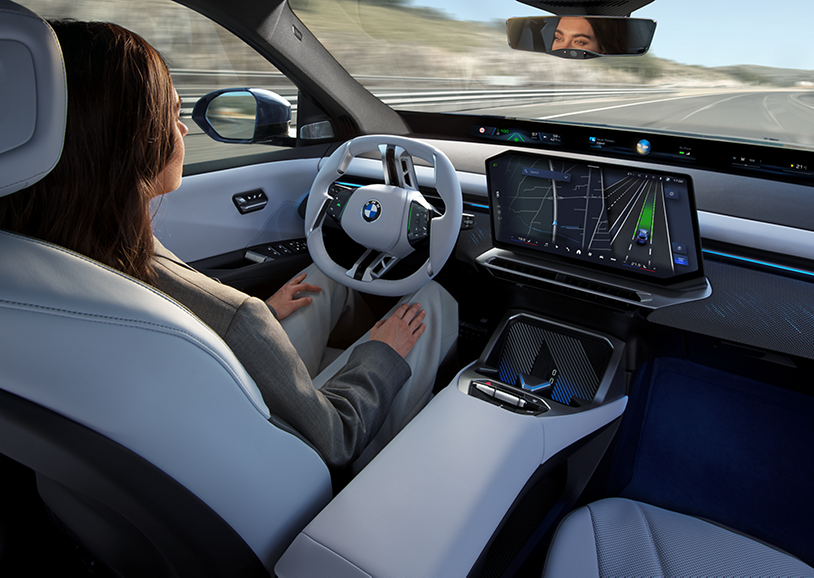

- AI-enabled Snapdragon Ride Pilot Automated Driving System, powered by Snapdragon Ride system-on-chips and a new jointly developed automated driving software stack, debuts in the all-new BMW iX3 at IAA Mobility 2025.
- System is validated in 60 countries worldwide and is targeted to be available in more than 100 countries by 2026.
- Scalable platform enabling cost-efficient single camera active safety system and scaling up to a multi-camera multi-radar L2+ highway and urban automated driving functions.
- Data-driven stack is continuously updated with information from global fleets, supported by a cloud-based data flywheel system.
- Snapdragon Ride Pilot is now offered by Qualcomm to all global automakers and Tier-1 suppliers.
Qualcomm Technologies and BMW Group have developed an automated driving (AD) system called Snapdragon Ride Pilot, after a three-year collaboration. The AD system is built on Qualcomm Technologies’ Snapdragon Ride system-on-chips (SoCs) using the Snapdragon Ride AD software stack co-developed by both companies.
The Snapdragon Ride Pilot is claimed to meet the highest safety standards and supports AD levels ranging from entry-level New Car Assessment Program (NCAP) to Level 2+ highway and urban navigation on autopilot (NOA) capabilities.
The system recently made its global debut in the BMW iX3, the first production vehicle in BMW’s Neue Klasse for 2026 and is now available to all global automakers and Tier-1 suppliers through Qualcomm Technologies.
“Our collaboration with BMW’s world-class engineering team has been truly transformative, enabling us to build a world-class system that is now available to bring the safety and comfort benefits of automated driving to consumers across all regions and vehicle tiers,” said Nakul Duggal, Group General Manager, Automotive and Industrial & Embedded IoT, Qualcomm Technologies. “Together, we’ve created Snapdragon Ride Pilot – a revolutionary driver assistance system that prioritises safety and sets a new standard for the industry. We anticipate its widespread adoption will drive a new era of innovation and excellence in mobility solutions.”
Dr. Mihiar Ayoubi, Senior Vice President Development Driving Experience, BMW Group, added: “This collaboration has enabled us to develop a cutting-edge driver assistance system, setting a new benchmark. Smart, symbiotic and safe is the core of the BMW philosophy when it comes to ADAS – our new BMW iX3 will deliver this on an unprecedented level.”
The Snapdragon Ride AD software stack features a perception stack developed by Qualcomm Technologies and a drive policy engine co-developed with BMW. It is engineered to enable automakers and Tier-1 suppliers to build scalable solutions with flexibility, cost savings and fast time-to-market, with their own drive policy or with a turnkey platform.
The stack is structured into multiple layers including:
- 360-Degree Perception: The system uses a camera-based vision stack for object detection, surround view, lane recognition, traffic sign interpretation, parking assistance, driver monitoring, and mapping. Perception performance is enhanced through low-level perception using bird-eye-view (BEV) architecture and new methods for information extraction from fisheye cameras. The low-level perception between camera and radar is designed to reduce tracking latency, optimise system performance in active safety scenarios, and detect complex urban intersections. To improve computational efficiency, hardware and software co-design along with network architecture search are applied to manage compute resources and memory bandwidth.
- Safety-First Approach: Snapdragon Ride Pilot prioritises safety through a steadfast commitment to Automotive Safety Integrity Levels (ASIL) and Functional Safety (FuSa) standards, supporting compliance with the latest safety regulations, including NCAP, FMVSS127 and DCAS. Snapdragon Ride Pilot also addresses Safety of the Intended Functionality (SOTIF) and incorporates robust cybersecurity measures, featuring multi-layered encryption and threat detection to help safeguard against potential threats.
- Advanced context-aware driving: Uses a balance of rule-based and AI-based models for behaviour prediction and behaviour planning to help enable safe handling of complex driving scenarios.
Stack development and testing is supported by the data and simulation factory, a key component of Snapdragon Ride. This toolchain integrates real-world data with synthetic data generation and AI-based simulations to create a robust and diverse set of driving scenarios, enhancing the training and testing of automotive models. The factory’s capabilities allow for fast development of automated driving software capable of addressing complex real-world scenarios.
Snapdragon Ride Pilot supports over-the-air (OTA) updates and is fully customisable via the Snapdragon Ride SDK, giving automakers the flexibility to tailor solutions across vehicle segments. The software stack leverages fleet data to evolve and enable enhanced safety and comfort over the life of the vehicle.
The ADAS system in the all-new BMW iX3 is built on Snapdragon Ride, which integrates high-performance, automotive-grade systems-on-chip (SoCs) for centralized sensor data processing, advanced computer vision modules for perception, and Snapdragon Ride Automated Driving software stack co-developed with BMW – including drive policy and safety guardrails.
The automated driving system of the BMW iX3 enables advanced capabilities including:
- Contextual lane change and overtaking: the system initiates manoeuvres based on subtle driver cues like mirror glances or steering nudges.
- Active lane change and highway assistant: hands-free driving on approved road networks.
- Ecosystem provided AI-powered slot detection parking assistance and camera-based in-cabin monitoring.
BMW’s “Superbrain of Automated Driving” (a central intelligent computer powered by Snapdragon Ride SoCs) combines automated driving functions, offering 20 times higher computing power than the previous generation. The system uses a unified architecture which includes an array of high definition 8M pixel and 3M pixel cameras and radar sensors enabling 360-degree coverage and along with high-definition mapping and precise GNSS localisation enables a robust system helping to enable safe and reliable automated driving.
The BMW iX3 is also equipped with Qualcomm Technologies’ V2X 200 chipset to support vehicle-to-everything (V2X) communications for enhanced safety. V2X communications allows vehicles to “see” and “hear” beyond line-of-sight ADAS sensors, helping reduce collisions by uncovering unseen risks through direct communication between vehicles and their surroundings, such as road infrastructure, pedestrians, and other road users.