
Iveda has launched a long-endurance autonomous helicopter-style drone for industrial inspection, emergency response and infrastructure monitoring.
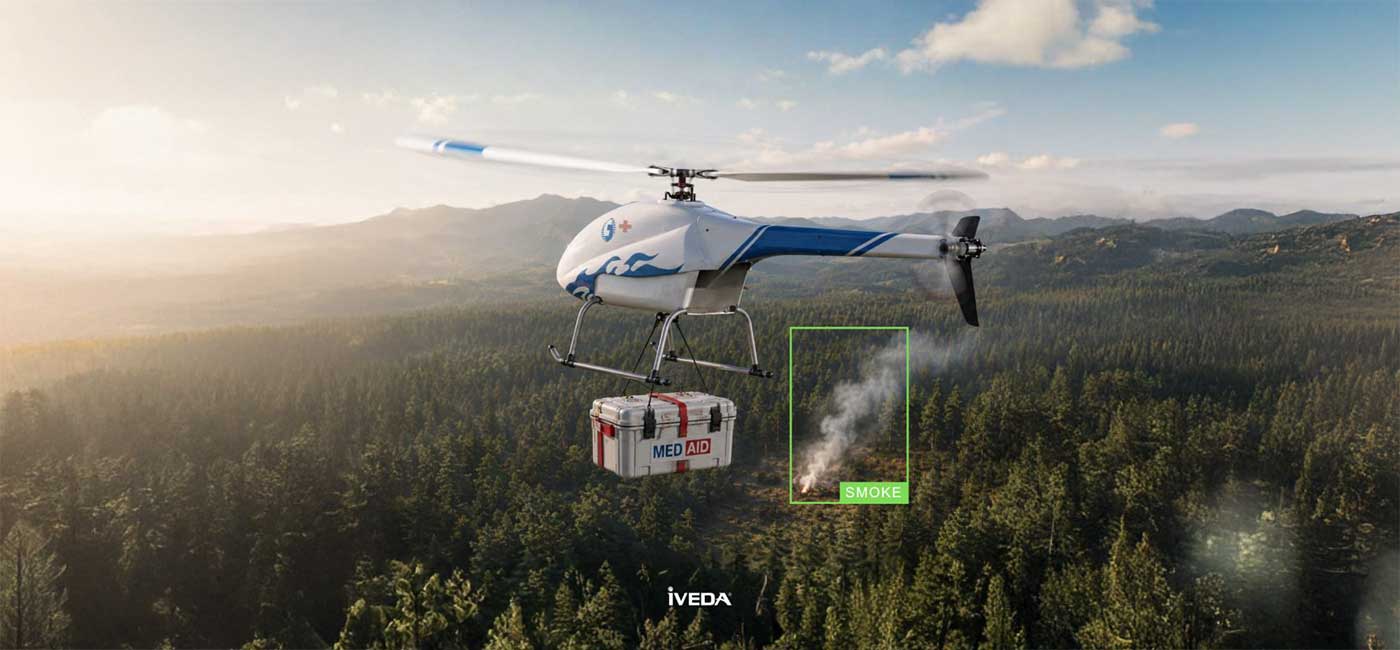
The US technology company said its new IvedaAir range can remain airborne for more than 150 minutes, with the gas-powered GX10-F100 model capable of carrying a 12lb payload. The company says the platform is intended for applications ranging from energy infrastructure inspection and construction surveying to maritime surveillance, search and rescue and disaster response.
The launch reflects a broader shift in industrial robotics towards autonomous machines capable of collecting and interpreting data in environments that are difficult, dangerous or expensive for humans to access.
“Public safety and mission-critical operators have been forced to work within the limitations of drone systems that were never designed for the environments they operate in,” said David Ly, CEO and founder of Iveda. “This new helicopter line was built to solve that problem — delivering extended flight endurance, real payload capability, and advanced AI intelligence in a secure, American-built platform designed for demanding missions.”
Iveda is entering a rapidly expanding UAV market. It estimates the global market will grow from $47.55bn in 2026 to more than $160bn by 2034, although the company’s own target is more modest: capturing $50m of market share over the next 24 months.
Unlike the increasingly common electric quadcopter, IvedaAir uses a helicopter-form design and a combustion engine. Iveda says this gives the platform the endurance and payload capacity required for longer missions, including operations in high winds, remote terrain and open water.
The GX10-F100 is listed by Iveda as offering more than 150 minutes of endurance while carrying a 12lb payload, a maximum payload of 19lb and a top speed of 68mph.
The company says the platform can perform autonomous waypoint missions and stabilised hover operations, while transmitting encrypted video over 4G, 5G and LTE connections. Its integration with IvedaAI is intended to allow the aerial system not simply to collect video but to identify objects and anomalies and support automated monitoring and response workflows.
That could make the system relevant to industrial operators looking to automate inspection rather than simply add another remotely operated camera to their operations.
Potential applications include inspecting pipelines, power lines, substations and remote energy facilities, as well as topographic mapping and construction-site progress monitoring. In maritime environments, Iveda envisages persistent monitoring of shipping lanes, vessel tracking and search operations.
The company is also targeting emergency applications, including firefighting, disaster response and search and rescue, where longer flight times could reduce the frequency with which an aircraft has to return to base to refuel or recharge.
“From persistent maritime overwatch to disaster response, search and rescue to critical infrastructure protection, IvedaAir represents a new generation of aerial intelligence — purpose-built for the operators who need it most, and accessible to them from day one,” Iveda said.
Security and procurement are another part of the proposition. Iveda says the drone line is compliant with the US National Defense Authorization Act (NDAA) and Trade Agreements Act (TAA), while models can support FIPS 140-3 validated cryptographic modules and Blue UAS-aligned components for customers with more demanding security requirements.
The company is positioning those features towards public-sector and critical infrastructure customers that may face restrictions on the procurement of connected aerial equipment.
IvedaAir is available for US government procurement through GlobalMed, Iveda’s strategic partner, via the Defense Logistics Agency’s Tailored Logistics Support contract vehicle. The company said it expects to expand access through additional federal procurement contracts.
The longer-term ambition is more unusual. Iveda says the technology could eventually provide a route for converting retired full-size helicopters into autonomous aerial systems.
Rather than treating autonomous aircraft as disposable specialist hardware, the company wants to explore whether existing airframes could be given a second life as unmanned platforms. Iveda says this could help organisations extend the operational life of existing aircraft while reducing the cost of deploying autonomous aviation systems.
“Throughout my career, I’ve been focused on one fundamental challenge: how do we get high-quality medical care and critical resources to people when distance, terrain, disaster, or conflict makes traditional delivery impossible or simply too slow,” said Joel E. Barthelemy, founder, chairman and CEO of GlobalMed. “I believe autonomous drone technology is an important extension of that mission.”