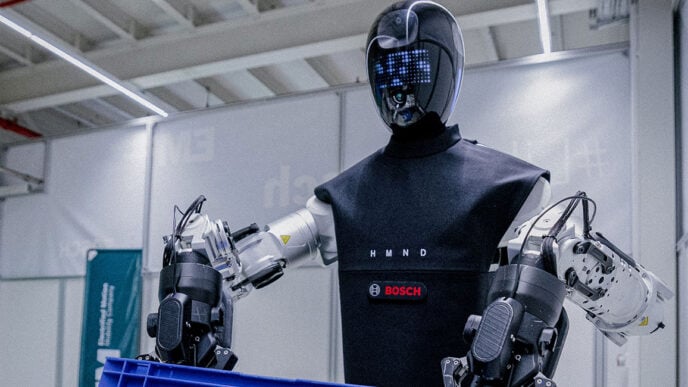


Humanoid robots remain years away from widespread industrial deployment despite intense global hype and billions in investment, according to industry leaders speaking during an Automation News webinar this week.
The discussion, hosted by Automation News Editor Lucy Barnard, brought together Mike Wilson, Chief Automation Officer at the Manufacturing Technology Centre and Visiting Professor of Robotics & Automation at Loughborough University, and Alexander Mühlens, VP Automation Technology & Robotics at igus, to assess whether humanoid robots are genuinely ready for factory floors, warehouses, and service environments.
While both speakers agreed the technology is advancing rapidly, they warned that major barriers remain around safety, dexterity, battery life, cost, and practical deployment.
Wilson, who began his career installing some of the automotive sector’s earliest industrial robots more than 40 years ago, said the current excitement surrounding humanoids risked obscuring the reality of what the technology can currently achieve.
“There’s a certain amount of publicity at the moment, and some very exciting demos being shown on YouTube,” he said. “But the reality is we’re not going to see lots of humanoid robots either in our factories or even in our normal lives for the near future.”
Wilson said several critical engineering challenges remain unresolved, including safe shutdown procedures, dexterous manipulation, and energy management. Unlike conventional industrial robots, many humanoids require continuous power to maintain balance, creating new safety concerns.
“If you cut the power, they fall over,” he said. “I don’t want something that weighs 100 kilos standing next to me if it then falls over on me.”
Mühlens, who oversees robotics development at German motion plastics specialist igus, demonstrated the company’s own humanoid platform during the webinar, while acknowledging that today’s systems remain largely experimental for industrial use.
“We are producing humanoids ourselves, but we are not using them productively,” he said. “At the moment it’s not usable for us in production.”
Instead, Mühlens said the most viable current applications involve remote inspection tasks in hazardous environments, where humanoids can navigate spaces designed for humans while being operated remotely by experts elsewhere.
One emerging use case involves inspection work in dangerous industrial locations, including power plants, where operators may need to remotely assess leaks, press buttons, or open doors without exposing staff to risk.
However, both speakers stressed that many of the viral demonstrations circulating online fail to reflect real industrial conditions.
“You can see very nice robots slowly doing things, often behind fences,” Mühlens said. “Sometimes the videos are even sped up.”
The webinar also highlighted growing concerns within Europe about falling behind China and the US in robotics development and deployment.
Wilson noted that the UK currently ranks only 24th globally for robot density, measured by the number of robots per 10,000 workers, and warned that underinvestment in automation poses a wider competitiveness challenge.
“China is definitely leading in this space,” he said, pointing to Beijing’s long-term industrial strategy around robotics and supply chain development.
Mühlens added that Chinese manufacturers are already producing between 10,000 and 20,000 humanoid units annually, even before large-scale commercial applications have fully emerged.
“Everyone wants to be an early adopter,” he said.
Yet despite the momentum, both speakers argued that humanoids are unlikely to replace workers en masse. Instead, they expect a mixed automation landscape combining conventional industrial robots, collaborative robots, mobile systems, and eventually humanoids for highly specific tasks.
“I don’t see it as a threat to jobs at all,” Wilson said. “Historically, every major technology shift has created more jobs than it replaced.”
Mühlens echoed that view, arguing that manufacturers globally are struggling more with labour shortages than labour displacement.
“Customers everywhere tell us they cannot find enough people anymore,” he said. “It’s not about replacing humans.”
The discussion also touched on cybersecurity and data sovereignty concerns, particularly surrounding Chinese-built humanoids that rely on cloud-based learning systems to improve performance.
Wilson warned that some robots currently store operational data externally to support AI training models, which could create security risks for sensitive industries.
Still, both speakers maintained that humanoid robotics remains an important long-term direction for automation.
“The speed of development is amazing,” Mühlens said. “There could be one application very soon where suddenly it all makes sense.”
You can watch the webinar again below.