

Manufacturers hoping to deploy physical AI at scale will need more than advanced robots and sophisticated AI models — they will also need a communications infrastructure capable of supporting real-time decision-making across the factory floor.
That was the message from Ericsson executives speaking at Smart Manufacturing Week at Birmingham’s NEC this week, where they argued that private 5G networks are becoming a critical foundation for the next generation of industrial automation.
Jan Dickman, Head of Business Development Enterprise 5G, Manufacturing at Ericsson, said private 5G should be viewed as the “nervous system” underpinning physical AI, digital twins, autonomous mobile robots (AMRs), and increasingly intelligent manufacturing environments.
“AI is the brain,” Dickman said. “But physical AI needs a nervous system.”
While much of the recent discussion around artificial intelligence has focused on large language models and Cloud-based applications, manufacturers are increasingly exploring physical AI — systems that allow robots, sensors, cameras, machines, and workers to interact with AI directly on the shop floor.
The challenge, according to Dickman, is that these systems depend on vast amounts of high-quality, real-time data.
“The problem often isn’t getting data,” he said. “The problem is getting the right quality data.”
Physical AI applications rely on continuous streams of information from cameras, sensors, robots, and machinery. Latency, packet loss, and network jitter can all affect performance, particularly when manufacturers are training AI models, coordinating fleets of autonomous machines, or feeding operational data into digital twins.
Digital twins are expected to play an increasingly important role in industrial operations, allowing manufacturers to simulate production changes, optimise workflows, and test new processes before deploying them in real-world environments.
Dickman argued that private 5G provides the deterministic communications and reliability needed to support these applications, particularly in complex industrial settings where conventional wireless technologies can struggle.
“If I want to build a platform for future development, I need to choose a platform that delivers mobility and deterministic communication,” he said.
Joining Dickman on stage, Vish Kour, Head of Business Development Enterprise 5G, Emerging Markets at Ericsson, said physical AI is fundamentally about transforming intelligence into action.
Kour highlighted the example of Hitachi Rail’s manufacturing facility in Maryland, where quadruped robots developed by Boston Dynamics have been deployed to conduct railcar inspections autonomously. The robots perform inspections, document findings, and return to charging stations without human intervention, creating a digital record throughout the production process.
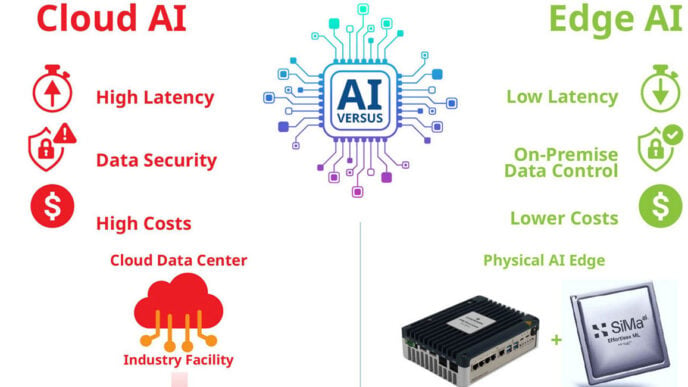
Such applications require reliable connectivity, comprehensive wireless coverage, and the ability to transmit large volumes of data from devices to Edge computing platforms, Kour said.
“Most of what happens on the shop floor, particularly with physical AI, is the ability to send images or continuous video streams to the Edge server or into the Cloud,” he said.
That shift is placing greater emphasis on uplink performance — an area where Ericsson believes private 5G offers advantages over many traditional wireless deployments.
Beyond supporting robots and AI applications, the company argues that private 5G is increasingly becoming a platform for broader digital transformation. Manufacturers are using private networks to connect AMRs, machine vision systems, sensors, scanners, and industrial equipment, while improving cybersecurity and simplifying connectivity across operational environments.
Dickman said many manufacturers initially invest in private 5G to solve specific operational challenges such as downtime, visibility, quality control, or material handling. However, once a secure wireless platform is established, additional use cases often emerge.
“The use cases will come along as you go,” he said.