

UK manufacturers could unlock a clean energy dividend worth more than £2 billion by 2035 by switching away from gas and scaling up proven energy technologies, according to independent economic modelling published by E.ON.
The analysis is part of E.ON’s ReIndustrial Revolution report exploring how smarter energy choices help business turn energy from a cost to be managed into a competitive asset that strengthens performance, supports investment and makes the transition to new energy work for everyone.
The report argues energy can be a source of lower costs, resilience and growth – but only if businesses have the confidence and support to invest. While the clean energy opportunity extends across the UK economy, the report focuses on manufacturing as one of the sectors where proven technologies such as onsite generation, smart energy management and waste heat recovery can deliver the biggest gains.
Independent economic impact specialists Development Economics1 modelled the impact of four proven interventions across UK manufacturing: energy audits, smart monitoring and management systems, on-site renewable generation and storage, and waste heat recovery.
- Under the highest adoption scenario, UK manufacturers could cut annual gas consumption by 15.2 terawatt-hours (TWh) and electricity use by 8.8TWh by 2035 – the same gas use as more than 1.2m average UK homes and electricity needs of 3.3m UK homes.
- The analysis also sees annual gas cost savings of £406m by 2035 and cumulative gas cost savings of £2.1bn between 2027 and 2035.
E.ON polling of more than 500 UK business leaders2 shows four in five (89%) expect to invest in energy efficiency or low-carbon technologies within two years, but almost half (48%) cite upfront costs as the biggest barrier, and more than a third (37%) say uncertainty over returns on investment is holding them back. This shows businesses are ready to invest but need clearer policy support to unlock investment:
- Make electricity more competitive for business: Shift policy costs such as the Renewable Obligation and Feed-in Tariffs from electricity bills into general taxation, or a dedicated Energy Transition Fund, helping firms electrify without undermining competitiveness.
- Provide long-term policy certainty: Create a clear pathway to close the gap between electricity and gas prices to support industrial electrification, strengthen commercial energy efficiency standards and scale up proven low-carbon technologies.
- Back investment in proven energy upgrades: Establish a Business Energy Upgrade Scheme that offers advice, grants, low-cost finance and tax incentives for technologies such as heat pumps, solar, batteries, smart controls and waste heat recovery.
- Reward flexibility: Reform balancing and network charging so businesses can reduce system costs by shifting demand, using storage and participating in flex markets.
- Speed up grid access and local infrastructure: Accelerate grid connections, reinforce local networks and provide clearer local energy plans so businesses to invest with confidence.
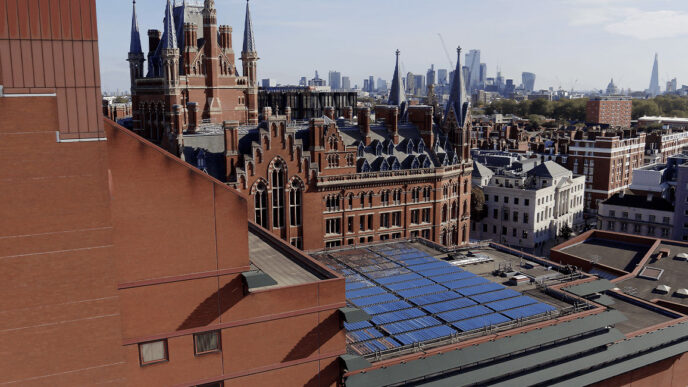
Chris Norbury, Chief Executive of E.ON UK, said: “Businesses don’t need to wait for tomorrow’s technology to start seeing the benefits of cleaner, smarter energy. We have the solutions and we have them now. We’re already helping customers to use less, waste less and generate more of their own power – from geothermal heating at Nottingham’s Queen’s Medical Centre, to the UK’s largest roof-mounted solar scheme at the Port of Liverpool, to our Strategic Energy Partnership with Coventry City Council, which is a blueprint to drive the energy transition for communities across the UK.
“Energy can be a source of resilience, competitiveness and growth. Removing barriers to investment means more businesses can cut costs, reduce carbon and help build the resilient energy system Britain needs.”
UK manufacturing currently contributes around £197bn to the economy and employs more than 2.1 million people. But the sector remains highly exposed to energy costs, consuming 82TWh of electricity and 193,000GWh of gas each year. With output forecast to grow by 2035, E.ON says action on energy efficiency will be increasingly important to protect margins and support investment.
A move away from the dark, satanic mills: a vision of the ReIndustrial Revolution
Some of Britain’s most recognisable artwork owes inspiration to the towns, perspectives and skyscapes that were shaped by industry and the original Industrial Revolution – from JMW Turner’s Rain, Steam and Speed to LS Lowry’s Industrial Landscapes.
E.ON commissioned acclaimed artist and illustrator, Mark Hearld, and its New Energy Academy to work with schools in three of the UK’s key industrial heartlands – Sheffield, Glasgow and the East End of London – to create his original artworks that re-imagine Britain’s industrial landscape for future generations.
Mark’s three collages provide an outlook on what the next industrial era could look like: cleaner, more connected and rooted in communities and nature.
Mark Hearld said: “When E.ON asked me to make a series of collages as part of its ReIndustrial Revolution campaign, to celebrate its commitment to sustainable growth and with a nod to the artworks of 19th century industrial revolution, it provided me with a bold visual starting point.
“All growth should be sustainable. E.ON’s campaign is a such a positive initiative. I was excited by the dynamic challenge of showing nature flourishing alongside the architecture of redevelopment and greener energy production. A derelict Mill at Silvertown on the Thames about to be redeveloped sustainably, a biomass power station with a ‘black paper cut’ silhouette rising up from a wildflower meadow alive with oxeye daisies in Sheffield, and finally pigeons roosting on the foreground ridge of a roofscape in Glasgow, with its solar panels and home batteries to make energy costs more affordable for low-income families.
“Children care about the world they live in, and it was a joy to see such creative optimism in the collages they made during our workshops. Similarly, it was huge fun to see the playful inventiveness in their choice of materials. There’s no doubt that their creative engagement has a vital role to play in the future of our world.”