
The number of industrial robots operating in factories worldwide rose 9% to five million units in 2025, according to new figures from the International Federation of Robotics (IFR).
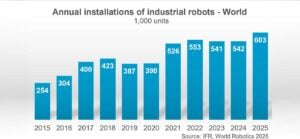
Factories installed more than 600,000 new robots during the year, an 11% increase on 2024, as manufacturers continued to invest in automation despite significant differences between regional markets.
“Industrial automation is progressing at high speed,” said Jane Heffner, President of the IFR. “The new mark of five million robots operational in factories worldwide is more than double the number seven years ago.”
Asia accounted for the largest share of new deployments, with China alone responsible for 59% of global installations.
Chinese factories installed 354,000 industrial robots in 2025, up 20% year on year and almost 60,000 more than the previous annual record.
Domestic manufacturers continued to gain ground against overseas suppliers. Chinese robot makers installed 195,000 units in the domestic market, up 15%, giving them a 55% share of installations compared with 57% in 2024.
Japan remained a major robotics market but installations fell 19% to 36,219 units. The decline moved the country from second to third place globally, behind the US.
South Korea installed around 30,000 robots, down 1%, while India recorded almost 10,500 installations, a 15% increase. India’s industrial robot installations have grown at an average annual rate of 27% since 2020.
US overtakes Japan
The US became the world’s second-largest market for industrial robots in 2025, with installations rising 12% to almost 38,500 units.
The figure was the third-highest annual total recorded in the US, according to the IFR.
Elsewhere in the Americas, Mexico saw installations fall 7% to fewer than 5,200 units, extending a three-year decline. Canada recorded almost 4,000 installations, up 5%, while Brazil posted one of the region’s sharpest increases.
Brazil installed almost 4,300 robots, up 38%. The automotive sector accounted for almost 2,100 of those installations, more than triple the previous year’s figure. The IFR said investment by Chinese carmakers in Brazil was likely to have contributed to the increase.
European market slows
Europe’s largest robotics market, Germany, installed fewer than 25,000 robots in 2025, down 8%.
Germany accounted for 41% of industrial robot installations across the European Union and remains the world’s fifth-largest market. However, installations across German industry have grown by only 2% a year on average since 2020.
The automotive sector remains the country’s biggest industrial robot user, although its share of installations is declining.
Italy, Europe’s second-largest market, recorded an 11% fall to about 7,800 units. France moved into third place with almost 4,500 installations, down 8%, while Spain installed about 4,300, a 15% decline.
The divergence between regions reflects differing investment cycles, industrial structures and manufacturing conditions, but the IFR expects global demand to continue rising.
Robotics market set to grow
The organisation forecasts that global industrial robot installations will increase by 9% to 655,000 units in 2026 and reach 806,000 by 2029.
The IFR said efforts to make supply chains more resilient, alongside changes in trade and industrial policy, are encouraging manufacturers to relocate production.
That could increase demand for automation in higher-wage economies and countries facing labour shortages, potentially altering the geographical distribution of future robot installations.
The IFR also points to demographic change and technological advances as longer-term drivers of demand. Developments in artificial intelligence, machine vision and sensing are expanding the range of tasks robots can perform, while easier programming and system integration are lowering the cost and complexity of deployment.