
For decades, manufacturing excellence has been measured by efficiency: faster production lines, leaner processes, lower downtime, and tighter margins. Those priorities remain essential, but they are no longer enough. Today’s manufacturers face growing pressure from labour shortages, rising production costs, increasing product customisation, and ongoing supply chain uncertainty. Success now depends not only on how efficiently factories operate, but also on how intelligently they can adapt to changing conditions.
This is where Physical AI comes in. Deloitte revealed that only 5% of firms say Physical AI is transforming their organisation today, yet 41% expect it to do so within three years. This anticipated acceleration reflects its potential to address persistent operational challenges across manufacturing. In its ‘Physical AI Readiness Report 2026,‘ Tata Consultancy Services surveyed manufacturers on AI-enabled machines and systems ranging from autonomous mobile robots and AI-enabled robotic arms to cobots, autonomous logistics vehicles, drones, humanoids, and quadrupeds. Across these forms of Physical AI, 60% of manufacturers see the technology as a way to address labour shortages, while 55% cite improved worker safety and 49% point to better quality consistency and defect detection.
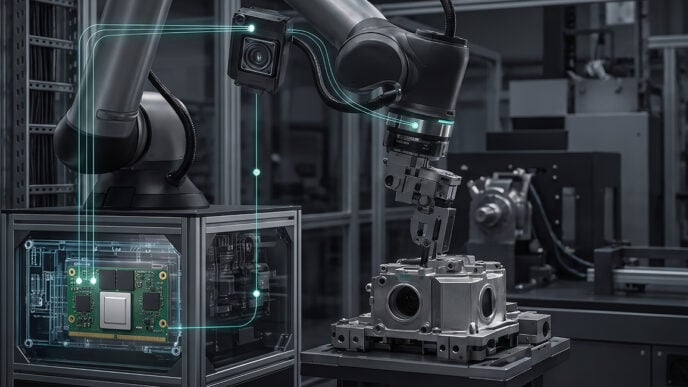
At its simplest, Physical AI brings digital intelligence into the physical world. By combining AI, robotics, sensors, Edge computing, and simulation, it enables machines to interpret their surroundings and respond to changing conditions. For manufacturing leaders, the potential is not simply to automate more tasks, but to make automation more adaptable to the environments in which it operates..
From automated operations to intelligent operations
The difference becomes clear in how machines respond to changing conditions. In many industrial environments, workers still spend significant amounts of time moving between locations or carrying out routine checks. Physical AI allows autonomous machines to take on more of that work while people focus on tasks that require judgment, oversight and decision-making.
Logistics is one of the clearest examples. Automated guided vehicles have been used for decades, but they typically follow predefined routes and struggle when conditions change. An autonomous mobile robot can instead receive a picking list, determine the fastest route, recognise when something is blocking its path and navigate around it. Autonomous guided forklifts apply the same principle to tasks such as loading, unloading and picking.
Robotic inspection offers another practical example. In facilities such as power plants, where equipment may be difficult to digitise, intelligent machines can move through the site, visually inspect analog meters, identify leaks or cracks and flag issues that require attention. This can reduce the need for people to carry out repetitive inspections in large or higher-risk environments while improving consistency, safety and asset availability.
What distinguishes Physical AI from traditional automation is not simply the use of AI but its ability to accommodate greater variation. Traditional robots are highly effective when tasks and conditions remain predictable. Physical AI can interpret changes in its environment and adapt its actions in response.
Finding the right use case
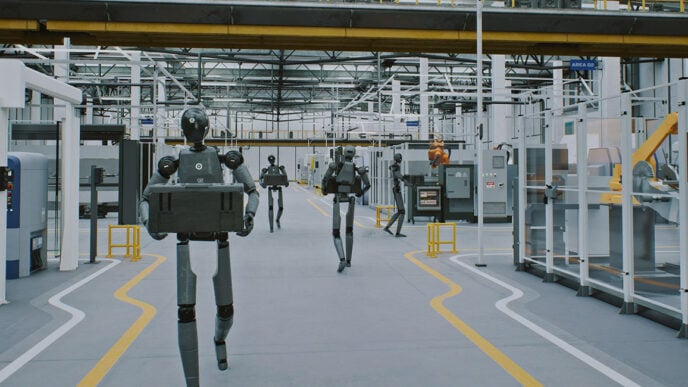
While humanoid robots have generated significant interest, manufacturers are still determining where they create the most value. The form of the robot should therefore not be the starting point. The more important question is which operational problem could be solved more safely, efficiently or consistently with Physical AI.
A humanoid may be appropriate for certain tasks that benefit from a human-like form, particularly where machines need to operate in environments designed around people. But autonomous mobile robots, inspection robots or other intelligent machines may be better suited for warehousing where they can perform specific tasks without the additional complexity of replicating the human form..
Different machines will make sense for different environments and requirements. Manufacturers should first identify the task and the outcome they want to improve, then determine what type of Physical AI is best suited to deliver it. This keeps the focus on operational value rather than adopting a particular form of robotics simply because the technology is new.
Physical AI automates tasks
One of the most common concerns around AI and robotics is whether they will replace jobs. A more useful way to think about their impact is at the level of tasks. Roles that are repetitive, labour-intensive or hazardous are likely to see significant transformation as automation develops. However, this does not necessarily remove people from manufacturing. It can instead give workers more capacity to focus on areas where human capabilities matter more. That makes Physical AI a question of how work is divided between people and machines. Machines can take on tasks they can perform more safely, consistently or efficiently, while people remain responsible for oversight, complex decisions and the work that depends on human judgment.
Physical AI is still at an early stage, and manufacturers are continuing to explore where different types of intelligent machines fit best. The opportunity is not to automate for automation’s sake, or to select a particular type of robot because it is attracting attention. It is to apply Physical AI where greater adaptability can make work safer, operations more efficient and workers more effective.