

Stephen Phipson, Chief Executive of Make UK, declared 2026 “the year of automation,” as the government’s new industrial strategy puts digital transformation and robotics at the core of advanced manufacturing.
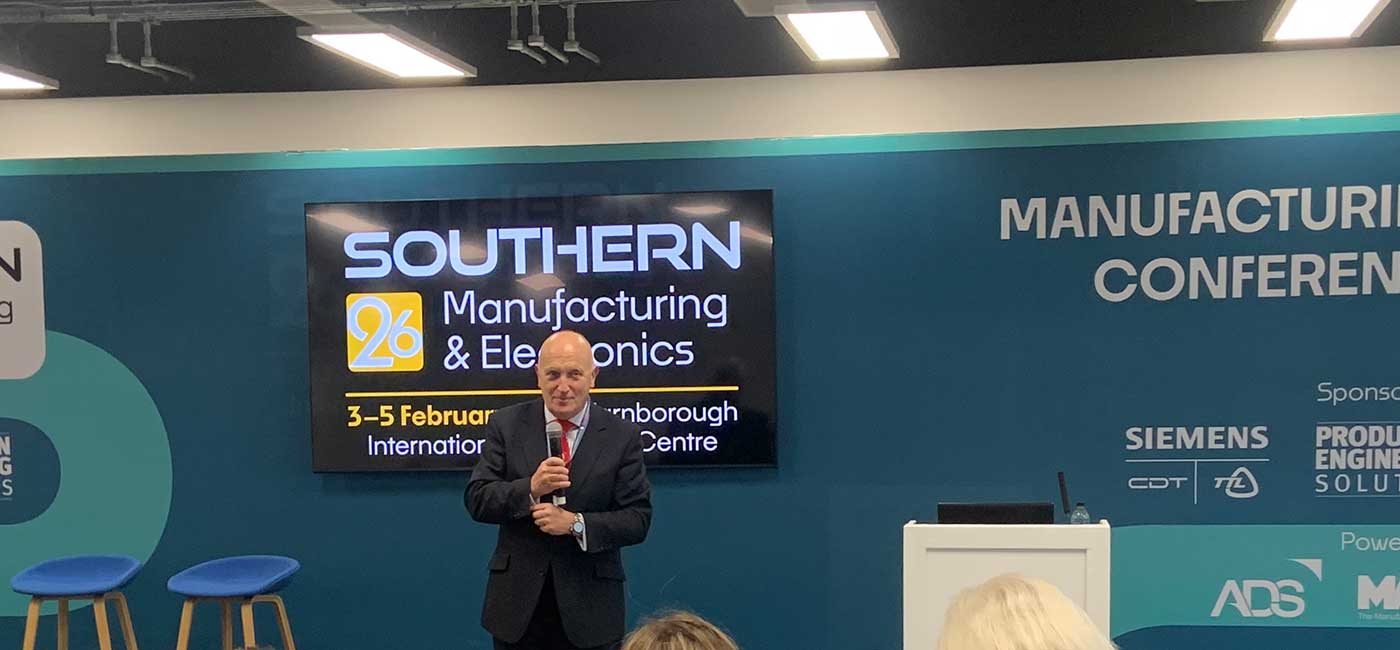
Speaking at the Southern Manufacturing conference in Farnborough today, Phipson described the strategy as a long-awaited foundation for firms to scale up automation and digitisation across both shop floors and back-office operations.
“With a stable policy framework, manufacturers can finally plan investments that span the full cycle of automation projects,” he said. “2026 is the year when we expect these technologies to become embedded across UK manufacturing.”
Phipson said industry sentiment supports that optimism. Make UK’s latest Executive Survey, conducted with PwC, found that a majority of manufacturers expect output and demand to rise this year, with nearly three-quarters planning investment in digital technologies and automation. Optimism is strongest among firms in renewable energy, aerospace, and other high-tech sectors, where robotics and AI are already improving productivity and resilience.
He said that small and medium-sized manufacturers are embracing digital transformation through government-backed programmes such as Made Smarter. Phipson said that thousands of SMEs have adopted automation tools and data analytics, often seeing immediate gains in efficiency for relatively modest investment.
Automation, however, is not being driven purely by opportunity. Labour shortages and an ageing workforce – with the average age in manufacturing now 52 – are pushing firms to adopt robotics and AI more rapidly.
Phipson said policy changes, such as the new Employment Rights Act, would accelerate this trend: “One of the reactions to things like the Employment Rights Act will be increasing automation in manufacturing to avoid having to employ more people.”
Energy costs remain a critical barrier. UK manufacturers pay some of the highest electricity prices in the world, in part because of five separate levies on top of wholesale costs, including the Climate Change Levy and network charges. Phipson said this makes energy-intensive sectors, such as steel and chemicals, “uncompetitive unless policy interventions reduce costs.” The industrial strategy includes measures like the Supercharger scheme, which removes certain levies for qualifying firms, and broader incentives to support energy-efficient automation.
Access to finance is another longstanding challenge. UK manufacturers have struggled to secure patient capital to scale automation projects, leaving innovative technologies under-commercialised. The industrial strategy addresses this through initiatives involving the British Business Bank and the new National Wealth Fund, aimed at providing long-term investment in advanced manufacturing.
Despite these challenges, confidence in the sector is rising. Export growth is improving, particularly to the Middle East and India, and manufacturers are beginning to commit capital after years of under-investment. Phipson highlighted the sector’s resilience and contribution to the UK economy: manufacturing accounts for £220 billion in output, 42% of exports, and 48% of private R&D investment, employing 2.6 million people with salaries on average 10% higher than the national average.
“The mood has shifted,” Phipson said. “There is a real sense that if government follows through on this strategy, automation can become a core driver of productivity and growth. We have the plan, and we have the optimism. Now 2026 has to be the year when automation actually happens at scale.”