
European manufacturers are beginning to see tangible gains from artificial intelligence on the factory floor, as industry leaders argue that a new generation of industrial AI is moving rapidly from pilot projects into real-world deployment.
Speaking at a panel titled “The Industrial AI Factory: Powering Europe’s Next Era of Innovation” at Hannover Messe, industry leaders said advances in simulation, robotics, and AI agents are already reshaping production and engineering workflows.
“AI… has reached the shop floor, starting to control its full potential,” said Horst J. Kayser, Chief Executive of Factory Automation at Siemens. “The key is to provide the data and then work with it.”

Kayser described a shift away from traditional automation towards more adaptive systems. “We’re moving from strict rule-based automation to intent-based automation,” he said. “We are on the way to autonomous, adaptive manufacturing.”
The transition builds on years of incremental digitisation across industry, from computer-aided design systems to more structured data architectures and, more recently, digital twins — virtual replicas of factories that allow companies to simulate production processes before physical rollout.
These tools are already delivering measurable results. Kayser pointed to a large industrial customer that “finds 90% of all bugs in the entire process before they even start to invest real capex”, while increasing output capacity “by at least 20% for the same investment”.
At one advanced electronics facility, he added, the application of simulation and optimisation tools is delivering “7% annual productivity year after year after year in an established manufacturing process”.
The role of simulation
Other panellists emphasised the role of high-performance computing and AI infrastructure in enabling these gains. Rev Lebaredian, Vice President for Omniverse and Simulation Technology at NVIDIA, said companies are increasingly using simulation to generate the data needed to train AI systems.
“We see a lot of companies using simulation to generate data — to convert compute into data,” he said. “We already see applications happening right here using sovereign compute for sovereign purposes.”
Lebaredian pointed to a growing ecosystem of users, from robotics companies building foundation models for machine control to firms developing AI-driven physical simulation. “Physically accurate simulation allows us to do simulation at speeds that traditional simulators can’t match,” he said.
The result, he argued, is a step change in how industrial systems are designed and operated. “All of this technology and innovation will be exported outside to the rest of the world as well.”
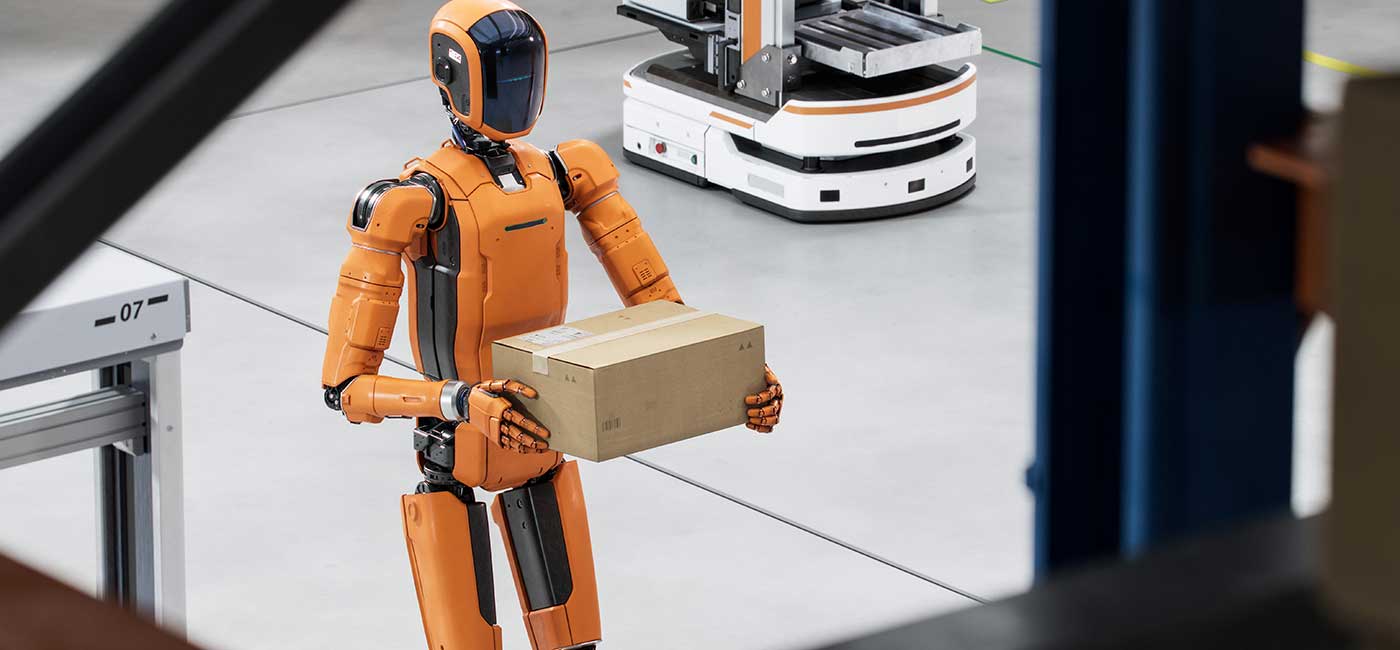
A central theme of the discussion was the emergence of so-called “physical AI” — systems that combine perception, reasoning, and action. Demonstrations at the event included robots capable of assessing their surroundings and performing tasks such as picking and packing items without pre-programmed instructions.
“That’s not pre-programmed,” Kayser said of one example. “The robot assesses the situation as it sees it and then reacts to it.”
Companies are also beginning to deploy AI agents to automate engineering processes. Kayser said new agent-based tools could increase the throughput of engineering and automation design “by at least 20%, if not up to 40%”.
Lebaredian argued that the rise of agentic AI represents a fundamental shift. “For the first time, we have the ability to manufacture agents that can go do work that only humans could do before,” he said.
“The cost of running these agents is decreasing exponentially,” he added. “Anybody can have a coder now… most of the software we’d like to develop never gets developed, but that has just changed.”
Deploying data
Reffi Abolhassan, Chief Executive of T-Systems, said the benefits would depend on how effectively companies manage and deploy their data.
“Bring your asset, which is your know-how and your data, into a fabric,” he said. “There is no excuse… you have your data.”
He also pointed to the importance of building European capabilities in industrial AI. “We can be the leader here in Europe on industrial AI,” he said, arguing that sovereign infrastructure would be key to maintaining competitiveness.
Panellists agreed that companies should start with the basics: ensuring manufacturing processes are fully digitised, building structured data environments, and deploying simulation and digital twins to optimise operations.
“Make sure you have a properly, fully automated manufacturing landscape,” Kayser said. “On that basis, you can start to develop the data that are necessary.”
They also encouraged companies to experiment more actively with new AI tools. “Start experimenting,” Lebaredian said. “This is a new thing that has just arrived, and we’re just starting to learn how to use it.”
With the underlying technologies now in place — from high-performance compute to advanced simulation and AI models — the panel’s message was that industrial AI is no longer a future concept, but a present reality.
“All this is possible,” Kayser said. “It’s happening now.”