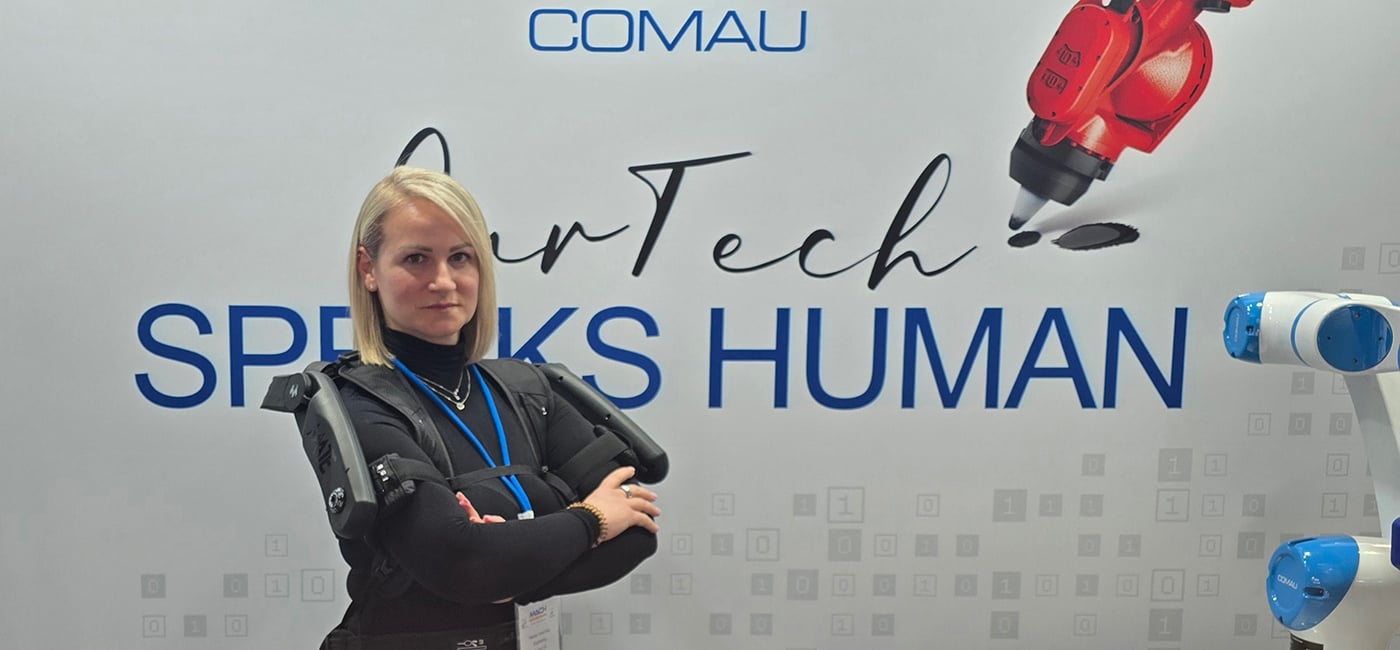

Ksenija Linda Esko is a woman with an appetite for knowledge. Working at the cutting edge of AI and transformation in manufacturing at Comau UK, Esko is flourishing in a supportive company that allows her to keep one eye looking forward to the next big thing in technology.
Getting ahead of the curve
As a naturally technically minded person, Esko was drawn to the field of computer science. It is an area she recognised as the future, and she made a calculated bet that it was going to be pivotal in business in the years to come.
“I’ve always been a technical person. I knew straight away that languages and literature were not my thing. IT was a very new area, and one I believed where the money was, hopefully, going to be, so I pursued it.
“In Latvia, if you’re skilled enough or smart enough, the government pays for your studies. So I got a fully funded three-year uni course. [And that] time and effort spent in school paid off.”
That was in 2008, and by 2011, Esko had obtained her degree; however, it did not open doors as easily as she’d hoped. “It was a very male-dominated area back then,” she said. Struggling to find work at home, she made a decision. She moved to the UK.
Life on the line: discovering the factory floor
Esko found herself working on the factory floor, starting with the basics of manual assembly. She then moved into the automotive industry for a brief time before landing in food manufacturing, where she developed a love for quality control. However, that role didn’t last, so she moved back into the automotive industry on a more permanent basis.
At 23, Esko was on the production line, physically building the famous London black cabs. She was the only woman on the shop floor.
“It was challenging to start with. I wasn’t used to working in that environment, and it was, again, male-dominated. [They had] their own banter, their own jokes. The language they used was different. It was a big learning curve … I was going home tired, mentally more than physically.”
During her time on the factory floor, Esko received some cutting comments. One she particularly notes was a “trigger for the rest of my career. I believe that by proving [them] wrong, you show [them] that it’s not the way the world spins anymore.”
The 10-question quiz game
Esko started work at a new company with a supportive manager who recognised her talent. Here, she was guided into metrology engineering, which is the science of high-precision measurement. However, at the time, the technical drawings were a world apart from anything she had encountered at university.
“I’d never seen technical drawings to that extent in my life. We did the basics at uni, but this was nine pages long and big. I told myself that if I wanted to stay in that lab environment, I had to do something about it. So I studied, and I learned.”
Yet, even in the precision environment of a metrology lab, the scrutiny Esko faced as a woman was relentless. She describes what she calls the “10-question quiz”, where a male colleague would be taken at his word, but she was interrogated. She would often receive questions like, “Do you know what this symbol means? Are you sure that’s the right answer? How did you arrive at that answer?” So, she learned to reframe it. “I stopped feeling penalised and took it as an opportunity to show off my skill. I’ve always gloated a little when I managed to tell them something they didn’t know.”
Ever hungry for more knowledge, once Esko had reached the ceiling of what metrology could offer, she pushed into continuous improvement. And then came another wall. She was blocked from a promotion she had earned. She decided to leave.
Finding a home at Comau
All the choices Esko has made have led her to Comau UK – a subsidiary of the global automation and robotics engineering company – where she initially joined as a Reliability and Maintainability (R&M) engineer. What she found at Comau UK was unlike anything she had experienced before.
“Despite Comau being a global business, the UK branch is much smaller, and it is very different to everywhere I was before. There’s obviously still banter and jokes, but it’s a completely different level. The team is more supportive … It’s more of a family.”
Within six months of joining, Comau UK offered Esko the opportunity to undertake a Level 7 apprenticeship in AI and data science. “That made me believe this is the place where I want to be and want to carry on my career,” she says.
Less than two years after starting as an R&M engineer, Esko was promoted to Lead of Methods, Change, and AI Transformation, and her remit spans the global Comau engineering family.
Automate the mundane: elevate the engineer
Part of Esko’s role is identifying the repetitive, data-heavy workflows that consume engineering time without requiring engineering judgement. This is where automation delivers value without diminishing the human role.
“I’ll be responsible for the internal improvements within the global Comau engineering team – to help, support, and identify the path we’re going to travel. It’s about making our lives better and easier using AI rather than replacing people. Identifying the mundane tasks and issues where data is available, and understanding how we can look at processes from a different perspective.
“I quite like new and innovative things. That’s probably one of the reasons I ended up in AI and kind of did a full circle. Once I’ve learned everything inside out … I need my brain to be exercised. AI is a growing field. It’s new, there’s a lot of potential there.”
Women have earned their place
Talking about the challenges women face in engineering environments, Esko says that “once you start climbing up and there’s a lot of talk about diversity and inclusion, people start to think you’re in the role not because of your skill, but because the company is ticking a box. I think that’s now the hardest bit. With diversity and inclusion, we didn’t necessarily make it better in certain areas. We kind of made it worse.”
When asked what advice she would give to women considering a role in automation, she said: “Don’t be afraid. Don’t be scared. Don’t overthink it. Ignore the noise and go forward. If you have a skill and ability and you think you can, you definitely can – because we can do a lot more than we think.”
As for the industry itself, she says: “If you have a technical mind, engineering is the way to go. You shouldn’t let anybody change the course of your ideas and career aspirations.”
Esko’s journey is proof that you shouldn’t let anything hold you down. If you want to do it, do it. No one is going to give you permission. Back yourself and don’t stop believing.
This article originally appeared in the June issue of Automation News