


ESOS (the Energy Savings Opportunity Scheme) is a UK Government initiative that requires large organisations to regularly assess their energy use and identify opportunities to reduce consumption and costs across their operations.
First introduced in 2014 to implement Article 8 of the EU Energy Efficiency Directive, the scheme is now entering its fourth phase, with increased emphasis on accountability and compliance.
What is the purpose of ESOS?
The purpose of ESOS is to help large organisations identify energy efficiency and cost-saving opportunities across their operations. While the scheme highlights potential improvements, there is currently no mandatory requirement to implement the recommendations, although they are strongly encouraged.
An ESOS assessment requires organisations to collect a full year of energy data across all major activities, including buildings, transport, industrial processes, and construction. This data set must include the qualification date of 31st December 2026.
Once collected, selected sites across the organisation are audited to identify energy-saving opportunities. These audits do not need to cover every site, provided that any sampling approach is appropriately justified.
The resulting data is then analysed across the organisation, with up to 5% of energy use able to be excluded under the “de minimis” principle, where minor or non-material consumption is considered insignificant.
A formal report is then produced, signed off at board level, and submitted via the MESOS portal. Organisations must also retain a supporting evidence pack, as submissions may be subject to regulatory review.
What are the penalties?
Failure to comply with ESOS can result in total penalties of up to £90,000 per compliance period, meaning organisations may be fined across multiple reporting cycles where non-compliance continues.
The most significant penalty applies where an organisation fails to carry out an energy audit, which can result in a fine of £50,000. Additional penalties may be issued for failure to notify the Environment Agency of compliance, or for failing to maintain required records, each carrying fines of £5,000.
Ongoing non-compliance may also result in daily penalties of £500 per working day, up to a maximum of 80 days, totalling £40,000. Submitting false or misleading information may result in a further penalty of up to £50,000.
In addition to financial penalties, the Environment Agency may publish details of non-compliant organisations, creating a reputational risk alongside enforcement action.
Do you need to comply?
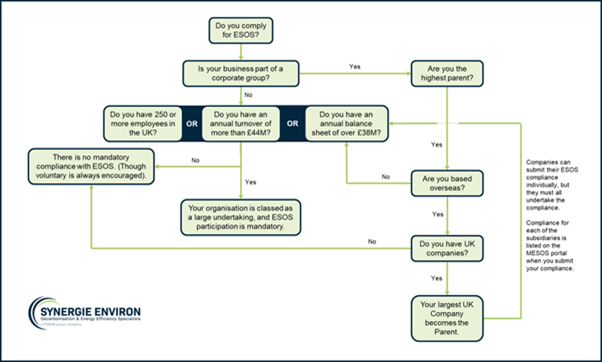
ESOS applies to “large undertakings”, defined as organisations with 250 or more employees, annual turnover exceeding £44 million, or an annual balance sheet total greater than £38 million.
Organisations that meet these criteria must comply with ESOS every four years.
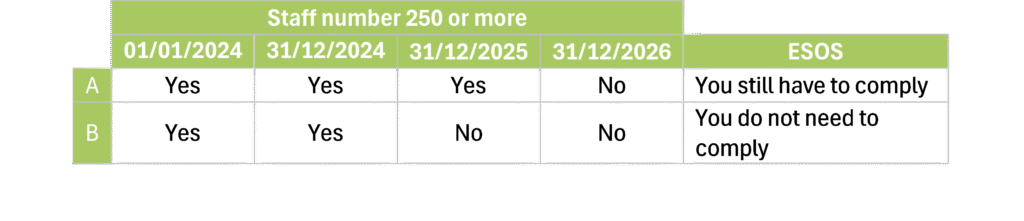
Businesses that previously qualified but have since fallen below the thresholds may still be required to comply. To become exempt, an organisation must remain below all qualifying criteria for two consecutive compliance periods.
The qualification date of 31st December 2026 is used to determine eligibility and defines the 12-month energy data period used for reporting.
When do you need to comply by?
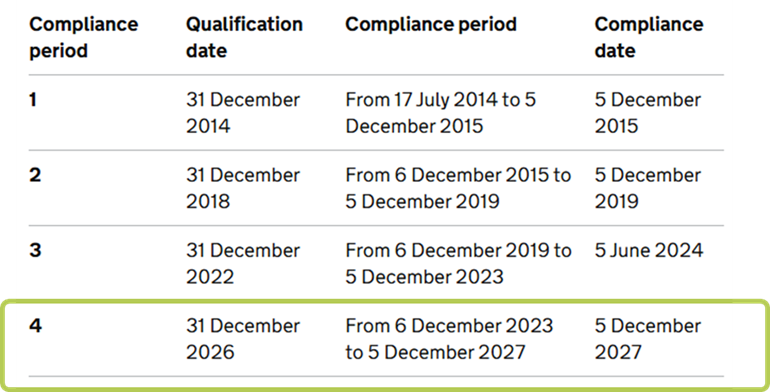
ESOS Phase 4 has two key dates. The qualification date is 31st December 2026, which determines whether an organisation falls within scope and defines the required data period.
The compliance deadline is 5th December 2027, by which time the ESOS report must be submitted via the MESOS portal.
What is a Lead Assessor, and do you need one?
A Lead Assessor is an individual approved by a recognised ESOS accreditation body to oversee and sign off on an ESOS assessment. A Lead Assessor is responsible for ensuring audits meet the scheme’s legal requirements, that they are based on accurate data, and follow the correct methodology.
The Lead Assessor does not have to carry out every site visit or analysis personally, but they must review the work and confirm its quality and compliance.
For ESOS Phase 4, most organisations require a Lead Assessor. There are situations where businesses are exempt, but this isn’t very common. A Lead Assessor is mandatory unless the business qualifies for exemption, without a valid exemption, a compliant ESOS submission cannot be made without a Lead Assessor declaration.
This article originally appeared in the June issue of Automation News