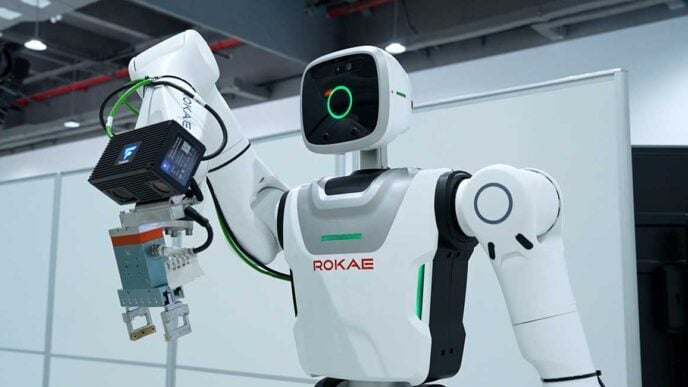
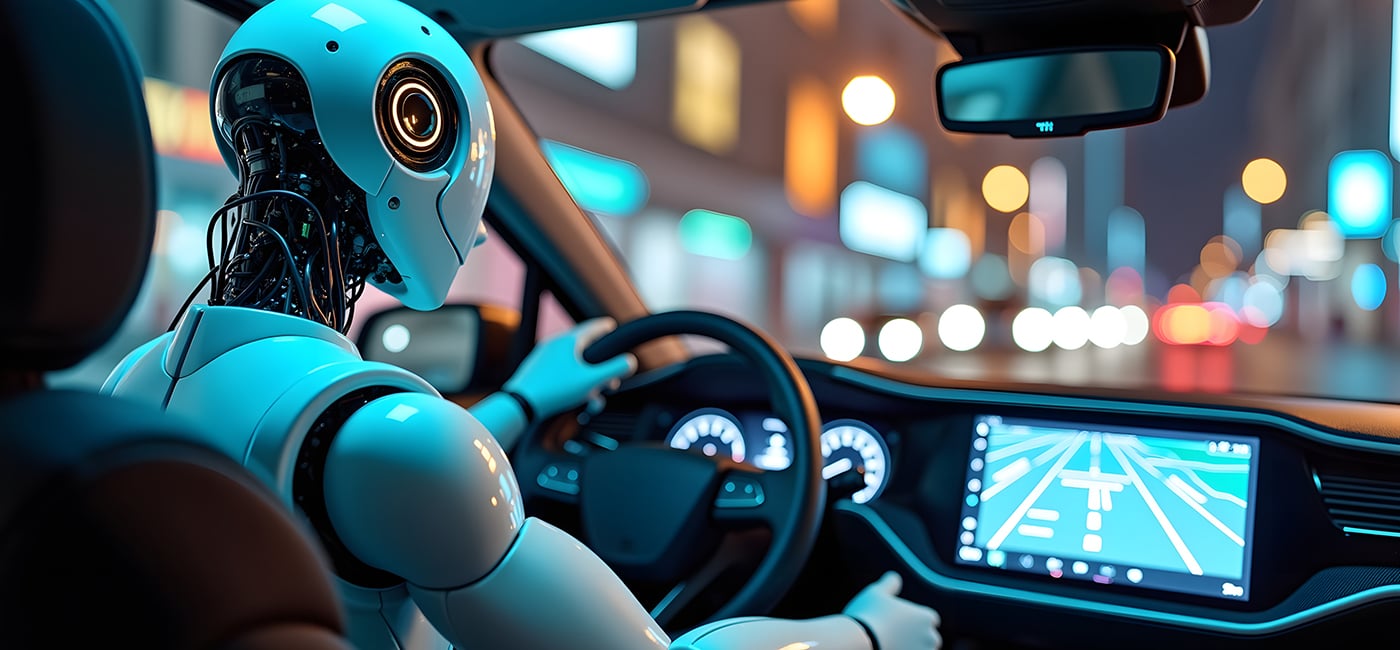

As more passengers step into Waymos and watch driverless cars weave through traffic, robotaxis are offering an alluring glimpse of an autonomous future. But they may also be serving as real-world testbeds for much of the technology behind humanoid robots.
Certainly, that’s the view of chip designer Arm, which last year set up a physical AI division aimed specifically at developing compute for this expanding area, based on two decades of experience designing chips for robotaxis.
“There’s huge uptick in humanoids from a technology development perspective now. You can see a lot of people already starting to jump on it. And for us at Arm, because we develop the foundational compute technologies that basically puts all of that together at the foundational level, it becomes super critical for us to stay ahead,” says Suraj Gajendra, the man leading Arm’s physical AI products and software division – and a former VP of its automotive division.
“The stuff that we worked on in 2020/2021 is now coming in the cars, and it’s really four to five years later when customers enable end use cases. So that’s why it becomes super important for us to ensure that we build the right technologies with the real- time and time-deterministic compute capabilities, with the safety capabilities, with security, with the right acceleration capabilities within CPUs and GPUs so that we can actually compute those workloads very efficiently.”
Certainly, the robotics industry is expanding rapidly. According to the International Federation of Robotics, more than 500,000 industrial robots were deployed globally in 2025, while Western Europe recorded a 3% year-on-year increase in robot density, maintaining its position above the global average.
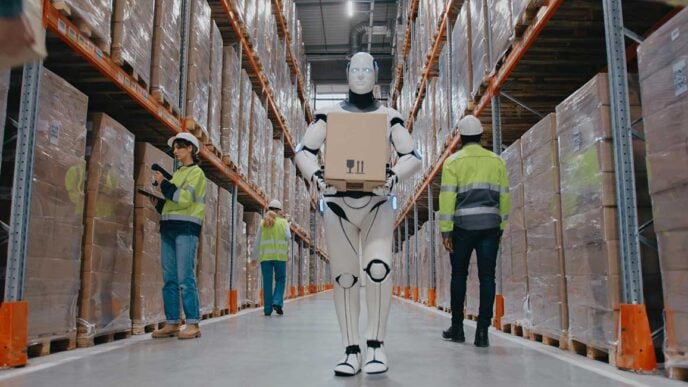
Yet despite growing investment and ambitious forecasts, humanoid robots remain largely confined to prototypes and pilot programmes, with no clear path to broad, real-world deployment at scale in the near term.
Gajendra argues that autonomous vehicles and humanoid robots are fundamentally similar, both in the way they need to be aware of the environment around them and in the way they need to interact with others.
First, there is what he calls ‘interactive intelligence,’ which in a robotaxi or autonomous vehicle comprises things like infotainment systems, conversational AI, driver monitoring and passenger monitoring.
“If you’re thinking about autonomous cars, people are actually talking about having an infotainment system where you can be watching a movie, or taking a Zoom call [while the car is driving], so for us, we have a class of products and technologies that we are actually developing, especially our GPUs that are going to be tailor-made to enable those use cases. On the robot side, obviously, similar things apply. It’s when you interact with the robot, when you give voice commands or gesture commands. The humanoid robot actually has to see the person that it’s interacting with. Is it male or female? Is it a kid? Does it have to have additional levels of safety when it’s interacting with a kid, for example?”
The second type of compute, Gajendra describes as ‘perception intelligence.’ In a car, this entails getting data from sensor modules and then using the main compute to understand where it’s driving and how to navigate around obstacles.
“The Tensor robocar has 433 Arm CPUs in each vehicle, all the way from sensors to the main CPU. And when you look at a humanoid, it is similar. There are sensors, there’s radars and LiDARs. There are cameras. And how does the data get computed, and how does it basically avoid obstruction? How does it know where it has to go? How does it know to go perform specific tasks that we expect it to perform? All of that stuff is driven and handled by this perception computer inside the humanoid robot.”
Another common requirement, Gajendra points out, is security. Just as you don’t want anybody to hack into your car when it’s driving autonomously on the motorway at 70 miles per hour, equally you don’t want someone to hack into a humanoid robot, which could be equally dangerous.
Similarly, he says, both robotaxis and humanoids need to make split-second decisions within very strict time limits. This means that, for a car, it can take evasive action at exactly the right time in a predictable manner.
“Every finger movement in a humanoid robot has to be very precisely managed. So the compute that sends the signal to every finger needs to be coordinated to a great degree,” he says. “The challenge is no longer just generating intelligence. It’s making decisions reliably in real time, under strict constraints around power, safety, security, and determinism.”
Yet robotics also introduces challenges that automotive developers have largely avoided.
Number one of these, Gajendra says, is ensuring that the giant humanoids envisaged don’t accidentally end up falling over onto their owners or harming the children and pets they are supposed to be looking after.
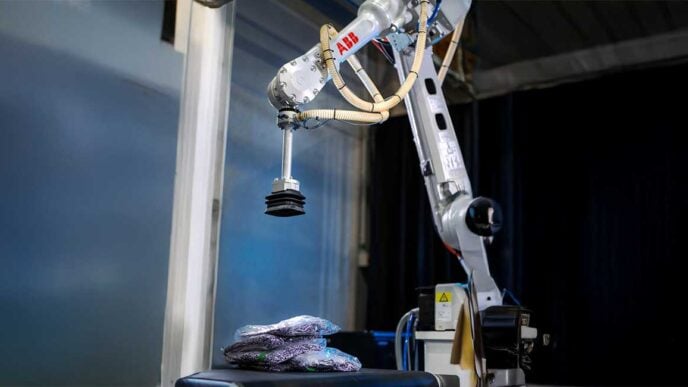
“Up until now, the robots were actually in cages, and I’m not kidding,” he says. “On the factory floor where you had robotic arms fitting a door in a car on an assembly line, they were actually caged off. If it detects a worker hovering around, the system comes to a halt. Whereas in a humanoid robot in a home setting, you have kids running around. So literally, the use cases that people are enabling today are bringing the robots out of cages and letting them loose; that’s a big challenge. How do you ensure that there is a 360-degree view all the time? How do you take evasive actions? How do you bring the robot to a safe state while it is performing a task?”
Another major problem, familiar perhaps to many of us, is being able to deal with and prioritise lots of things happening at the same time. Arm calls this ‘freedom from interference.’ Essentially, it means being able to keep doing an important task without being interrupted by distractions.
“For us humans, when we’re doing something, and if there is a distraction, yes, we stumble, but we also know how to manage it. If it’s not a high-priority interruption, we ignore it and keep doing what we’re doing. So a humanoid robot needs to be aware of what is time-critical, which task is high priority, and which one needs to be ignored,” he says. “In an autonomous car, you basically sit in the car, and you say, okay, go to wherever, and you don’t jump in and say, hey, by the way, don’t do that. The car has got a task, and it’s basically going to go do that.”
Power consumption presents another challenge. While electric vehicles can accommodate relatively large battery packs, humanoid robots don’t have the space in them to fit a large battery. But if you try to make batteries powerful enough to do all the things humanoids require, they can end up getting dangerously hot.
“In a car, you can actually have a pretty large battery, and the power that the computer basically takes is much less than the power that it needs for driving, be it the mechanical movement and generation of torque and stuff like that,” Gajendra says. “Whereas in a humanoid you need to be within a very strict limit from a battery life perspective. Then again, you can’t have a humanoid robot that’s active for five minutes and charging for three hours. And you can’t stick a big fan around its eye. You basically have to operate in a very strict power envelope.”
Although future robotics-specific silicon may emerge, Gajendra expects significant overlap between the two industries as AI models evolve and become more capable.
“So right now, the people building humanoid robots are actually using the chips that are available for autonomous driving,” he says. “However, the software stack for a humanoid robot is entirely different compared to an autonomous driving software stack. For a robot, you need a robot operating system that basically can handle a lot more real-time workloads. So there’s a lot of difference in the software story on how you actually enable a humanoid; that’s where the bulk of the differences are.”
This article originally appeared in the June issue of Automation News.