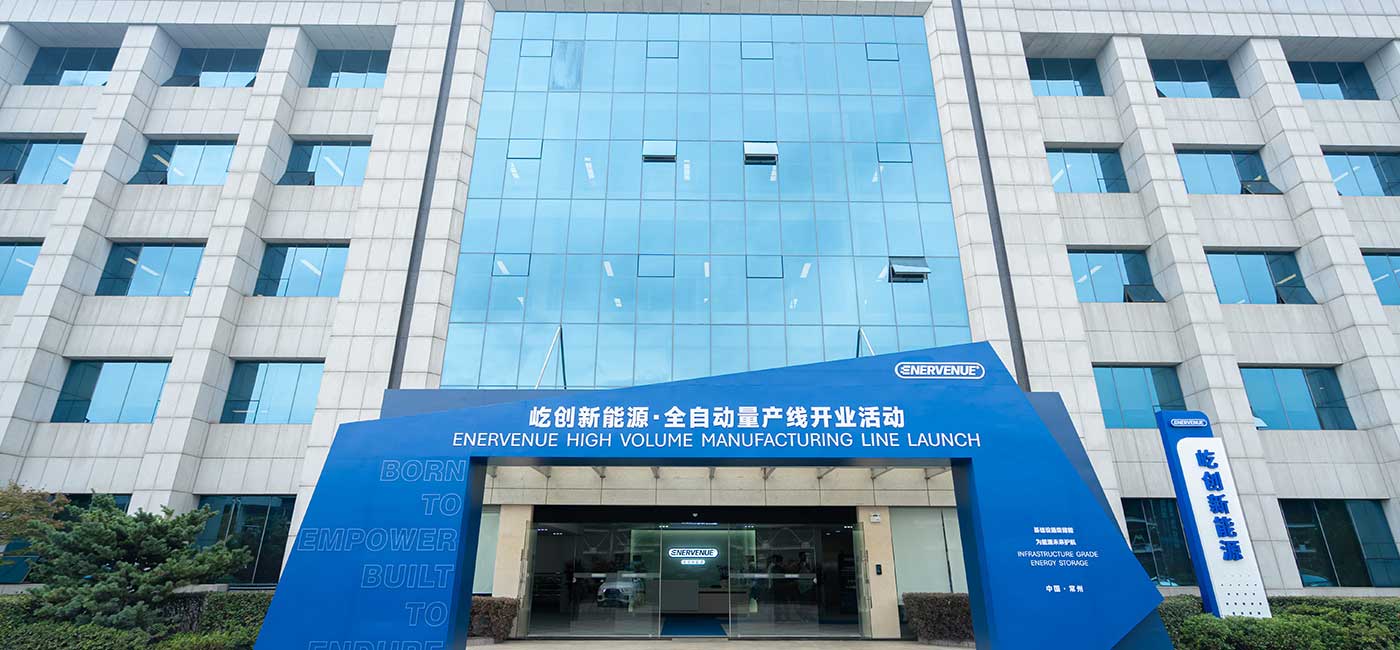

EnerVenue has started production at what it describes as the world’s first high-volume manufacturing line for its Aqueous Metal Cell, a water-based nickel-hydrogen battery designed for long-duration energy storage and industrial applications.
The line in Changzhou, China, was built in 25 weeks and has an initial annual capacity of 250MWh. EnerVenue plans to increase capacity to 1GWh in 2027 and to multi-gigawatt-hour scale by 2028.
The company said the line will ramp to full production through November, when it is expected to produce about 300 cells a day.
Unlike conventional lithium-ion batteries, the Aqueous Metal Cell (AMC) uses a water-based electrolyte and nickel-hydrogen chemistry. EnerVenue is targeting applications where long service life, reduced maintenance and fire safety are important, including data centres, industrial facilities and grid-connected storage.
The company says the cells are designed for 30,000 charge cycles and up to three cycles a day over 30 years, without scheduled augmentation. It is positioning the technology against other long-life storage technologies such as pumped hydro, flow batteries and compressed air, rather than solely against lithium-ion on upfront cost per kilowatt-hour.
EnerVenue Chief Executive Henning Rath said the start of production marked a shift from developing the technology to manufacturing it at scale. “This is the only facility in the world making this high performing water-based nickel-based battery,” he said.
Because EnerVenue is the only company manufacturing its particular battery chemistry, the production line had to be developed specifically for the AMC.
The manufacturing process runs from raw materials to finished cell as a single flow, with automated guided vehicles moving cells between stations. A vision system monitors electrode stacking, while automated equipment controls the winding of the cell in fibreglass.
Each cell undergoes 41 quality checks across 11 testing and measurement stations, covering areas including weld integrity, leak tightness and performance.
The production equipment was first engineered and validated on EnerVenue’s research and development line, around 6km from the new facility, before being transferred to the high-volume plant.
The factory covers about 20,000 square metres, with space allocated for a second phase of similar size. EnerVenue says the manufacturing stations are standardised so that additional capacity can be added by replicating them.
The approach is intended to support what the company calls a “local for local” manufacturing model, with Changzhou serving as the first production site.
The AMC forms the basis of EnerVenue’s Energy Core, Energy Cube, Energy Rack and Energy Prism products, spanning systems from 30kWh to 1MWh.
The company announced its first signed multi-megawatt-hour commercial order on 23rd September. The deal covers 26 Energy Prism containers with a combined capacity of 11MWh for an oilfield in northern China, where the storage system will be paired with on-site generation. The first containers are due to ship in December.
EnerVenue also signed memoranda of understanding with eight companies at the plant opening, including Towngas, Towngas Smart Energy, Shanghai Electric and Guangzhou Development Group.
The company already has an operating fourth-generation AMC installation at Jintan in Changzhou. Commissioned in November 2025 with Towngas, the project combines on-site renewable generation with electric-bus charging.
EnerVenue said its cells have also been shipped to customers in the US, Belgium and Saudi Arabia, with projects and customer engagements across China, Australia, the US, European Union, Saudi Arabia and Canada.
The AMC is based on nickel-hydrogen chemistry that has been used in spacecraft, including the Hubble Space Telescope and International Space Station. EnerVenue has adapted the chemistry for terrestrial energy storage using materials it says are more readily available and less costly.
The company says the water-based electrolyte is non-flammable and that the chemistry does not undergo the thermal runaway sequence associated with lithium-ion batteries. It therefore sees potential applications inside buildings and data centres, as well as at industrial sites where fire risk is a particular concern.
EnerVenue also says the cells contain no lithium or rare earth elements and that nickel can be recovered at the end of the battery’s life.
The Changzhou facility was funded in part by a $300m Series B extension announced in March 2026 and led by Full Vision Capital. EnerVenue says it has raised more than $700m to date.
The company is now using the Changzhou plant as the template for scaling production, with further capacity intended to follow as demand for long-life energy storage grows.