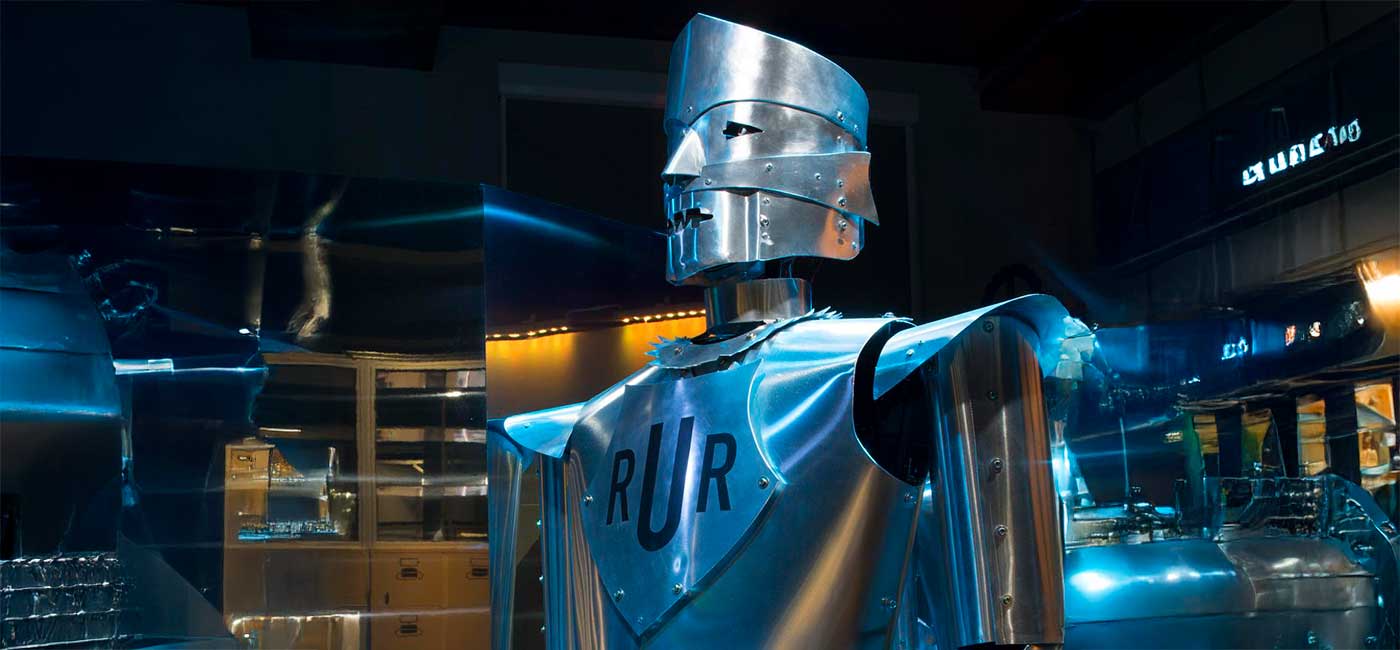

A hundred years before today’s humanoid robots captured the world’s imagination, Britain’s first humanoid, Eric the Robot, was already wowing audiences.
Created as an “all steel man” to open the Model Engineer Exhibition at London’s Royal Horticultural Hall in 1928, Eric certainly looked the part. He stood, bowed, delivered a short speech to an audience and, according to some sources, gave a Fascist salute.
Aside from his questionable political leanings, Eric was a masterpiece of cutting edge technology of the time. His voice travelled by radio signal and his movements were powered by an electric motor. He was, in every visible sense, a machine designed to resemble a man. An early humanoid robot, and one of the first public demonstrations of its kind.
For a brief moment, Britain was not observing the future of automation from a distance. It was staging it.
Then Eric disappeared. He toured America, introduced himself in New York as “Eric the robot, the man without a soul”, was described by the press as “the perfect man”, and was later dismantled or lost. Even now, his fate is uncertain. When the Science Museum rebuilt him in 2016, it was less recovery than reminder: Britain had once demonstrated robotics as spectacle and then moved on.
Nearly a century later, the UK still remains unusually good at producing robotics research, credible startups, and polished demonstrations. Yet it remains unusually poor at doing the thing that matters
most: scale.
Cut to a bright spring morning in 2026 at the London College of Contemporary Arts, where a small panel of industry leaders gathered to exactly that problem.
The future is not the problem
“We are here to talk about what the future workforce looks like and how industry supports the next generation,” says Mike Wilson, Chief Automation Officer at the Manufacturing Technology Centre.
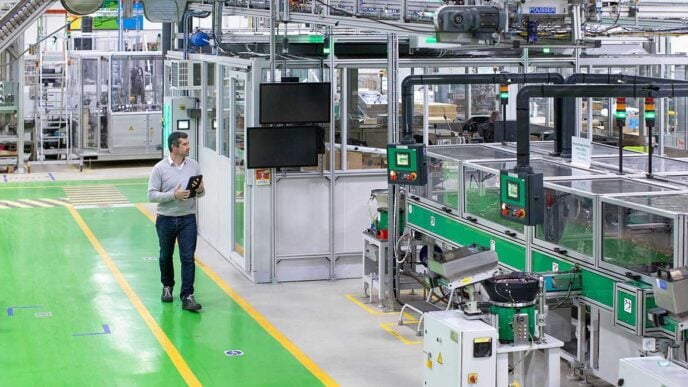
But, as he points out, the uncomfortable reality is that the future is not where the UK is falling behind. It is the present. The UK sits around 24th globally in robot density in manufacturing, sitting below Germany, Italy, and Canada, as well South Korea, Singapore, and Japan in terms of world rankings of the most robots per 1,000 employees. Even Denmark has more robots as a proportion of its workforce than us.
“And if we remain on that trajectory,” Wilson notes, “we are looking at significant lost potential by 2035.”
The figure attached to that warning runs into tens of billions of pounds in potential gains. But the more important point is what it represents: a gap between what the UK could produce and what it actually does.
Neil Bellamy, Head of Technology, Media, and Telecoms at NatWest Group points out that the reasons behind this lie not in some sort of stubbornness on the part of British manufacturers but rather in the size and shape of the sector. He says that although the UK’s largest manufacturers are often ahead of the curve in adopting robotic systems, they number barely a thousand and are vastly outnumbered by the 250,000 or so small and medium-sized manufacturing businesses which make up the backbone of the country’s manufacturing sector.
“SMEs are conservative,” he says. “They don’t always invest ahead of demand. There is a confidence issue.”
“We are uniquely placed to support these businesses,” Bellamy adds. “But what they need is confidence, not just funding.”
The missing middle
Rory Daniels, Head of Emerging Technology and Innovation at techUK, is direct about the structural gap.
He points out that analysis from the Robotics Growth Partnership suggests that widespread adoption of robotics and smart machines could contribute up to £150 billion in Gross Value Added (GVA), the economic metric measuring the value of goods and services produced by a particular industry.
“The UK has strong capability, but it is fragmented,” he says. “The central issue is the gap between research and deployment.”
For Daniels and techUK, fragmentation, in this context, is not just organisational complexity. It is the absence of a coherent pathway from research to deployment for British companies.
That gap is where UK robotics repeatedly stalls. Research excellence does not translate into industrial scale. Startups emerge, but do not always become manufacturers. Pilots succeed, but do not always become systems.
To respond to the challenge, techUK has made nine key recommendations to the UK government. These include recognising robotics as a frontier technology; strengthening robotics capacity at DSIT, the government department
responsible for overseeing the sector; and developing a national Robotics Opportunity Action Plan.
They also include using public procurement strategically to drive adoption, ensuring robotics is an explicit priority within the government’s scale up support service; and working with the public at large to tell a more compelling story about the opportunities robots can provide rather than the threats.
“People still think robots replace jobs,” Daniels says. “But it is tasks. Not jobs. Always tasks.”
Industrial AI infrastructure
Even so, Anthony Hills, Regional Director, UK and Ireland, Enterprise & Public Sector at NVIDIA, believes the direction of travel is changing. Hill points to NVIDIA’s recent £2 billion investment in UK computing infrastructure and AI startups, as part of a catalyst for growth.
“I believe the sector has a hugely bright outlook. A year ago, our CEO Jensen Huang was here. He stood on stage with the Prime Minister and he talked about the UK in terms of having a ‘Goldilocks Moment,’” says Hill. “What
he meant was, we’ve got a huge amount of talent in research, in innovative AI startups, and access to venture capital. What we didn’t have was the industrial AI infrastructure to support that growth but that is changing.”
He believes advances in simulation and AI training are accelerating development cycles, making it easier for British robotics startups to compete on a global scale and simpler and cheaper for small manufacturers to adopt new technology.
“You can now train systems in virtual environments millions of times before real-world testing,” says Hills. “That changes the speed of iteration completely.”
Future talent
David McGreene, Associate Dean (Computer Games) at the London College of Contemporary Arts, argues that the industry’s long term success depends on a challenge that begins far earlier than most people realise.
The problem, he says, is not attracting young people to STEM subjects. It is keeping them engaged.
“Children are naturally curious,” he says. “They enjoy building things, creating things, experimenting. The challenge comes during the transition into secondary education, where we often see participation begin to fall away.”
That drop-off is particularly noticeable among girls, creating a talent pipeline problem that ultimately affects industries such as robotics, engineering, and AI years later.
McGreene believes the answer lies partly in meeting young people where they already are. Platforms such as Minecraft and game-development tools can be used to teach programming, systems thinking, design, and problem-solving in ways that feel engaging rather than instructional.
The skills developed through games and digital creation are increasingly relevant far beyond the entertainment industry. Collaboration, prototyping, user-centred design, systems thinking, and iterative development all have direct applications in robotics and advanced manufacturing.
“The technologies are different, but many of the underlying skills are transferable,” he says. The use of game engines in applications ranging from digital twins to AI training environments demonstrates how disciplines that once appeared separate are increasingly converging.
Yet listening to the discussion, it is difficult not to think back to Eric the Robot. For all the talk of AI infrastructure, simulation environments, workforce development, and government policy, the UK’s robotics challenge ultimately comes down to something much simpler: it is not enough to build the technology. The technology has to be used.
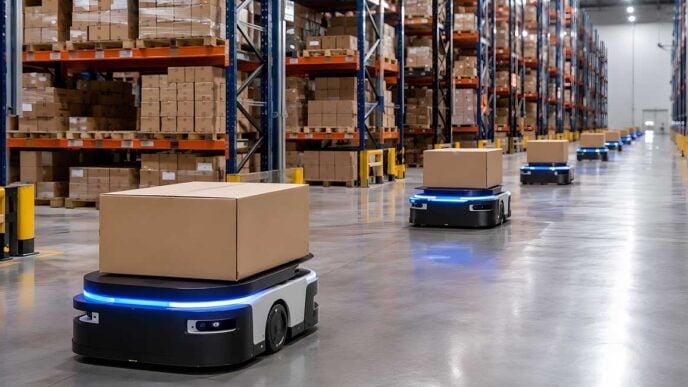
Wilson is keen to stress that adoption is rarely as straightforward as purchasing a machine and plugging it in.
“It is not just buying the robot,” he says. “It is everything around it. Power, integration, space, systems. Those are the hidden costs. Sometimes you have to rebuild the warehouse before you can install the robot. ”That observation
gets to the heart of Britain’s robotics dilemma.
The UK does not lack research capability. It does not lack startups, investors, or technical expertise. What it lacks is the infrastructure, confidence, and industrial commitment needed to turn promising technologies into widespread deployment.
Nearly a century ago, Eric stood on a stage and offered audiences a glimpse of the future. Today, the future is no longer the problem. The robots exist. The software exists. The investment is arriving. The expertise is already here.
The question facing Britain is whether it can finally do what it has so often struggled to do: move from demonstration to adoption. Because if Eric’s story teaches us anything, it is that building the robot is only the beginning. The harder challenge is finding a place for it in the real world.
This article originally appeared in the June issue of Automation News.