
For years, internal logistics has received far less attention than the production line itself. Manufacturers have invested heavily in productivity, quality, cycle times and line automation, while what happens between one stage and the next has often been treated as a secondary concern.
Yet this is exactly where the hidden inefficiencies of manufacturing can build up.
Materials have to move between workstations, Pallets must be delivered and collected. Empty containers have to be returned. Assembly areas need replenishing. Finished products have to reach the next stage without creating a bottleneck. When these movements depend on people or manual vehicles, small delays can quickly become waiting time, micro-stoppages and lost productivity.
Today, that picture is changing. In many plants, as manufacturers face greater pressure to produce more variants, respond faster to changing demand and make better use of limited space and labour, intralogistics is increasingly being recognised as one of the main areas where a company’s ability to be fast, flexible, and resilient is put to the test.
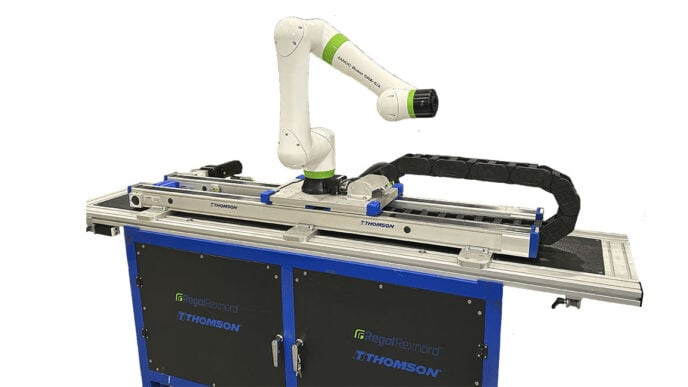
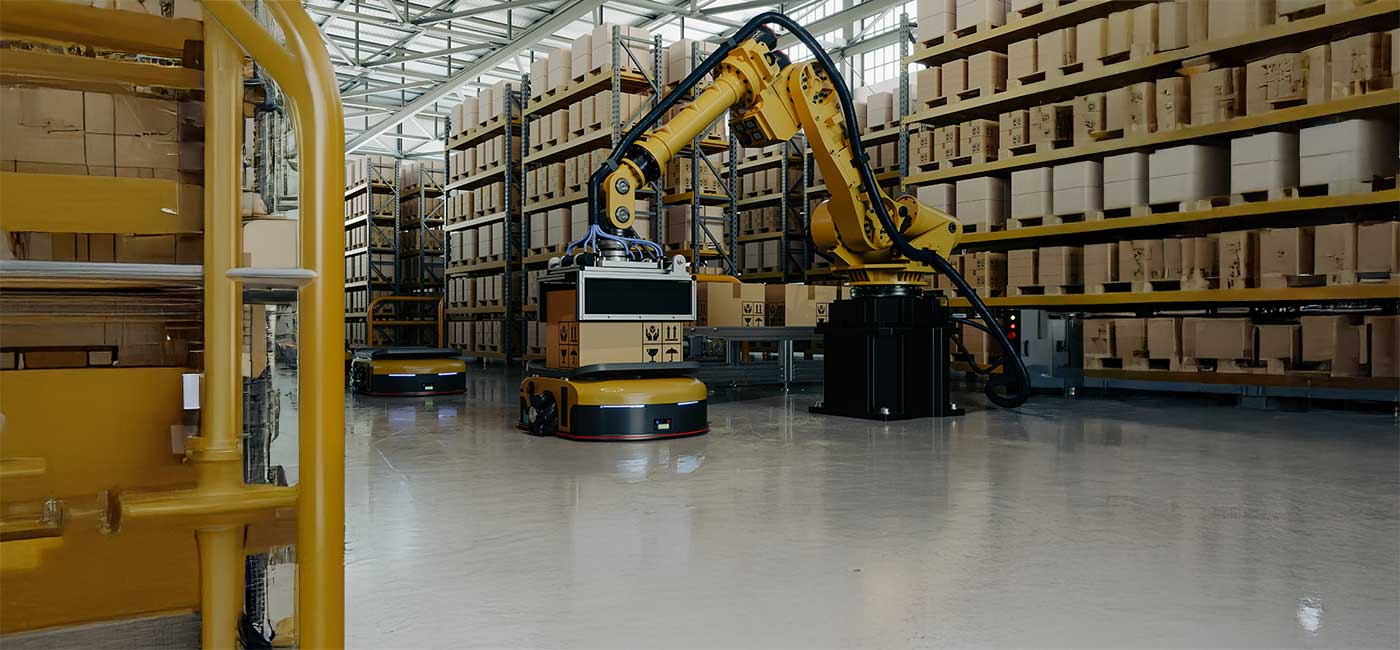
This is where collaborative robotics is finding some of its most compelling applications, both through collaborative industrial robot arms (cobots) and through autonomous mobile robots (AMRs) for material transport.
These two technologies are not addressing different needs. Instead, they are addressing different moments within the same process. Cobots handle the task itself; AMRs handle the flow. This distinction matters because it helps define the value of automation more precisely.
The real step change, however, comes when these two approaches are combined: when automation no longer supports just one isolated station, but helps make the entire production ecosystem smoother. This is the point at which logistics stops being just a cost item and becomes a competitive lever.
Instead of automating an individual workstation in isolation, manufacturers can begin to automate the flow of materials around it. That changes the question from “What task can we automate?” to “Where is the production process losing time?”
Start with the problem, not the robot
A successful logistics automation project should always begin with a process analysis rather than a technology selection.
Where do waiting times build up? Which internal transport missions are repetitive but not truly value-adding? Where is time lost between one stage and the next? Which activities absorb people without generating proportionate value? Where does product or layout variability make rigid automation ineffective?
In logistics and intralogistics, the best applications are often those that address relatively mundane problems: keeping material moving, replenishing workstations, reducing repetitive handling, improving ergonomics or making better use of existing factory space. That is particularly relevant to European manufacturing, where high product variety and evolving layouts can make rigid automation difficult to justify.
End-of-line operations are an obvious target. Palletising, de-palletising, packing, sorting and case handling contain repetitive and physically demanding tasks, while collaborative automation can accommodate changes in batch sizes and product formats.
The same principal applies to line feeding and assembly bay replenishment. If material does not arrive at the right place at the right time, the line slows down; operators wait, or they end up acting as material handlers.
AMRs can help stabilise these flows by taking on repetitive missions, and easing the burden of routine handling tasks. Their value is not necessarily that they replace a forklift, but that they make the movement of material more predictable.
The handling of full and empty pallets is another example. Individual movements may appear insignificant, but repeated pallet handling can create congestion and consume operator time. This is where the distinction between task automation and flow automation becomes important: automating a single operation can improve that operation, while automating the flow between operations can improve the wider production system.
Vibo: solving a logistics problem
The experience of Italian manufacturer Vibo case illustrates this approach.
The company, which supplies the furniture sector with production and sales operations in more than 70 countries, identified pallet handling in the assembly area as a bottleneck. Pallet movements were being carried out by electric forklifts, whose charging cycles left parts of the shift uncovered.
Rather than redesigning the production environment around a new automated system, the company introduced a MiR1200 Pallet Jack in 2025 to automate pallet transport. The system was selected because it could operate in an open environment, without fencing or major layout changes, while adapting to the variable flow of materials within the factory.
The result was not a technology showcase, but a targeted automation project aligned with how the factory actually operates – demonstrating that the real value of collaborative automation lies in practical integration, not automation for its own sake.
Connecting the pieces
The same principle applies to packing, order preparation, machine tending and end-of-line palletising. A cobot can load a machine, but components still need to arrive. A palletising robot can build a pallet, but that pallet still needs to move.
This is why the next stage of collaborative automation should be about integration rather than individual machines. The objective is not to automate everything, but to identify where manual intervention interrupts the flow and decide where automation can remove those interruptions most effectively.
For companies operating in high-mix, space-constrained or rapidly changing environments, this could become increasingly important. But the technology should remain secondary to the process.
The most successful projects will not necessarily be those with the fastest robot or highest payload. They will be those that identify where time, labour and space are being lost and apply automation to those specific problems.
In that sense, the real opportunity for collaborative robotics is not simply to automate tasks. It is to make the factory flow better.
That is where the next gains in industrial efficiency may be found – not on the production line itself, but in everything that has to happen between one operation and the next.
Author biography:
Birol Esmer is Director of Software Product & Applications, Mobile Industrial Robots