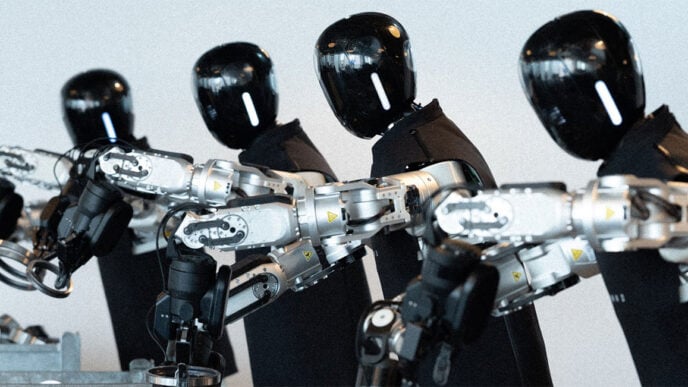


Researchers around the world are taking different approaches to one of robotics’ most stubborn problems: how to give machines a sense of touch.
The aim is to develop so-called electronic skin, or e-skin – networks of sensors and electronic materials designed to reproduce some of the sensory functions of biological skin.
Rather than simply making a robot react when something touches it, researchers want machines to be able to detect and interpret different physical stimuli, from pressure and temperature to proximity, texture and potentially even damage, just like human skin can.
But that’s where the engineering challenge comes in Human skin is an extraordinarily sophisticated sensing system. Millions of receptors continuously gather information about what is happening around the body, while the nervous system processes those signals to help us understand our surroundings and decide how to respond.
Electronic skin sensors
One recent approach comes from researchers at Hanyang University in South Korea, who claim to have developed a compact electronic skin sensor capable of detecting both contact and proximity while allowing its sensitivity to be adjusted.
In a paper made available online on 9 April 2026 and published in Nano Energy, Volume 153, on 15 June, the team, led by Associate Professor Jaekyun Kim of Hanyang University’s Department of Photonics and Nanoelectronics, reported developing a tiny electronic sensor that uses electrical charges created by touch to detect contact and how close something is, with an extra control that lets researchers adjust its sensitivity.
The device uses a layer of polydimethylsiloxane (PDMS) as its sensing surface, positioned above an indium-tin-zinc-oxide (ITZO) thin-film transistor.
When an object touches the PDMS surface, electrical charges are generated. As the object moves away, those charges create an electrical potential that changes the current flowing through the transistor.
That change allows the device to detect contact. It can also detect an object approaching the surface.
“Our vertical dual-gate architecture not only offers gate-tunable amplification of the triboelectronic responses, but also minimizes pixel footprint, enabling high-density, large-area integration,” said Kim.
Sensitivity adjustments through voltage changes
The researchers can also adjust the sensor’s sensitivity by changing the voltage applied to a second part of the transistor. Increasing the voltage makes the sensor more sensitive.
That could allow the sensor to be tuned for different applications, whether a robot needs to detect a light touch or firmer pressure.
The researchers also found that greater pressure produced a stronger response because it increased the area of contact with the sensing surface.
To test whether the architecture could be scaled, the team built a 10 × 10 transistor array. The researchers demonstrated pixel-level responses to finger touches and used a stainless-steel probe to detect objects at distances of up to 500 micrometres.
The device recorded response and recovery times of 127 milliseconds and 212 milliseconds respectively, and continued to operate without noticeable degradation after 1,000 cycles.
Robots, prosthetic devices and wearables
“Our research could contribute to the development of electronic skin systems that allow robots, prosthetic devices, and wearable electronics to perceive touch, pressure, and proximity more precisely,” Kin added. “This will lead to safer and more reliable human–machine interaction, with applications in healthcare robots, health monitoring and autonomous systems.”
The Hanyang research is part of a wider effort to solve different pieces of the same problem: how to make artificial skin sensitive enough to detect subtle changes, flexible enough to move with a robot and sophisticated enough to interpret what it senses.
In 2025, researchers from University College London and the University of Cambridge developed a flexible electronic skin in which the material itself acts as a sensor. The researchers used a conductive gelatine-based material capable of responding to different stimuli. The system was able to distinguish between different types of touch, including pressure and temperature, as well as detect damage from a sharp object.
Researchers at the University of Texas at Austin developed a stretchable e-skin in 2024 designed to maintain its pressure response as it stretches. The team demonstrated the technology on inflatable probes and grippers and is working towards applying it to a robotic arm.
Meanwhile, a project led by UCL and backed by a £1 million grant from the UK’s Advanced Research + Invention Agency is developing MagTecSkin, a stretchable electronic skin that uses magnetic technology to measure three-dimensional contact forces across multiple points. The project aims to create skin flexible enough to cover articulated and soft robotic surfaces while providing information about how and where a robot is being touched.