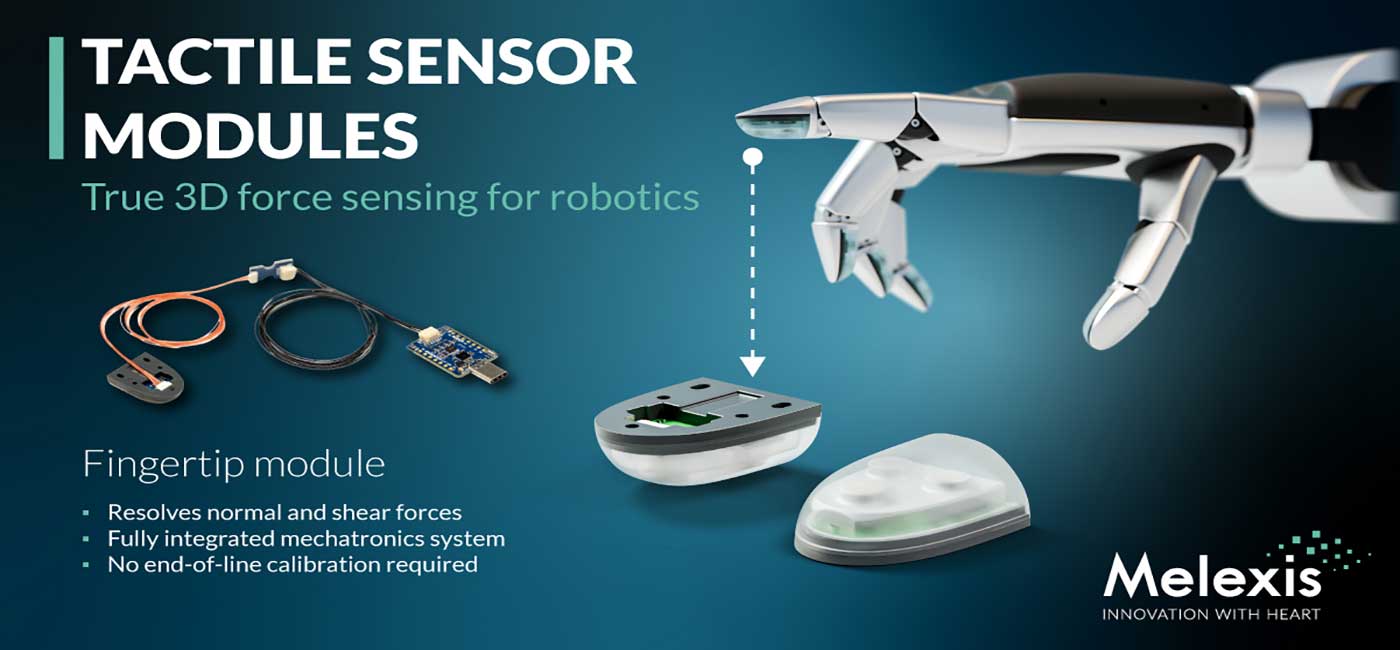

Melexis is taking its automotive sensing expertise into robotics with the launch of a magnetic tactile sensor designed to give robotic hands a more sophisticated sense of touch, addressing one of the engineering challenges holding back the development of more capable machines.
Unveiled at electronica 2026 in Munich, the sensor detects the force, direction and location of contact, allowing robotic fingers to adjust their grip and manipulate objects without relying entirely on visual feedback.
The launch reflects the Belgian semiconductor manufacturer’s broader ambition to expand beyond its traditional automotive market into robotics and industrial automation, where increasingly sophisticated machines are creating demand for more precise sensing and control.
For Julien Ghaye, Product Line Manager Robotics at Melexis, the priority is moving robotics beyond demonstrations of impressive movements towards machines capable of performing useful industrial – or even domestic – work.
“We see a lot of dancing robots. They dance a lot. It’s great, but then you see that it’s nice, and then you’re like, what’s next? This is not really what we want as an industry,” he said.
The more significant opportunity, he argued, lies in developing robots that can complement human workers, undertake dangerous or physically demanding tasks and maintain production when employees are unavailable.
That requires a step change in their ability to interact with physical objects. While robots have become increasingly capable of computationally intensive tasks, relatively simple human activities such as walking or picking up an object remain difficult to replicate.
Ghaye described this as a fundamental paradox in robotics: tasks that are straightforward for humans can be exceptionally challenging for machines.
A key part of the problem is touch. Robots typically use cameras and vision systems to identify objects and guide their movements, but vision alone cannot provide the detailed information needed to establish how firmly an object is being held or whether it is slipping.
Melexis’s new sensor is designed to provide that missing feedback. Based on magnetic sensing technology, it uses small magnets embedded in a compliant rubber-like material. When a robotic finger makes contact with an object, the material deforms, moving the magnets and changing the surrounding magnetic field. Magnetometers detect these changes, which are processed to produce information about the applied force and contact location.
The sensor can detect compression, lateral forces and the position of contact across the fingertip. Its initial force detection threshold is 20 grammes, with a localisation accuracy of approximately 3mm.
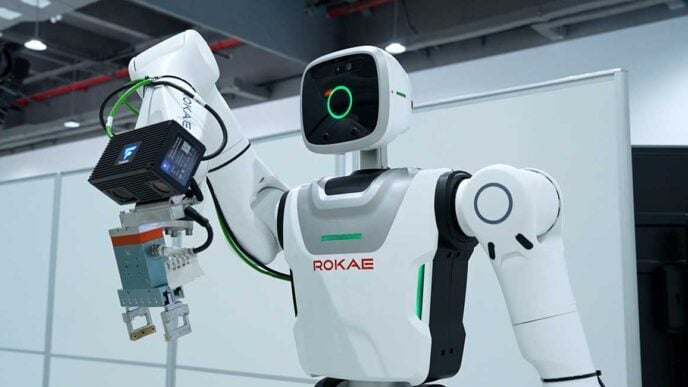
Ghaye demonstrated the technology using a robotic hand that could manipulate an object through tactile feedback alone, without a camera. The demonstration illustrated how the sensor could help a robot adjust its grip in response to the force being applied.
The technology is intended to complement rather than replace other sensing systems. A vision system identifies an object and helps position the hand, while tactile sensing provides feedback once contact is made. Combined with position sensors and control systems, this could allow robots to handle objects with different levels of force.
He said the new technology is particularly relevant for fragile items. A robot picking up an egg or fruit, for example, needs to apply sufficient pressure to maintain its grip without damaging the object.
Melexis’s first-generation sensor is designed to provide the underlying feedback, although Ghaye acknowledged that more refined force sensitivity will be needed as the technology develops.
“We’re down to 20 grammes of force pressure as a limit. This is the first release. Now we’re going to make this and bring it closer to zero,” he said.
The initial sample price is approximately €100 per module, with the expectation that costs will fall as production volumes increase.
Ghaye said the company was already in discussions with a number of major humanoid robot manufacturers, although he declined to disclose customers or sales figures. Melexis expects to move into mass production in 2027.
“The concept is simple. You all understood the concept,” he said. “Now the challenge is the integration. It is making making it work reliably, so that you can be sure that when we manufacture them next year, they’re all going to work the same. As soon as we have this subsystem – the hand that’s able to do something productive – then the industry will say, okay, that model works. Then we can scale the numbers.”