
Teradyne Robotics has partnered with German robotics AI company Sereact to expand the deployment of AI-powered automation in retail, logistics and manufacturing, targeting tasks that have traditionally been difficult to automate.
The partnership combines Sereact’s Cortex Physical AI platform with collaborative robot arms from Universal Robots, a Teradyne Robotics subsidiary, to handle variable goods and packaging without requiring task-specific retraining.
The companies said they had already shipped hundreds of Universal Robots arms in dual-arm configurations to customer sites across Europe, moving the technology beyond demonstrations and pilot projects.
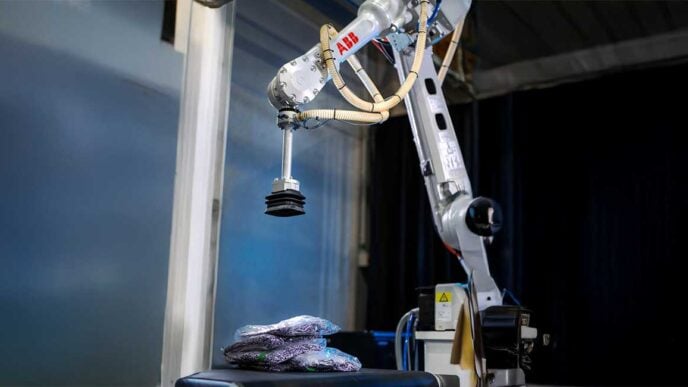
One application is the processing of returned fashion items, which can arrive in unpredictable combinations of shapes, orientations and packaging. Robots using Cortex are operating at fulfilment centres in Greven, Germany, and Świebodzin, Poland, in deployments involving logistics provider CEVA Logistics for fashion platform Zalando.
The installations form the first phase of a wider initiative to expand returns automation across Europe.
Returns processing presents a particular challenge for conventional automation because goods do not arrive in a consistent sequence or format. Sereact says its system can identify and handle varied items, helping to prepare returned products for resale.
The technology could also help retailers meet European Union requirements restricting the destruction or landfill disposal of unsold and returned goods, although the commercial and environmental benefits will depend on how effectively individual operations can be automated.
Sereact’s Cortex platform uses a vision-language-action model, which combines visual perception with language-based reasoning and robot actions. The company says a shared model can support applications including store replenishment, piece-picking, sortation, order induction, machine tending, kitting and packing, with knowledge gained by one robot benefiting other deployments.
Dr Ralf Gulde, Sereact’s Chief Executive and Co-Founder, said the approach allowed multiple applications to run on the same production model, reducing the need to retrain systems for individual items or tasks.
For Teradyne Robotics, the agreement provides a route to broaden the applications supported by its collaborative robots through partnerships with AI developers and systems integrators.
Jacob Pascual Pape, Chief Commercial Officer of Teradyne Robotics, said the combined technology could handle mixed goods, unfamiliar items and varied packaging in live operations.