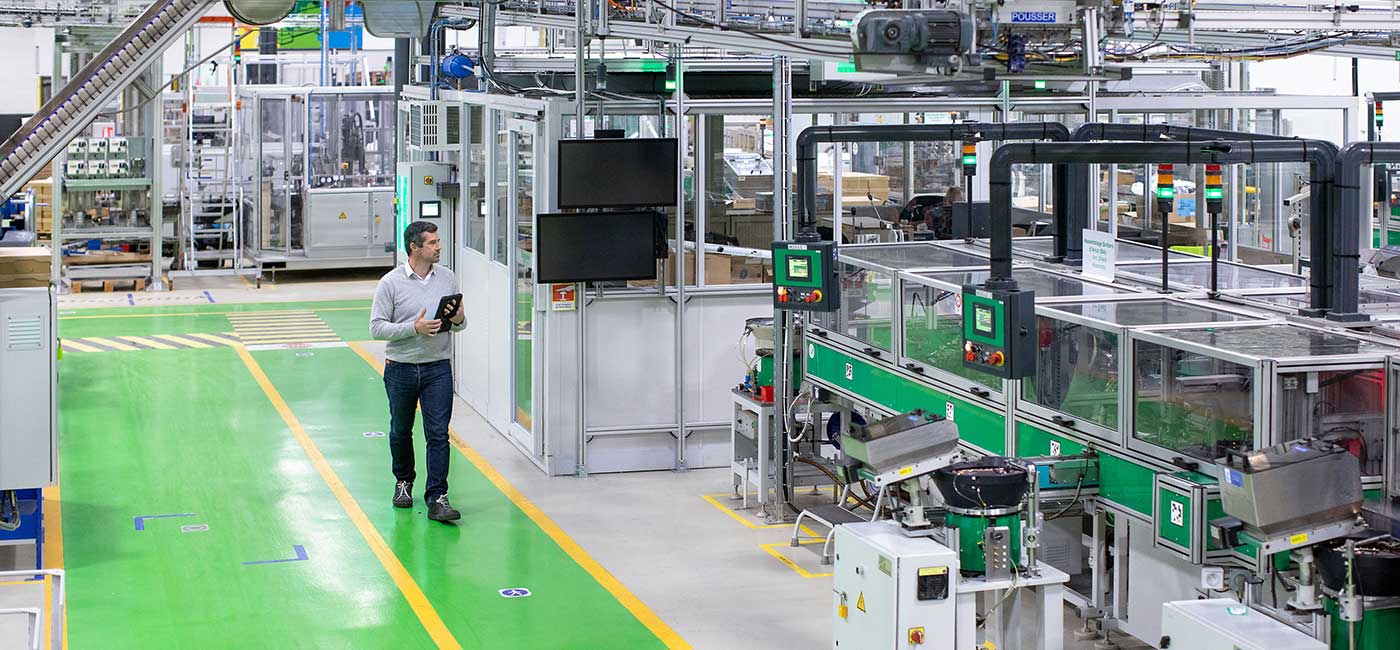

On an industrial estate in Le Vaudreuil, a small town in Normandy in northern France, a decades-old factory is being recast as something else entirely: a working prototype for how Europe might rebuild its industrial base.
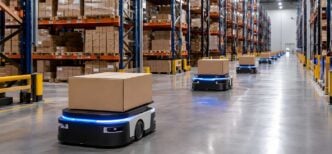
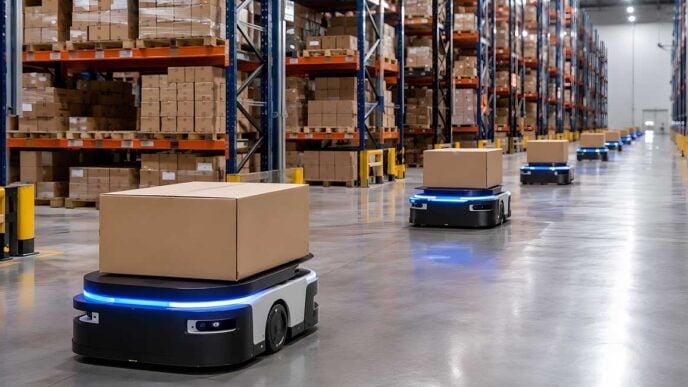
Inside the Schneider Electric site, automated guided vehicles (charmingly named Paul and Emile) glide past 40 year-old machines as they travel between production areas. And sensors track energy use, equipment performance, and
production flow in real time.
AI models are used to predict the exact sodium level of individual components after industrial washing processes, speeding up production and reducing unnecessary water waste.
Some 25 smart CCTV cameras are used to check for defects, verifying 17 specific criteria in less than three seconds.Workers coordinate logistics, schedule maintenance, and feed operational data into a continuous loop of adjustment on the
factory floor using digital interfaces connected to the company’s software platforms.
None of this is unusual in itself. Most of the tech on display in the facility which manufactures electrical contactors and contacts, has been available for more than a decade. What sets Le Vaudreuil apart is that although the site itself is half a century old, Schneider has managed to stitch together layers of automation from various different decades into a single AI-driven operational fabric, where production, energy management, and maintenance are increasingly informed by the same stream of data.
And that is the message that Schneider is hoping to get out; that with some clever automation, Europe’s legacy industrial sites can compete with newer and bigger rivals in China and North America.
Marc Fromager, Senior Vice President Commercial and Segment Industrial Automation at Schneider Electric France, has seen the transformation from its earliest stages. He began his career at the site in 1994 as an apprentice working on early automation systems that would eventually underpin its reinvention.
“The entire French industrial fabric has become aware that digitalisation is a major challenge,” he says. “Manufacturers have no choice but to digitise in order to innovate constantly, to ensure productivity, and to remain competitive internationally.”
Today, Fromager works with manufacturers globally, using Le Vaudreuil as proof that digitalisation only delivers real impact when it is embedded across an entire system, not layered on in fragments.
The key challenge, Schneider argues, is not necessarily spending millions on the latest AI driven machinery but rather connecting all of the legacy gear using the right software – and then filling in any gaps.
Of course, the company is keen to show off its own supervision platforms; EcoStruxure and Aveva, which it describes as a form of ‘software defined automation’ – enabling hardware from a variety of different vendors to be coordinated through a central system and to capture their data.
In Le Vaudreuil, this means that ultimately Schneider plans to be able to combine operations data with real time electricity price data, enabling non-critical parts of the plant to consumer more and produce more when prices are low and to slow down when power prices increase.
Beyond technology showcases
The Le Vaudreuil site is part of the World Economic Forum’s “Lighthouse” network, a group of manufacturing facilities recognised for applying advanced technologies at industrial scale.
Launched in 2018, the initiative focuses not on isolated automation projects, but on facilities where digital systems are integrated across day-to day operations. According to the WEF, many manufacturers struggle to move beyond pilot projects because of fragmented legacy systems, disconnected data, cybersecurity demands, and the difficulty of upgrading live production environments.
“Many manufacturers have the ambition to transform but lack a coherent path to do it consistently and at scale,” says Federico Torti, Head of Technology and Innovation at the World Economic Forum. “The Lighthouse OS addresses that directly; it takes what the world’s best factories have learned through years of real operational experience and turns it into a practical framework any manufacturer can apply. This is about making Lighthouse-level performance a realistic target for the whole industry, not just its most advanced players.”
A factory evolving in stages
Like the other 200-odd WEF lighthouse factories, Le Vaudreuil provides an example to others. Rather than rebuilding the site from scratch, Schneider Electric has spent the past several years layering digital systems onto existing infrastructure.
And what’s more, the company reports major gains from the transformation. Since 2018, it says energy consumption has fallen by 36%, waste by 27%, and CO2 emissions by 81%.
Industrial policy meets operational reality
Across Europe, this kind of transformation is no longer just an operational issue – it has become a matter of industrial policy. Governments are pushing reindustrialisation in response to fragile supply chains exposed by the pandemic, rising energy costs, and geopolitical instability. At the same time, climate targets are forcing heavy industry tomdecarbonise while staying globally competitive.
As a result, investment is increasingly focussed, not on building entirely new, but on modernising existing facilities. These “brownfield” upgrades are often cheaper than greenfield builds, but they come with a different challenge: complexity. Every improvement has to work within existing systems that were never designed for full digital integration. Research from Capgemini suggests that around 60% of European and US manufacturers pursuing reindustrialisation are focusing on modernising current facilities rather than constructing new plants.
“Reindustrialisation is increasingly being driven by a combination of geopolitical pressure, climate targets, and supply chain resilient concerns,” says Pierre Bagnon, Executive Vice President and Global Head of Intelligent Industry Accelerator at Capgemini.
What the future factory may look like
Fromager points out that human operators remain central to production. What changes is the layer beneath them: a dense network of digital systems that increasingly coordinates logistics, maintenance, energy use, and production planning in real time.
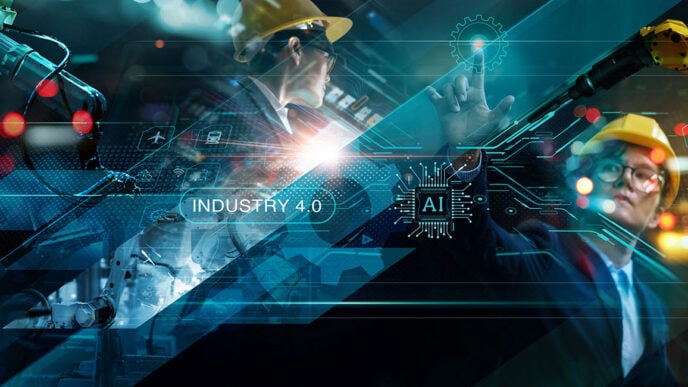
“It is above all about digital technology at the service of productivity through the capture and exploitation of data,” he says. “It is important to understand that Industry 4.0 is not only about the automation of processes.”
This article originally appeared in the June issue of Automation News.