
Norway’s dramatic comeback victory over Brazil on Sunday night delivered all the ingredients of a classic World Cup encounter: a goal behind, a fightback against one of football’s most celebrated nations, and a late surge that turned the match on its head. But amid the spectacle on the pitch, the game also marked another milestone in the tournament’s long history: the first humanoid robot to appear in a live FIFA World Cup match environment.
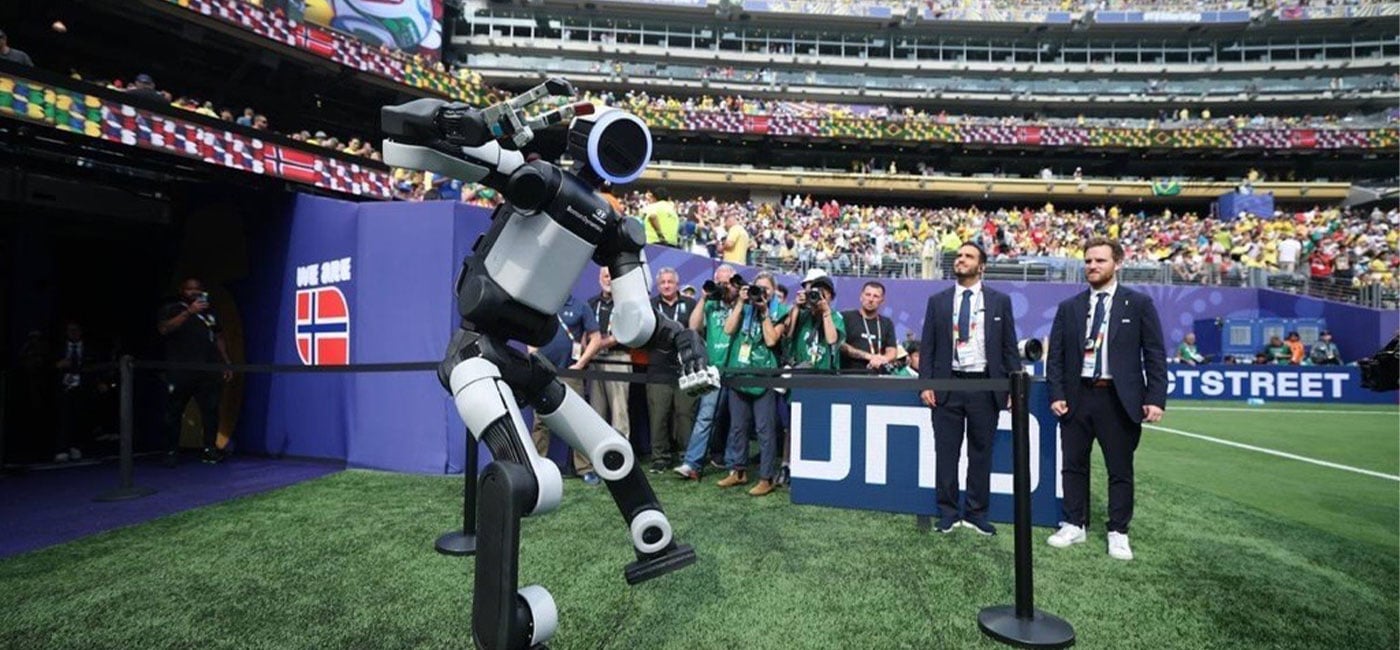
During the halftime break, Boston Dynamics’ Atlas humanoid robot took to the field, performing a series of football-inspired movements before delivering the ceremonial match ball to the referee. To the delight of Norway fans, at the time hoping against hope for an equaliser, its moves included imitating Erling Haaland’s meditation goal pose.
The robot also showcased a number of soccer tricks, performing its own version of the ‘rabona,’ a complex move, popularised by soccer legend Pele, where the kicking leg is crossed behind the back of the standing leg. The rabona is one of football’s most difficult skills: a player must disguise their intention, shift their weight, cross one leg behind the other and strike the ball while maintaining balance.
The football trick is only the beginning
For Boston Dynamics, the Hyundai owned company which built and trained Atlas, teaching a robot to perform what it called the ‘Ghost Rabona’ — combining a fake-out step-over with a crossed-leg rabona kick – demonstrates how robots can move beyond traditional programming towards a future where machines learn from human examples and develop the flexibility needed to operate in real-world environments.
“We wanted to bring that energy into our lab and see if football can teach a robot how to move,” says Roberto Shu, senior staff research engineer at Boston Dynamics, who produced a blog detailing his experiences teaching Atlas to play.
The challenge was not simply teaching Atlas a sequence of movements. Football may appear simple to humans, but for a robot it represents a complex combination of skills. A player must constantly maintain balance while running, judge the movement of a ball, adjust their position and apply the correct amount of force at exactly the right moment. For Atlas, even a single kick requires coordination across the entire robot. It must move towards the ball, maintain stability on one leg, generate enough power to strike the ball, and recover without falling.
The Ghost Rabona pushes these requirements even further. Atlas must first perform a convincing fake movement, rapidly change direction, leave the ground, land safely and complete the kick while maintaining control.
Teaching a robot the physics of movement
The result is a visually impressive display of robotic agility. However, the significance goes beyond a robot learning a football trick. The technologies used to train Atlas — including motion capture, motion retargeting, reinforcement learning and simulation — are the same foundations being explored for the next generation of industrial robots.
“We see human athletes perform amazing acts of physicality every day. That’s a bar that we want to achieve for our robots as well,” Shu says.
The challenge reflects a wider issue in robotics. Traditional industrial robots are highly capable within controlled environments, carrying out precise and repetitive tasks such as welding, painting or assembly. However, they are generally designed around a specific task and a fixed workspace. Humanoid robots are being developed to tackle a different problem: how to create machines that can operate in environments built for humans.
According to Shu, rather than programming every individual movement, Boston Dynamics used human demonstrations as the starting point for Atlas’ football training.
The team captured the movements of a professional football player using an optical motion capture system, recording the detailed movement of the human body during actions including kicks and passes.
Shu also participated in the process, wearing a motion capture suit to record some of the basic drills and movements that Atlas would later learn.
This approach represents a shift in how robots are programmed: instead of engineers manually defining every movement, robots can begin learning from examples.
“Human demonstration simplifies robot programming, turning what used to be a complex coding process into an intuitive task,” Shu says.
For industrial automation, the implications could be significant. One of the biggest barriers to deploying robots in new applications is the time and expertise required to programme them. A robot capable of learning from demonstrations could be trained for new tasks more quickly, opening up applications including component handling, inspection and physically demanding support tasks.
Beyond traditional programming
However, copying human movement is not as simple as transferring instructions from one body to another.
Although Atlas has a humanoid design, its joint ranges, weight distribution and mechanical limitations differ from a human body, meaning it cannot simply copy an athlete’s movements.
Instead, Boston Dynamics uses a process called ‘motion retargeting.’ This allows human movements to be translated into actions that are achievable for Atlas while preserving the intent and style of the original movement.
“The difficulty lies in adapting these movements to Atlas’ kinematics, as there isn’t a direct correspondence between human and robot morphology,” Shu says.
This challenge is central to the development of general-purpose humanoid robots. A machine working in a factory environment will need to adapt to different tasks and physical conditions rather than following a single predetermined sequence.
After capturing and adapting human movements, Atlas then learns how to execute them through reinforcement learning.
Rather than relying solely on programmed instructions, Atlas improves through reinforcement learning. The process takes place largely in simulation, where thousands of virtual versions of the robot can practise simultaneously without risking damage to hardware.
“The robot still has to figure out the physics of how to move its body,” Shu says. “It’s not just the motion, but it’s actually the actuation, how it controls the motors in order to balance and imitate the motion performed by the human.”
What does it mean for industrial automation?
Running thousands of simulations in parallel allows Atlas to gain experience far faster than physical testing would allow. “It’s similar to how humans learn through trial and error, except the robot gets to try things much faster than a human could: the equivalent of a full year’s worth of physical trial and error in the span of just 24 hours,” Shu says.
This ability to train robots virtually is becoming increasingly important for industrial automation, where companies need to reduce deployment times and minimise disruption to operations.
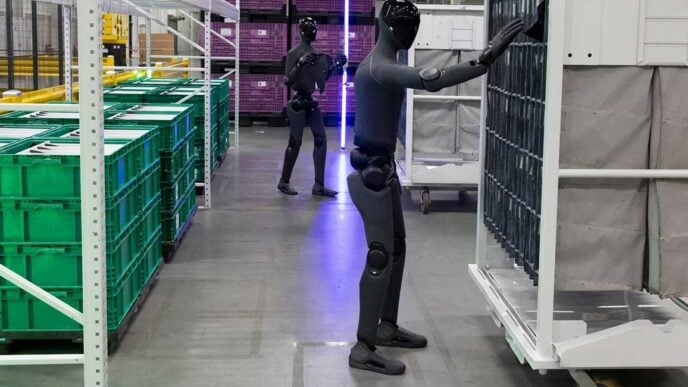
While Atlas’ football skills may appear far removed from manufacturing, Boston Dynamics argues that the underlying capabilities are closely connected. A factory robot may not need to score a goal, but it may need to navigate a workspace, manipulate objects and respond to changing conditions — tasks that require the same combination of movement and adaptability.
“Many of the same tools we use to train the robot for football transfer to training the robot to do a job in a warehouse or in a factory,” Shu says.