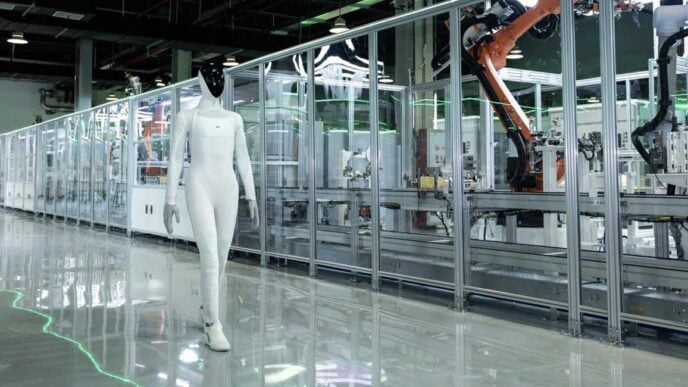

Aetina has launched two Edge AI systems designed to combine multimodal AI inference, high-resolution sensor processing and deterministic motion control for collaborative and humanoid robots.
The AIE-KT78 and AIE-KT68 use NVIDIA Jetson Thor modules to run large language models (LLMs), vision-language models (VLMs) and Vision-Language-Action (VLA) models locally. Aetina said the approach is intended to reduce reliance on cloud processing where robots need to interpret sensor data and make decisions close to the machine.
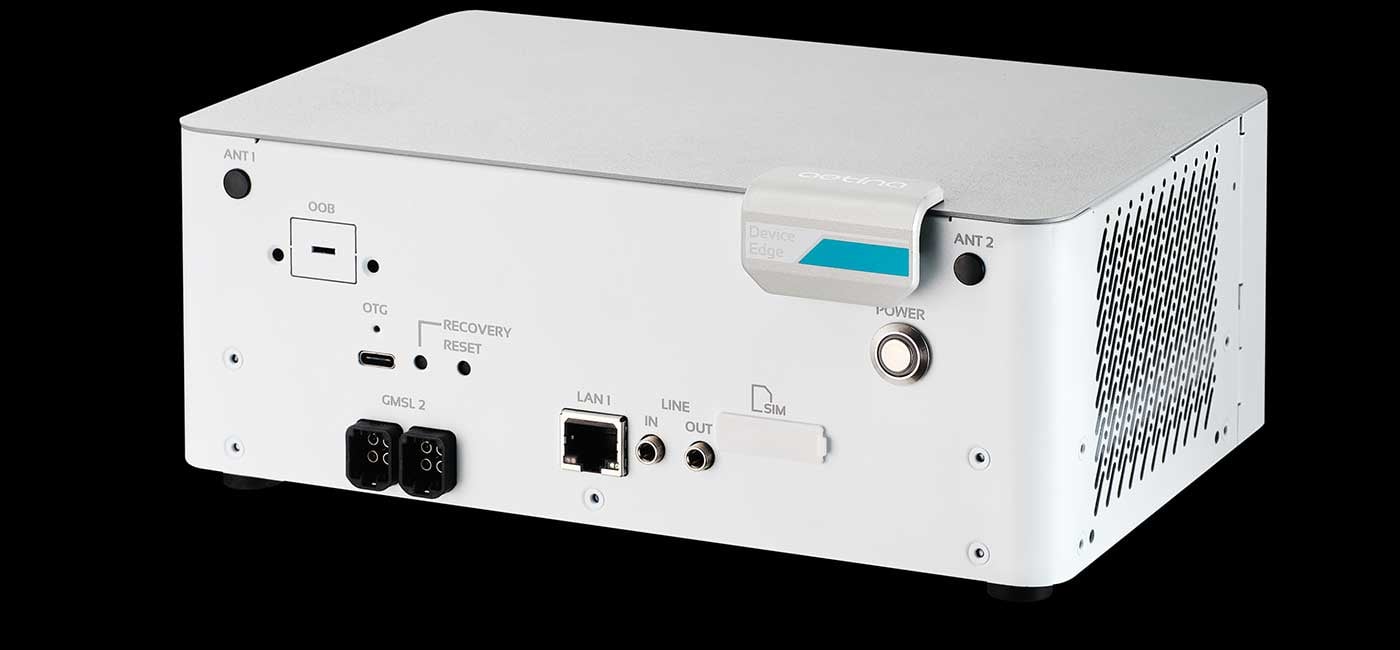
The systems combine AI compute with interfaces for cameras and other sensors, including 3D LiDAR, radar, depth cameras and IMUs. They support up to eight GMSL2 camera inputs, alongside QSFP28 connectivity providing up to four 25Gbps links, depending on configuration, and dual 10GbE ports.
A dedicated 1GbE EtherCAT port operates as an independent EtherCAT Master, allowing the systems to connect AI processing with motors, joints, sensors and actuators. Aetina said the interface provides microsecond-level synchronisation between AI inference and industrial control.
The architecture is designed to bring perception, decision-making and physical control into a single edge platform, potentially reducing the need for separate compute and control hardware in robotic systems.
The higher-performance AIE-KT78 uses NVIDIA’s Jetson T5000 module with 128GB of LPDDR5X memory and delivers up to 2,070 FP4 TFLOPS of AI performance. The AIE-KT68 uses the Jetson T4000 with 64GB of memory and delivers up to 1,200 FP4 TFLOPS.
Both systems operate from a 9–48V DC supply and are rated for operation between -25°C and +55°C. They include USB 3.2, isolated digital I/O and M.2 expansion slots, and run Linux with NVIDIA software including JetPack, CUDA, TensorRT, DeepStream, Holoscan and Isaac ROS.
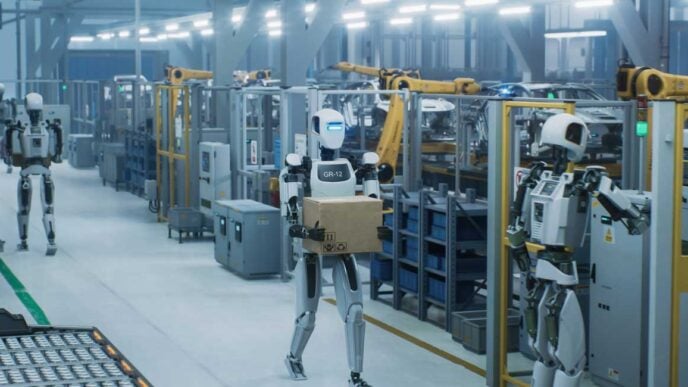
Aetina is positioning the systems for collaborative robots, humanoid robots, industrial robotic arms and autonomous machines. The company said both systems are available to ship now.