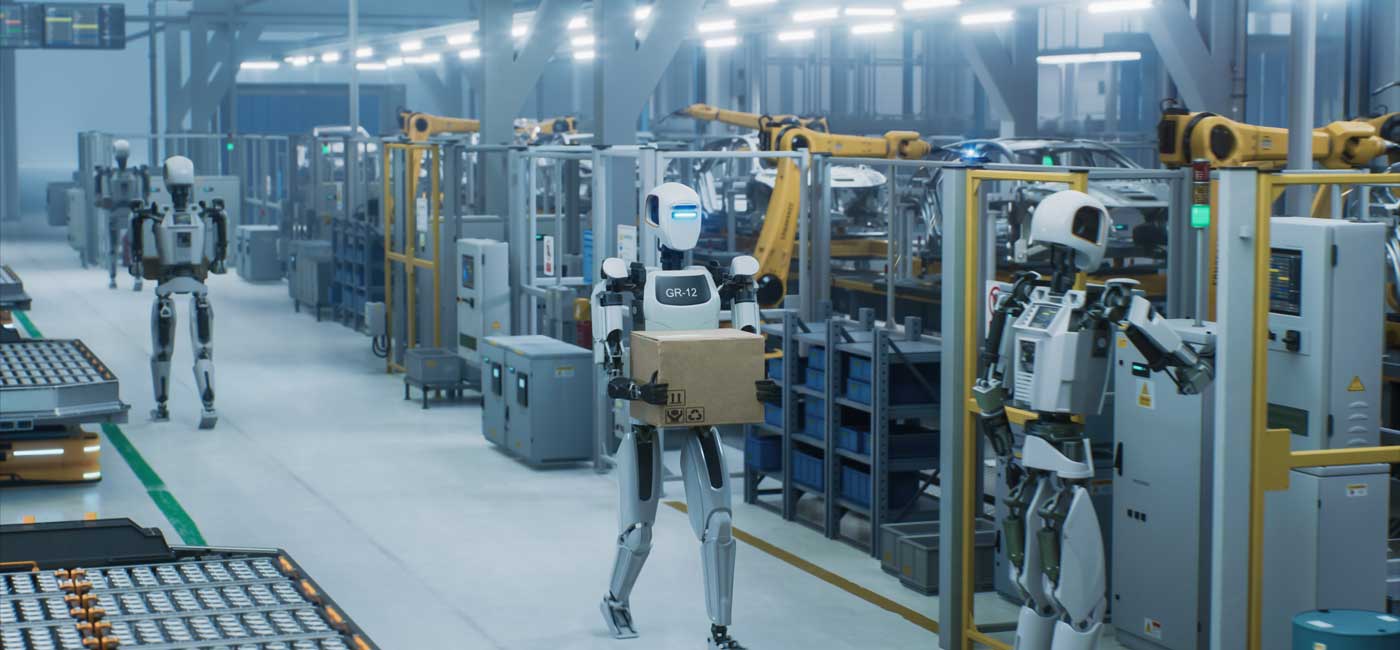

The rapid expansion of humanoid robot production is creating a new source of demand for collaborative robot (cobot) arms and actuators, with humanoid manufacturers increasingly turning to established robotics suppliers as they scale production.
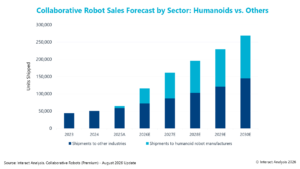
Global humanoid robot production exceeded 20,000 units in 2025 and is expected to more than triple this year, according to research from Interact Analysis. At the same time, the research company forecasts that cobot shipments to humanoid manufacturers will rise from about 5,000 units in 2025 to more than 43,000 in 2026.
That would mean humanoid applications account for about 37% of total cobot shipments this year, based on announced orders from major suppliers. The wider cobot market is forecast to grow by 22.7% year on year in 2026.
The figures point to a significant shift in the role cobot technology could play in the emerging humanoid market. While some humanoid manufacturers are developing their own hardware, others are increasingly sourcing components or complete robot arms from established suppliers.
Humanoid manufacturers tend to follow one of three broad approaches: developing most of the robot hardware internally, buying components such as actuators and assembling the robot themselves, or purchasing complete robot arms from established suppliers. In practice, companies often combine these strategies, choosing whether to manufacture or source individual components according to cost, technical requirements and production volumes.
Cobot technology is particularly suited to the application because many of the capabilities required by humanoids – including precise motion, force control and human-robot interaction – are already established in collaborative robotics.
Existing cobot arms can also be adapted for humanoid applications, although modifications may be required to reduce weight and dimensions, add degrees of freedom and enable coordinated control of two arms.
The requirements are nevertheless pushing suppliers towards hardware specifically designed for humanoids.
Dedicated humanoid arms typically use seven axes rather than the six found on conventional cobots, providing additional flexibility. Some also use cross-coupled wrist designs to reduce the distance between the mounting flange and wrist centre, allowing the arm to work in tighter spaces without moving the entire robot.
Force sensing is another important consideration. Humanoid robots are expected to interact with their surroundings and adapt their movements in real time, increasing demand for torque sensing and sophisticated force-control systems at the joint level.
Weight is equally important. Most humanoid arms currently have payload capacities of between 3kg and 10kg, while relatively few reach 15kg to 20kg. Maintaining a high payload-to-weight ratio is critical because the weight of the arms affects both the overall size of the robot and its energy consumption.
These additional requirements can also make humanoid-specific arms more expensive than conventional cobots from the same supplier.
China is currently at the centre of this emerging supply chain. The country accounts for a large share of humanoid production and its robotics manufacturers have been able to respond quickly to demand with customised hardware at relatively low prices.
Tianji, part of Gento Robotics, reported shipments of more than 2,000 humanoid robot arms in 2025 and had 10,000 units on order by the first quarter of 2026, according to Interact Analysis.
Other established Chinese robot manufacturers, including Rokae, Fairino and Huayan Robotics, are also expanding into the humanoid arm market. Rokae has increased shipments since introducing dedicated products and working with humanoid manufacturer AgiBot, while Fairino is introducing new models aimed at humanoid applications.
Interact Analysis expects this market to expand beyond China’s current dominance as humanoid production develops in other regions and manufacturers seek to diversify their supply chains.
By 2030, cobot vendors are forecast to ship about 124,000 robot arms for humanoid applications. That would put the segment close to the combined number of cobot arms shipped into all other sectors.