
France-based Dracula Technologies is seeking to expand beyond its core energy-harvesting business by applying its organic electronics expertise to OLED displays and next-generation flexible electronic devices, as manufacturers look for more sustainable alternatives to conventional production methods.
The company, known for its LAYER organic photovoltaic (OPV) technology that harvests ambient light to power low-energy IoT devices without batteries, said it is exploring opportunities in OLED displays and broader organic electronics applications, while seeking strategic partners to commercialise its patented technologies.
The move comes as interest grows in multifunctional electronic surfaces capable of combining energy harvesting, sensing, and light emission within a single flexible platform. Industry efforts to integrate OPV, OLED, and organic semiconductor technologies are increasing demand for scalable manufacturing processes that reduce material waste and environmental impact.
Dracula Technologies says its experience in additive manufacturing and organic materials positions it to address some of the key challenges facing the sector.
“Our expertise in organic materials and sustainable manufacturing processes positions us at the forefront of this transformation,” said Brice Cruchon, Chief Executive of Dracula Technologies. “We are eager to unlock new possibilities across multiple industries.”
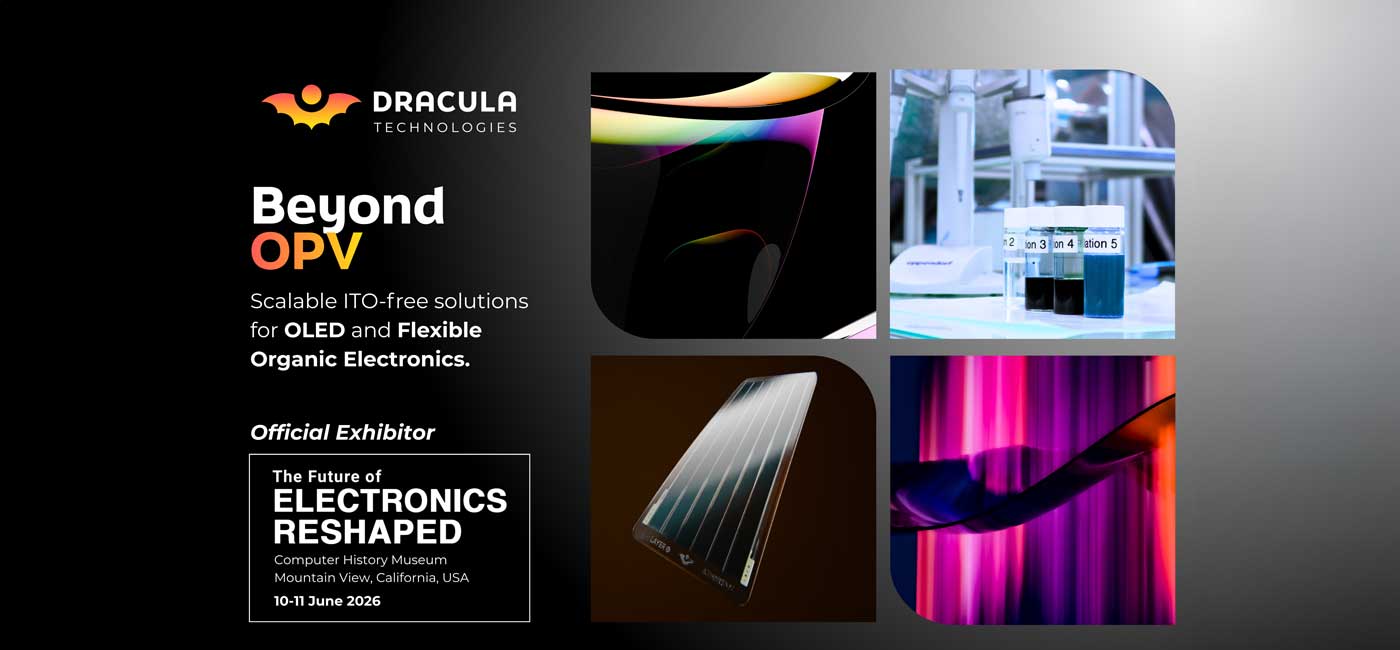
At the centre of the company’s strategy is its work to eliminate indium tin oxide (ITO), a widely used transparent conductive material in OLED displays. ITO has long been considered a bottleneck for flexible electronics due to its cost, brittleness, and reliance on vacuum-based manufacturing processes.
Dracula Technologies is developing a fully printable, ITO-free electrode formulation that can be deposited under ambient conditions and integrated onto flexible substrates including polyethylene terephthalate (PET) and polyethylene naphthalate (PEN). The company says the technology offers strong conductivity and mechanical flexibility while removing the need for vacuum manufacturing steps.
If successfully commercialised, the approach could support the development of foldable displays, wearable technologies, medical sensors, and other emerging organic electronic applications where lightweight, flexible components are increasingly required.
The company is leveraging capabilities developed through its LAYER platform, which uses patented digital printing processes to manufacture ultra-thin OPV modules designed for indoor energy harvesting. Its products are aimed primarily at battery-free IoT deployments across smart buildings, asset tracking, and connected devices.
Dracula Technologies recently expanded production capacity through its Green Micropower Factory in Valence, which the company describes as the world’s largest fully automated facility dedicated to printed OPV manufacturing, capable of producing up to 150 million cm² of printed devices annually.