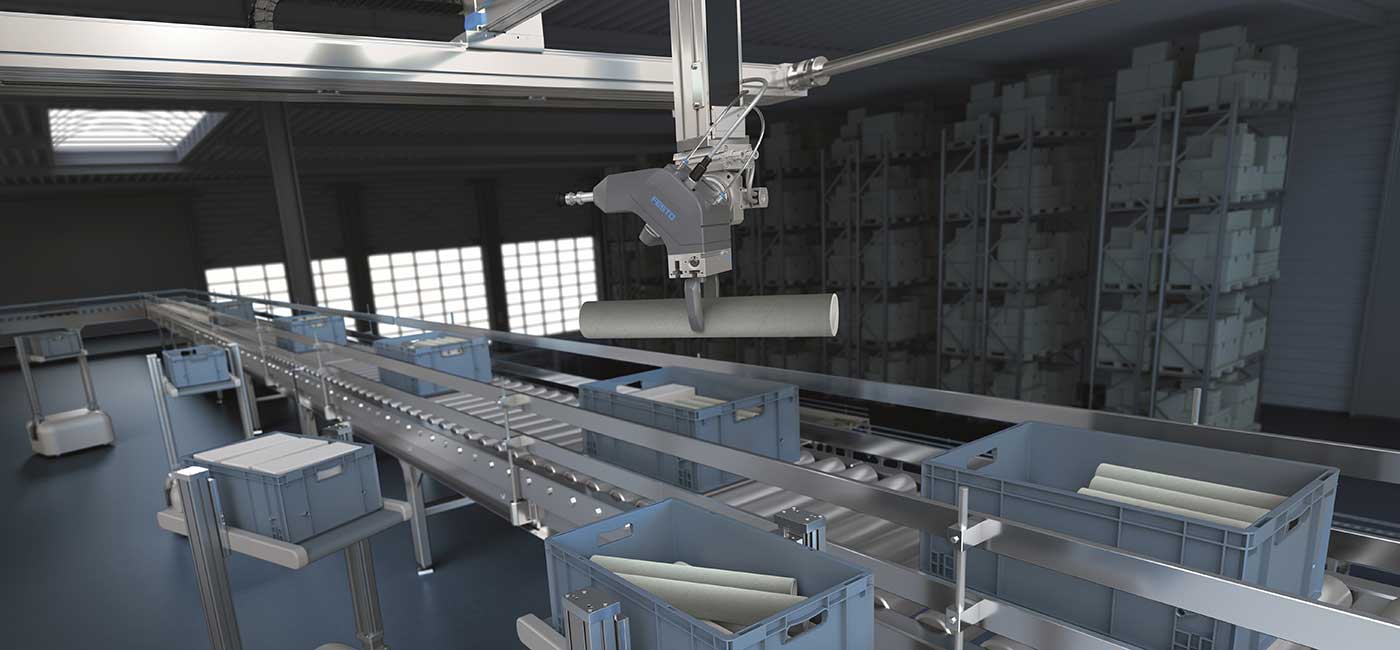

Festo has launched a new AI-based software platform designed to enable industrial robots to identify, grasp and handle unfamiliar products without requiring extensive programming or pre-loaded templates.
The system, called GripperAI, uses 3D vision and AI algorithms to determine optimal gripping points for randomly positioned objects and can automatically select the most suitable end-of-arm tool from those available within a robotic cell.
The launch reflects growing demand from manufacturers and logistics operators for more flexible automation systems capable of handling increasingly diverse product ranges without lengthy reconfiguration.
Traditional robotic picking applications often require engineers to programme gripping positions for individual products or product families. This can limit flexibility in operations where product mixes change frequently, such as e-commerce fulfilment, packaging and high-mix manufacturing environments.
According to Festo, GripperAI enables robots to work with products they have not previously encountered, allowing handling systems to adapt automatically as new stock keeping units (SKUs) are introduced.
The software supports both vacuum and mechanical grippers and can operate across multiple gripping technologies within the same application. It runs on a standard industrial PC connected to a 3D camera and communicates directly with the robot’s motion control system.
If an attempted pick is unsuccessful, the software recalculates the gripping strategy and retries the operation without requiring operator intervention.
Festo said the platform has been designed to work with a wide range of industrial robots, collaborative robots and Cartesian handling systems. The company also highlighted its compatibility with different camera technologies, allowing users to select vision hardware based on application requirements rather than being tied to a specific supplier ecosystem.
Peter Potters, Product Manager for End-of-Arm Tooling at Festo, said manufacturers increasingly require automation systems that can respond to changing production demands without adding engineering complexity.
“By reducing the programming effort traditionally associated with flexible robotic handling, GripperAI enables manufacturers to deploy automation more quickly, respond more easily to changing production demands and make better use of their existing equipment investments,” he said.
The launch comes as AI-driven machine vision and robotic manipulation technologies attract growing attention across manufacturing and logistics sectors. Advances in computing power, sensor technology and machine learning have enabled robots to tackle handling tasks that were previously difficult to automate using conventional rule-based programming approaches.
Festo said the technology has already been deployed in logistics applications where robots are required to identify, grip and package thousands of different products.
The company said GripperAI forms part of its wider strategy to expand the use of practical AI applications within industrial automation, helping manufacturers improve flexibility while reducing deployment complexity.