
In aerospace and defence, failure is not an option. Lives, missions, and national security sit on the line with every subsystem that makes it onto a platform. That reality has long shaped a deliberate approach to development, but compressed timelines, rising production volumes, and the complexity of modern missions are changing how OEMs think about sourcing critical hardware.
Nowhere is that clearer than in the actuation systems that control motion on everything from missile fins to ground vehicles.
Across the sector, defence OEMs are moving away from piecing together subsystems from a wide cast of component suppliers. Instead, they are increasingly working with partners that can deliver complete, co-engineered electro-mechanical solutions – and manufacture the components inside them. For Regal Rexnord Aerospace Solutions, this plays directly to capabilities built up across more than a century of supplying the defence market.
A focus on fin control actuation
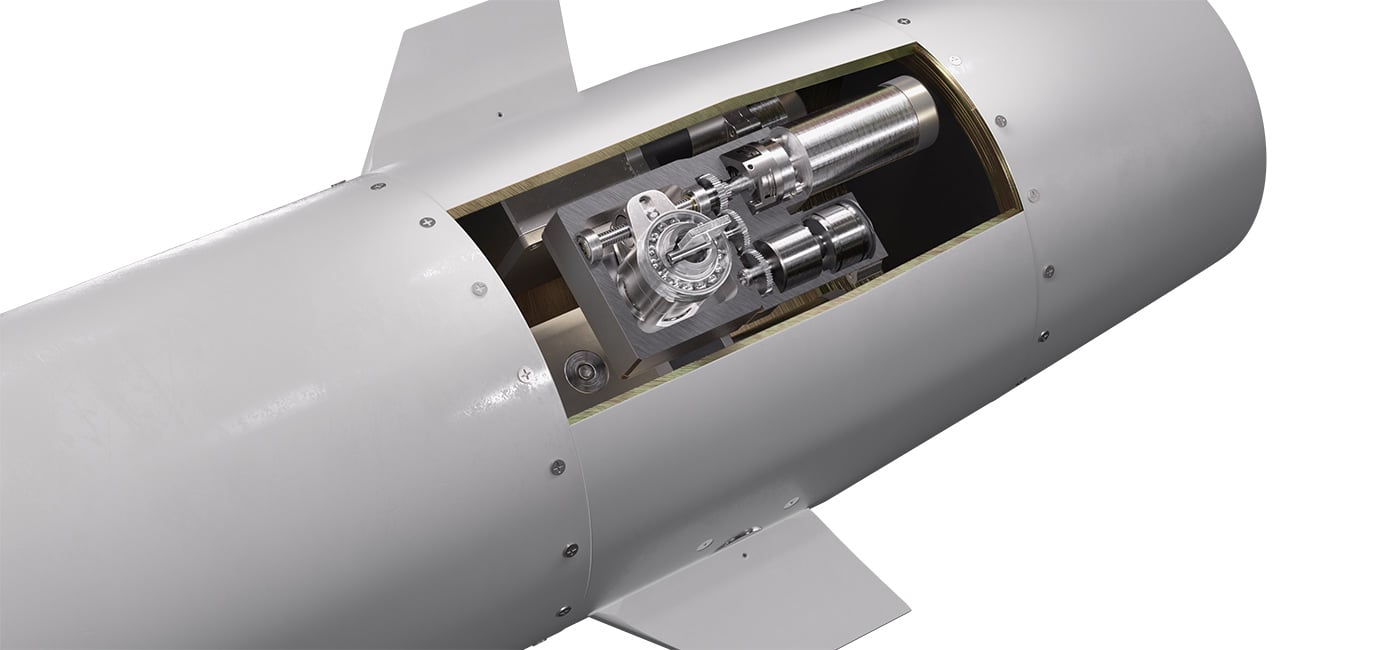
One of the most visible places this change is playing out is in fin control actuation systems (Fin CAS) – the electro-mechanical assemblies that steer guided missiles.
A Fin CAS is a critical component of a missile’s flight control. Drawing on inputs from inertial navigation, GPS, or laser guidance, a central navigation computer calculates the fin position needed to reach the target, and the actuator moves the fin accordingly.
While this doesn’t seem an especially complex task, the engineering demands are unforgiving. A Fin CAS must deliver high power density in a tight form factor, respond to control signals with minimal latency, hold positional accuracy under dynamic loading, and operate reliably across vibration, shock, salt spray, and conditions that swing from sea level to 40,000 feet and back in a single flight.
At the component level, a Fin CAS may bring together an electric motor, gear train, ball screw, brake, and feedback devices such as resolvers or encoders. Each is a mature technology that defence OEMs have long sourced individually and integrated in-house. The problem is that optimising each in isolation rarely produces the best overall system: torque density, thermal performance, efficiency, and mechanical tolerances trade against each other, and those trade-offs can only be made properly when the components are designed together.
“With a vertically integrated approach, you can understand how this motor interacts with this resolver, or what gear ratio is required with a specific motor, and how the whole system operates as one,” explains Julian Del Campo, Director of Business Development at Regal Rexnord at Regal Rexnord. “That is where the real optimisation comes from – not from separate conversations with three different suppliers.”
Vertical integration as the differentiator
Plenty of suppliers will sell a complete Fin CAS assembly. What is less common is a supplier that also designs and manufactures every major component inside it – and that is what Regal Rexnord points to as its differentiator.
Across its group of specialist motion control brands, Portescap and Kollmorgen supply the motors, Nook provides the ball and lead screws, and Rexnord Aerospace contributes gearing and mechanical components. Add linear motion systems from Thomson, clutches from Formsprag, Delevan resolvers, and other technologies from the wider portfolio, and the full hardware stack for a Fin CAS can be built under one roof.
“A lot of companies can supply a complete assembly, but most are buying the critical components from someone else,” says Del Campo. “Manufacturing and vertically integrating those components in-house is what lets us actually optimise the design and give the customer confidence in the supply chain behind it.”
The benefits of this are already becoming apparent.
Recently, a UK-based defence customer researching components for a next-generation Fin CAS, noticed the same Regal Rexnord parent brand appearing on website after website as they searched for motors, ball screws, and related parts. That recognition eventually prompted a direct approach – the customer was, in effect, reassembling the portfolio before realising it could come from one place.
An application-first approach
Alongside vertical integration, a second shift is underway in how these systems are designed. Engineers first define requirements at the system level – mission, environment, performance targets – then are increasingly pulling proven technologies from existing solutions.
“It increases the modularity of the system design,” notes Del Campo. “We have proven components that can be combined in different ways depending on where the brake needs to go, and what gearing the application calls for, for example. The design work is in how those pieces are integrated for each program.”
In practice, that often means combining pre-existing designs and components to stand up an early prototype quickly, then refining toward something more application specific. This is an approach that can carry a program through early-stage development before final modifications are made.
Fin CAS is the clearest recent example, but the capability is not confined to missile systems. Regal Rexnord Aerospace Solutions supports electromechanical actuation programs across air, land, surface, subsea, and space domains, from thrust vectoring and UAV flight surfaces to space valves. In each case the challenge is the same: precise, reliable motion from hardware that can survive shock, vibration, thermal extremes, and, in some cases, decades of service life or prolonged storage.
This is where the change is coming.
The hardware inside an actuator is not, in itself, revolutionary. What is changing is how OEMs are being supported – with a single partner capable of supplying a component, a kit of components, or a fully integrated assembly, backed by in-house manufacturing and a resilient supply chain.
The motion technology may be familiar, but the way it is helping customers innovate the future of flight is anything but.