
Europe risks falling behind global rivals in the race to deploy AI-powered autonomous industrial systems, according to a major study of energy and chemicals companies that found North America is preparing for the fastest acceleration in artificial intelligence-driven operations over the next five years.
The report, commissioned by Schneider Electric, asked 400 senior energy executives across 12 countries to rate themselves on a five-point autonomous operations maturity scale based on their progress towards autonomous operations.
Overall, firms rated themselves at a current average of 3.52 (a level where some processes are automated and machinery is able to alert humans when abnormal actions occur), with ambitions that by 2030 they could reach 4.02 (the next level in autonomous control where humans supervise the system actions).
However, the survey found a wide variation between global regions with Asia and Gulf countries reporting a current level of automation of 3.75 and 3.78 while North America and Europe reported significantly lower levels of 3.25 and 3.31 respectively.
“Industrial AI is the most powerful lever we have to drive productivity, safety and sustainability simultaneously,” said Devan Pillay, President of Heavy Industries at Schneider Electric. “Progress remains uneven and hesitation carries a cost. The risk is not standing still, the risk is moving too slowly while others accelerate. The opportunity for Industry is to act now and turn this moment into a competitive advantage”
Moreover, the findings highlight growing divergence in how major energy-producing regions are approaching automation at a time when operators face pressure to cut costs, improve safety, address labour shortages, and reduce carbon emissions.
When asked where they expected to be in three years time, companies in Asia predicted they would lead the world with a predicted maturity level of 4.28 – a level reflecting rapid progress towards full autonomous control of operational technology without human intervention.
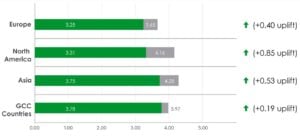
North America, which currently ranks third behind the Gulf states and Asia on autonomous maturity, is expected to record the largest increase in adoption. Companies in the region forecast their maturity score will rise from 3.31 today to 4.16 by 2030, reflecting growing investment in artificial intelligence, machine learning, advanced analytics, and software-defined automation.
Executives increasingly view autonomous operations as a commercial necessity rather than a technology experiment. Enhanced productivity and cost reduction were the most frequently cited benefits, each identified by 35% of respondents, while 34% highlighted competitive advantage.
By contrast, European companies reported the lowest current maturity level among the four regions surveyed and projected the weakest improvement by 2030 (to just 3.65). Executives cited cybersecurity concerns, regulatory uncertainty, and ageing infrastructure as significant constraints.
The report warned that Europe’s slower pace of adoption could compound existing economic pressures, including higher energy costs, weaker industrial growth, and growing competition from North America and Asia.
The shift comes as energy producers grapple with rising power demand from datacentres and artificial intelligence infrastructure. According to the International Energy Agency, electricity demand from AI and datacentres could almost double to nearly 1,000 terawatt hours by 2030, roughly equivalent to Japan’s annual power consumption.
The report found that just 8% of UK organisations surveyed described themselves as fully autonomous today but that 75% identify autonomous operations as a strategic priority, with just over a third (36%) aiming to reach full autonomy within five years.