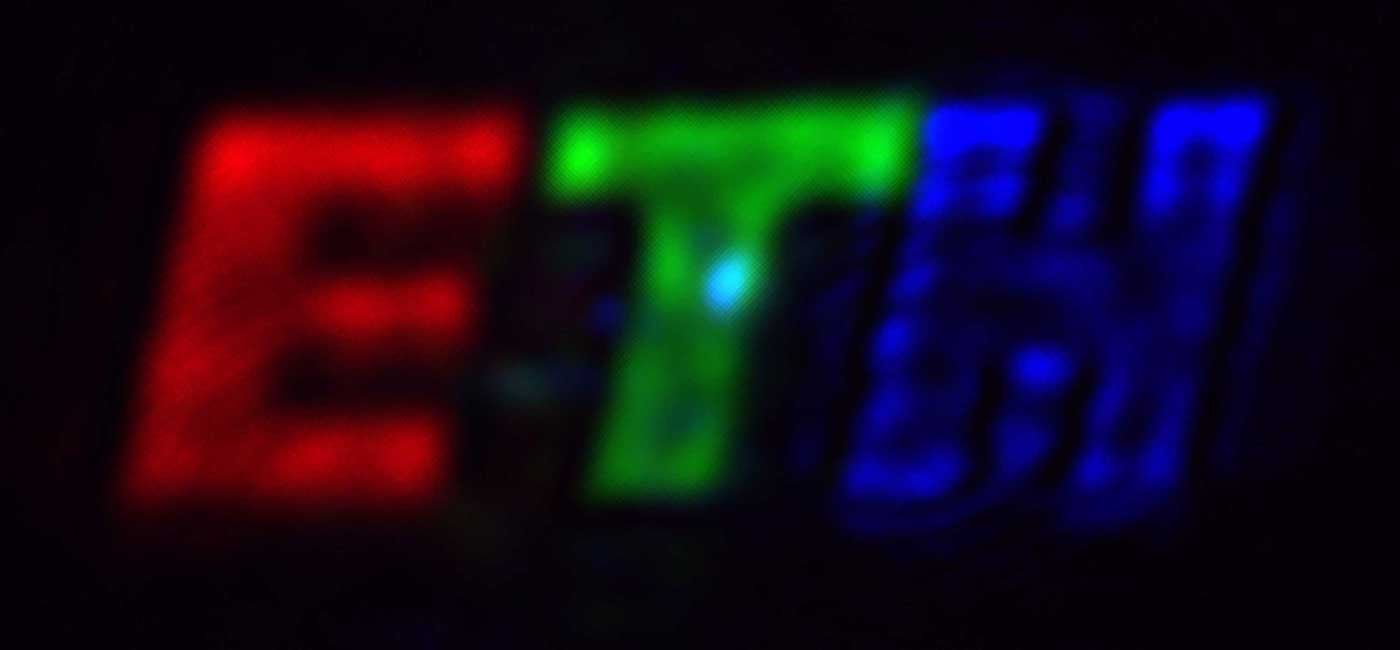

Researchers at ETH Zurich say they have developed a new type of optical “pixel” that can both display and analyse light in a single component, challenging a long-standing separation between light emission and detection in imaging systems used in machine vision.
The work, which has implications for industrial automation where machine vision systems are used for defect detection, robot guidance, and high-speed inspection, centres on nanophotonic “Fourier pixels”, engineered structures that manipulate light at sub-wavelength scales.
In conventional systems, pixels either emit light, as in displays used for operator interfaces, or detect it, as in industrial cameras. The new approach combines both functions, potentially reducing the number of optical components required in automated inspection and sensing systems.
The researchers point to the long history of the pixel as a one-way device. In 1927, the term “picture element”, later shortened to pixel, first appeared in the magazine Wireless World. Since then, pixels have become central to imaging and display technology, but they have remained functionally divided between emission and detection. The team, led by David Norris, Professor at the Optical Materials Engineering Laboratory at ETH Zurich, say the new devices go beyond that limitation by controlling and analysing multiple properties of light at once.
“In addition to light intensity, meaning the bright and dark areas from which images are created, our Fourier pixels can also control other properties of the light waves, for example their polarisation,” says doctoral researcher Yannik Glauser. For automation engineers, polarisation is increasingly relevant in industrial inspection because it can reveal information about surface structure, stress, and material composition that standard intensity images may miss.
The devices can also operate in reverse, effectively turning the same structure into a sensor. “We can also, however, apply the principle of interference and Fourier analysis in the opposite direction to analyse light using the Fourier pixel,” says postdoctoral researcher Sander Vonk. This means a single optical element can both generate structured light patterns and decode incoming optical signals, reducing reliance on separate imaging and processing stages.
Vonk adds that the approach brings multiple optical measurements into one compact unit. “Thanks to the fact that the relevant surface profiles of the pixels can be determined using Fourier analysis, we can combine the control and analysis of amplitude, phase and polarisation on a single pixel,” he says. These properties are key to extracting depth, shape, and material information in advanced machine vision systems.
For industrial automation, the significance lies in system simplification and speed. Today’s machine vision setups typically rely on a chain of components: illumination sources, lenses, cameras, and external compute units that process the data. Each stage introduces latency, cost, and physical complexity. By embedding both sensing and analysis into the optical layer itself, Fourier pixels could compress parts of this pipeline into a single surface.
That could be particularly relevant for high-throughput manufacturing environments such as semiconductor production, precision assembly, and inline quality control, where rapid feedback is essential. A device that simultaneously projects light and analyses its return signal could reduce response times and enable more compact inspection systems.
While the technology remains at a research stage, it reflects a broader shift in photonics towards integrating computation directly into optical hardware. Rather than treating light purely as a signal to be captured and processed elsewhere, these devices suggest a model in which optical elements themselves perform part of the computation.