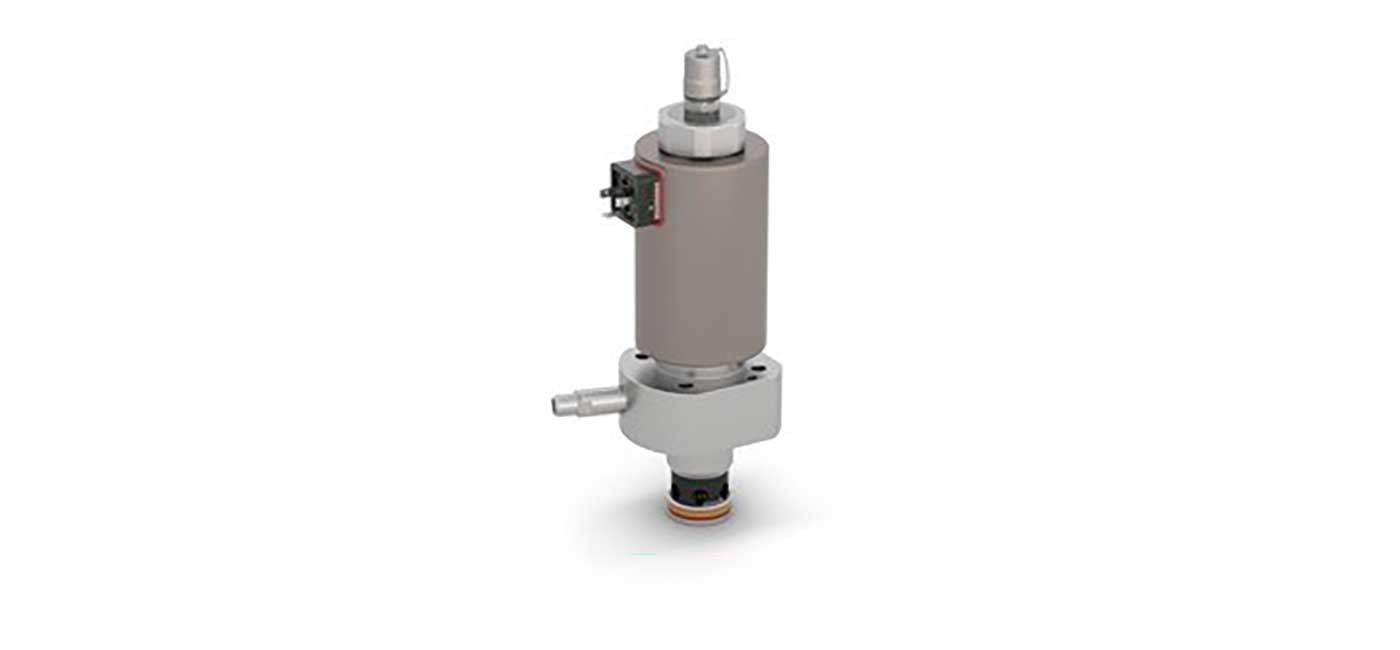

WEBER-HYDRAULIK has launched a direct-controlled seat valve designed to improve efficiency and reliability in dynamic hydraulic systems, as manufacturers seek to cut energy use and simplify system architectures.
The valve is intended for stationary and servo-hydraulic applications where loads must be held securely without continuous control pressure. Unlike conventional pilot-controlled valves, it operates without an auxiliary control pressure supply, allowing loads to remain locked in position even when pumps are switched off.
The company says the valve combines high flow capacity with near-total tightness, a combination that has been difficult to achieve in a single component. It can handle volume flows of around 100 l/min with a pressure loss of about 1 bar, while limiting leakage to a maximum of three drops per minute. This makes it suitable for safety-critical holding functions in presses, test rigs, and automated production systems.
Speed is another focus. The valve opens in as little as 70 ms and closes in up to 180 ms, without relying on accumulators or secondary pump units for control pressure. By removing these elements, system designers can reduce component counts, maintenance requirements, and overall complexity.
In mechanical and plant engineering, where modular, pre-assembled units are increasingly favoured, the valve can be used for both simple switching tasks and reversible motion sequences, as it allows flow in both directions. WEBER-HYDRAULIK argues that this flexibility supports more energy-efficient servo-hydraulic axis designs, particularly in large-scale industrial equipment.
“The directly controlled seat valve opens up new options for energy-efficient, dynamic, and virtually leak-free hydraulic solutions,” said Dominik Vogt, Head of the Valve Technology Division at the Reichenau site. “For designers who want to dispense with control pressure while still requiring maximum load reliability, it represents a sustainable alternative to conventional hydraulic valve technology.”