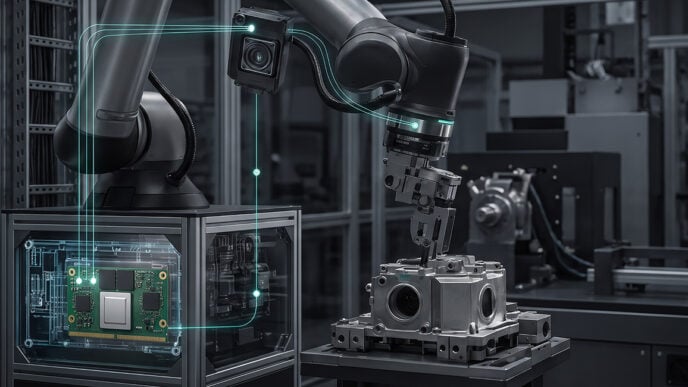

Schneider Electric, NVIDIA and Hewlett Packard Enterprise (HPE) are developing AI agents that run at the industrial Edge, targeting process industries where security, data sovereignty and the cost of deploying artificial intelligence remain barriers to adoption.
The collaboration combines Schneider Electric’s industrial automation expertise with HPE’s Private Cloud AI infrastructure and Nvidia’s AI technology. The companies said the system would allow AI agents to monitor industrial operations, identify problems and recommend or initiate corrective action in real time.
The announcement extends the concept of Physical AI beyond robotics and autonomous machines to the control and optimisation of industrial processes, where interruptions can have significant safety and financial consequences.
The initial applications focus on operational technology (OT) monitoring, cybersecurity and energy optimisation. Schneider Electric said customers would be able to deploy and manage multiple agents through its EcoStruxure Industrial Insights applications.
Running AI workloads close to industrial equipment is intended to reduce the need to transfer sensitive operational data to external cloud environments. The companies also said the approach could reduce data-transfer and AI inference costs, although they did not disclose deployment costs or quantified savings.
For manufacturers and infrastructure operators, keeping data within operational boundaries can help address concerns about regulatory compliance and cybersecurity. However, deploying AI in industrial environments also requires safeguards to prevent automated decisions from disrupting critical processes.
Schneider Electric said the agents would assess operational conditions and verify the results of interventions, with people retaining control of critical decisions.
The first applications build on Schneider Electric’s existing operational technology monitoring system (OTMS), which has been used by Chilean pulp, paper and packaging producer CMPC for three years to monitor the health and availability of its control systems.
The system provides a consolidated view of control systems, servers, workstations and network switches, helping maintenance teams identify emerging problems and prioritise interventions. Schneider Electric said this deployment provides a foundation for introducing AI agents to accelerate fault investigation and decision-making.
The proposed monitoring agents will combine equipment configurations, process topology, alarms and maintenance histories to identify potential issues and assess their likely operational impact. Cybersecurity agents will correlate network activity with control-system behaviour to detect anomalies, while energy optimisation agents will analyse consumption patterns and production requirements to identify opportunities to improve efficiency.
NVIDIA’s contribution includes its Nemotron open AI models, while HPE Private Cloud AI provides the infrastructure for running the workloads locally. The companies did not specify a commercial launch date or provide performance benchmarks for the new agents.
Gwenaelle Huet, Executive Vice-President of Industrial Automation at Schneider Electric, said embedding intelligence in industrial systems could improve resilience, efficiency, cybersecurity and sustainability.
Sri Kodali, Global Head of Developer Relations for Energy and Utilities at NVIDIA, said the collaboration aimed to turn industrial data into operational action. Alexia Clements, senior vice-president of hybrid cloud solution sales at HPE, said the approach would allow organisations to expand AI use while maintaining control over sensitive data and critical systems.