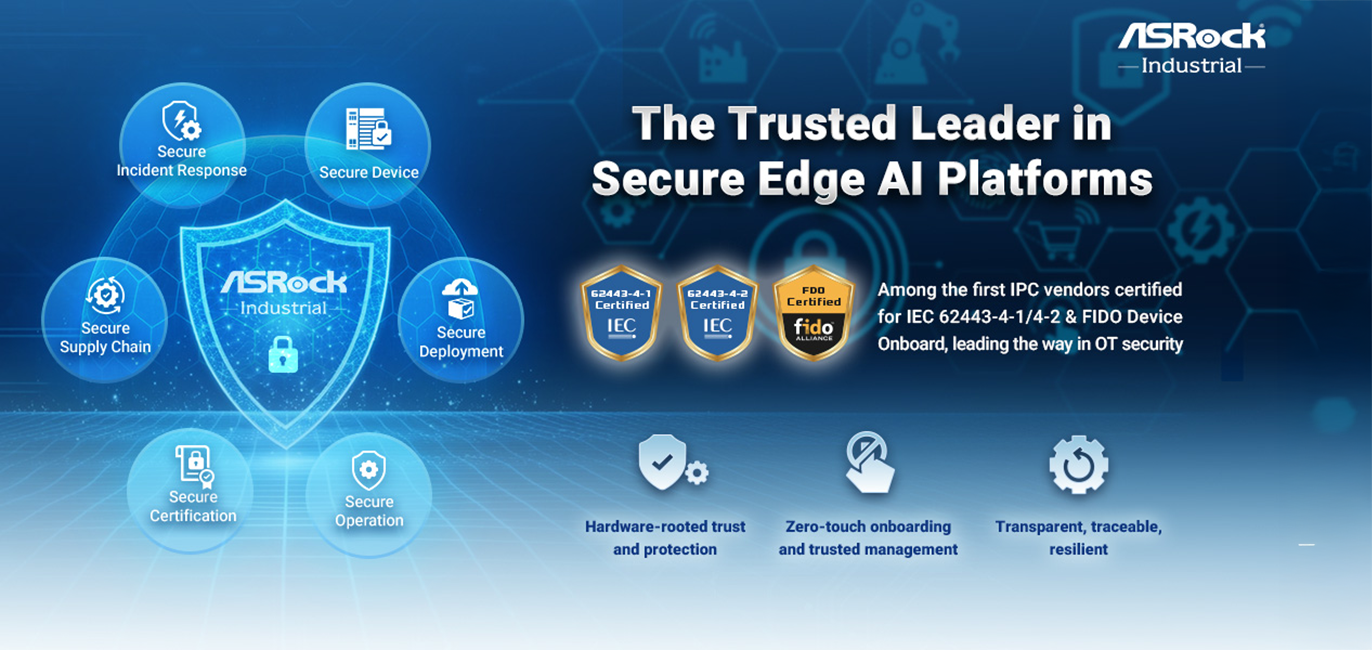

ASRock Industrial has become one of the first industrial PC vendors to achieve IEC 62443-4-1/4-2 and FIDO Device Onboard (FDO) certifications.
The company said the new accreditations reinforce its standing as a benchmark for trusted, standards-based security in industrial computing.
The Taiwan-based manufacturer, a subsidiary of ASRock Inc. under the Pegatron Group, said its focus on “secure by design” systems reflects the growing global emphasis on cybersecurity in critical infrastructure.
Frameworks such as the EU Cyber Resilience Act (CRA), NIST, and NIS2 have raised the bar for resilience and transparency, turning cybersecurity from an optional feature into a baseline requirement for connected systems.
“Edge AI is transforming industries, but without security, it cannot be trusted,” said James Lee, Chairman of ASRock Industrial. “We are not following trends, we are setting them. By embedding security into every layer of our platforms – from hardware and deployment to lifecycle operations and supply chain transparency – ASRock Industrial gives industries the foundation they need to innovate and scale with confidence in the AI era.”
The company’s Secure Edge AI Platforms integrate protection across three pillars: device, deployment, and operation.
Device security is underpinned by a hardware-rooted chain of trust, combining Trusted Platform Module (TPM) integration and secure boot features with virtualisation and I/O isolation to reduce attack surfaces. Runtime and memory protection help ensure applications operate in a trusted state, while hardware-accelerated cryptography through AES-NI and SHA extensions enhances data privacy without compromising performance.
Deployment security is managed through Ai FDO, ASRock Industrial’s zero-touch onboarding system based on the FIDO Alliance standard. The platform automates the provisioning process, establishing a verifiable chain of trust from manufacturing to field deployment. It enables devices to be registered, configured, and connected securely without human intervention – a process aimed at reducing errors and accelerating rollouts across large-scale industrial networks, such as factories, power grids, and smart cities.
Operational security is maintained through AiSafeguard and AiSMA. The former applies Zero Trust principles and containerised architectures to manage device security, isolate applications, and enable real-time monitoring. The latter uses the Redfish open standard to provide cryptographically hardened out-of-band management for remote systems, ensuring secure oversight across distributed deployments.
The company said its IEC 62443 certification demonstrates compliance with a Secure Product Development Lifecycle, involving continuous risk assessment and testing to guard against evolving cyber threats.