
Phoenix Contact, one of Germany’s largest electrical component makers, is seeking to position itself at the forefront of industrial electrification by moving towards direct current (DC) supply at its showcase Blomberg factory.
At a press briefing ahead of the Hannover Messe 2026, the company said its new €35 million facility, known as the “all-electric society factory,” demonstrates its vision for a fully electrified industrial ecosystem.
Dr Martin Wetter, Executive Vice President Innovation at Phoenix Contact, described the project as a testbed for next-generation power distribution. “From my point of view, DC is a real key enabler for the all-electric society,” he said, emphasising the potential of DC for sustainability, energy efficiency, peak shaving, grid stability, and reduced resource use.
Direct current differs from the alternating current (AC) standard that has dominated electricity supply for over a century. In DC, electricity flows in a single direction, whereas AC alternates its direction cyclically, typically 50 times per second in Europe.
The move is notable given the long history of alternating current (AC) dominance. Starting in the late 1880s, Thomas Edison and Nikola Tesla were embroiled in the so-called War of the Currents. Edison developed direct current, which runs continually in one direction, while Tesla championed AC.
AC could be transformed to different voltages relatively easily, giving it a major advantage over DC. Edison famously campaigned to discredit AC, even electrocuting stray animals in public demonstrations. Ultimately, Tesla’s AC system powered the 1893 Chicago World’s Fair and the Niagara Falls Power Company’s generation for Buffalo, New York, solidifying AC as the standard.
Yet DC has seen a modern renaissance. Although AC power runs along electrical grids, most renewable sources such as PV cells and wind turbines produce DC power while computers, LEDs and electric vehicles all run on DC power.
“Since the world has been electrified for over 130 years, there was the famous War of Currents between AC and DC. Alternating current has won historically because it is easy to transport over long distances and to transform between voltage levels. But for localised industrial systems, DC allows more efficient integration of renewable sources like solar panels, smoother energy storage, and simpler control of distributed loads.”
The facility, also known as Building 60, is the newest on the Phoenix Contact campus. It spans 125 metres by 88 metres, and will house around 400 employees. The factory’s DC grid includes a 650-volt DC bus, bi-directional AC-DC converters, modular converters for photovoltaic inputs, and storage integration.
“We can charge vehicles during the day, discharge them at night, and optimise production energy use,” Dr Wetter said. “Sustainability, energy efficiency, peak shaving, grid stability, and less resources. That is what we are demonstrating here, and we hope to lead the way in making DC a practical solution for industry.”
So far only a few of the company’s production machines and electric vehicle charging stations are powered by the facility’s DC grid as well as one of its main lights, but Phoenix Contact says it hopes to increase this over time.
Ulrich Leidecker, Phoenix Contact’s Chief Operating Officer, highlighted the practical advantages of DC in industry: “The more exciting part for us is DC technology. It’s more efficient in general—you need less installation, you have higher efficiency in usage and consumption, and you have less losses in conversion… When you slow down, recuperation regains some of the electrical energy back into the battery. That’s the same you can do with a DC grid in industry. In logistics centres, you’re lifting big loads up and lowering big loads down—it’s almost a zero-sum game if installed correctly.”
Despite these benefits, DC power presents significant technical challenges. Unlike AC, which naturally passes through zero volts 50 times per second—a feature that helps limit the severity of electrical arcs—DC remains at a constant voltage, making short circuits more dangerous.
“I have been a big enemy of DC systems for many years… on a 650-volt DC line, you need protection that turns off in microseconds, not milliseconds. This is something we’ve built and are introducing into the industry,” Leidecker said. In addition, DC grids require specialised equipment, converters, and regulatory adjustments, making large-scale adoption more complex than conventional AC systems.
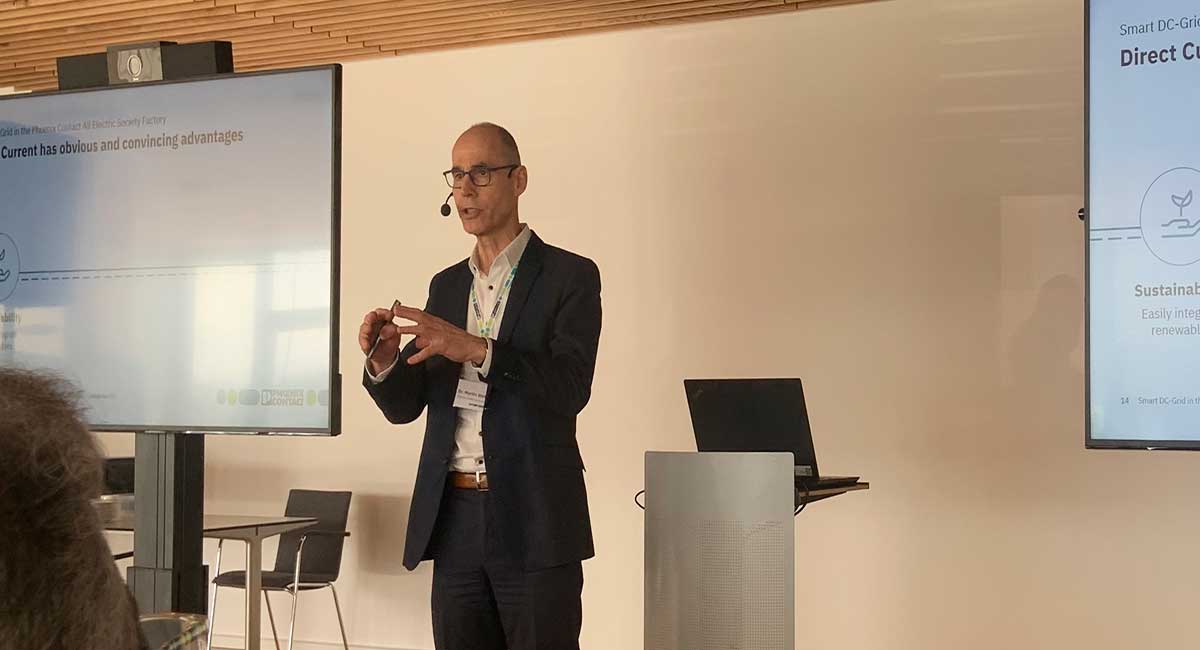
Leidecker also warned of the risks of DC: “I have been a big enemy of DC systems for many years. If you cut a live 400-volt AC wire, it’s loud—a big flash of light, a big noise. If you do the same on a 650-volt DC line, you are dead. That fries you. AC naturally goes to zero voltage every few milliseconds, but DC does not. You need protection that turns off in microseconds, not milliseconds. This is something we’ve built and are introducing into the industry.”
The factory also integrates an ice storage system providing thermal energy for heating and cooling, heat pumps, and a campus-wide heat network.
Electrical energy is supported by battery storage, bi-directional electric vehicle charging, a photovoltaic installation generating 2.5 megawatts, and plans for power-to-hydrogen and hydrogen-to-fuel-cell systems.
Dr Wetter described the ice-based heating system as “fascinating technology,” explaining the physics: “If you take liquid water at zero degrees centigrade and freeze it, you remove almost one kilowatt hour per litre… During the winter months, we extract heat by freezing the water, and in the spring, the compartment is nearly completely frozen, which allows us to cool the building in hot months very efficiently.”