
Ask almost any electrician in Britain for a WAGO and they will instinctively reach into their toolbox.
In much the same way that people ask for a Hoover rather than a vacuum cleaner, WAGO’s screwless spring connectors have become so ubiquitous that the brand name has become shorthand for the product itself.
In Britain, electricians almost universally pronounce WAGO with a hard W, despite the company’s German owners insisting it should be a V.
“The other week I was talking to an electrician at the Installer Show in Birmingham,” recalls Darren Hodson, Managing Director of WAGO UK & Ireland, himself a trained electrician. “He said, ‘You’re like the Apple of our business now.’”
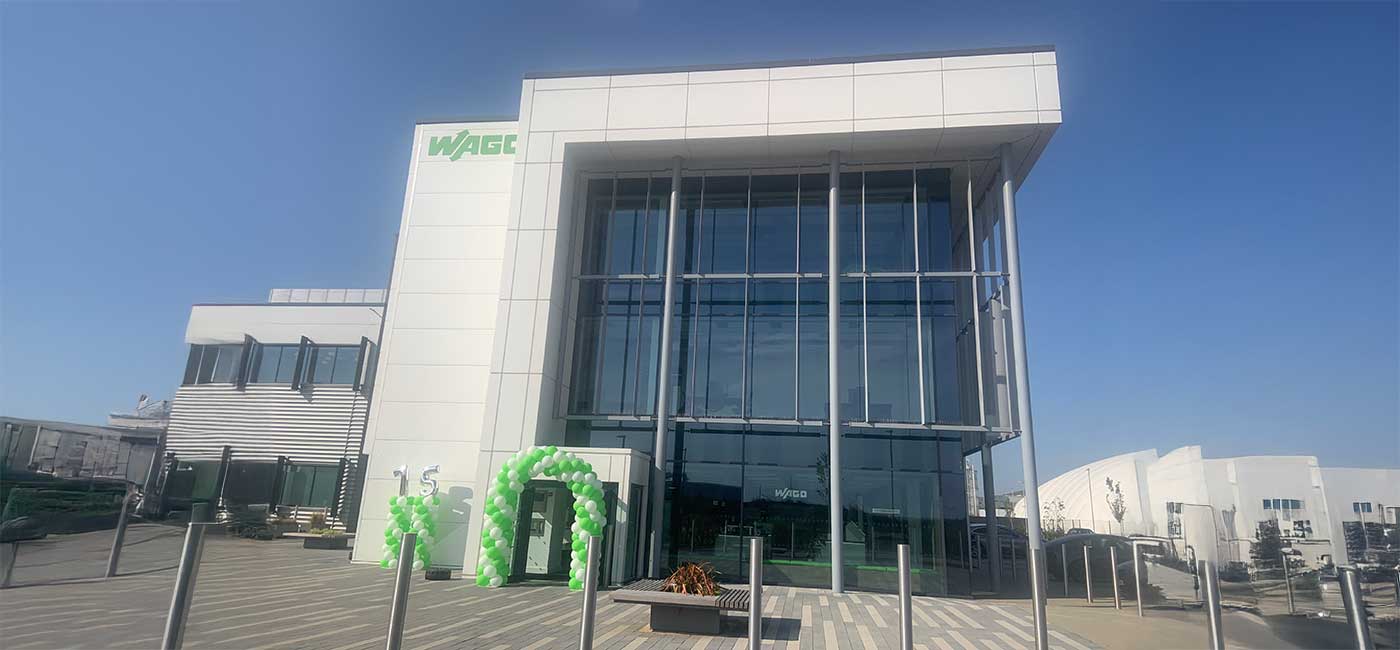
That success, however, presents WAGO with an unusual challenge. The company has become so closely associated with connectors that many manufacturers remain unaware it now competes across industrial automation, from control systems and networking through to energy management. Its new headquarters in Rugby is the company’s most tangible attempt yet to change that perception.
More than a warehouse
But as Hodson welcomes Automation News into the company’s new multi-million pound UK headquarters in Rugby, he is clear that the connector is no longer the whole story.
“What people probably don’t know is what we’re going to demonstrate to you today,” he says. “There’s a little bit more to the organisation than just the connector.”
The building itself feels almost like two businesses sharing the same address.
The front half resembles a modern technology showroom rather than a traditional industrial headquarters. Bright, minimalist meeting rooms sit beneath unusually high ceilings where WAGO’s own modular wiring system is left deliberately visible overhead.
Every room doubles as a demonstration space. Customers come here for product training, specification meetings, and application workshops, while local community groups, universities, and schools are also encouraged to use the
facilities free of charge.
“We don’t want WAGO just to be seen as a big grey building,” says Hodson. “We want to be seen as an organisation that’s part of the local community.”
Behind the offices, however, the atmosphere changes completely.
Charles Stanley-Grey, WAGO UK’s QSHE Manager, jokes that the building reflects the two halves of the business.
“There’s the vision side,” he says, gesturing back towards the customer experience centre. “Then there’s the reality side, where we turn vision into reality.”
Another door opens to reveal the logistics side of the operation where boxes are shuttled between towering racking filled with stock arriving from WAGO’s factories in Germany and Asia. Staff on benches work from computer terminals assembling customer orders, while shelves of individual components allow engineers to dispatch urgent replacement parts the same day. Green painted lines on the floor indicate where those without protective boots are allowed to walk, leading most of the way towards a storage facility containing millions of pounds worth of stock.
The warehouse reveals perhaps the company’s biggest selling point. WAGO isn’t trying to manufacture everything in Britain. Instead, it is trying to combine the scale of a global manufacturer with the responsiveness of a local engineering business.
“A customer might have bought a wagonload of stock, but then the engineer gets on site and suddenly realises he just needs two more. We can pick them, pack them, and get them straight out,” says Stanley Grey.
Stanley-Grey repeatedly contrasts “the behemoth German manufacturer” with “a local British manufacturer with a bit of British common sense.” Problems can be solved by walking across the office rather than opening a ticket with a European headquarters.
Despite the lack of traditional manufacturing, engineers still assemble bespoke DIN rails, wire control cabinets, and modify standard products for individual customers. If an engineer working on site suddenly discovers they need two extra terminals or a customised assembly, Rugby can build and dispatch it immediately rather than waiting for a shipment from continental Europe.
And, with the UK government keen to favour British firms in procurement decisions when awarding defence contracts, WAGO is quick to point out that it has plenty of expansion space in the facility which could be used.
Automation takes centre stage
WAGO’s connectors remain everywhere. Product Manager Andy Turtle cheerfully admits that millions are still sold every year and that, over the past seven years alone, WAGO has sold more than one billion connection products. But during the tour they almost feel like the supporting act.
Instead, Turtle spends most of his time demonstrating programmable logic controllers, Edge controllers, industrial Ethernet switches, remote I/O systems, and energy management software.
The demonstrations become progressively more ambitious. Visitors begin with the connectors that made WAGO famous before being led through increasingly sophisticated automation technologies, culminating in a miniature intralogistics demonstrator where a robot, machine vision system, and remote I/O are integrated into a single control platform.
“Clearly we’ve done extremely well with interconnectivity,” he says. “But automation is where the future is really heading with digitalisation, big data, intralogistics, and data centres.”
John Mackey, Head of Automation, insists that unlike many of the larger automation vendors, WAGO is deliberately avoiding the “rip-and-replace” sales pitch.
“Our whole ethos is to sit on top of the existing technology stack,” says Mackey. “We don’t need to force manufacturers into a complete rip-and-replace.”
Instead, it wants manufacturers to keep existing ABB, Siemens, or Schneider Electric equipment and add WAGO hardware where it can deliver quick improvements.
That approach, he argues, is particularly attractive for Britain’s medium-sized manufacturers, many of whom simply cannot justify replacing entire production systems.
Proving it on the factory floor
“For SMEs struggling to get capital investment to modernise, our ability to sit on top of the existing stack means they don’t need a full replacement. They can modernise step by step.”
Rather than talking about automation in abstract terms, Mackey points to projects where WAGO has quietly modernised existing manufacturing sites.
One of the most striking is Orm’s Brewhouse in Cumbria. The craft brewery occupies 14th-century farm buildings and had been relying on little more than basic start-stop controls, with brewers manually estimating water volumes, adjusting temperatures by instinct, and timing ingredient additions by hand. For a small brewery, that meant inconsistent batches, longer brew days, and little confidence that each recipe would turn out exactly the same.
Rather than replacing the brewery with a proprietary system, WAGO built an open control platform around its PLCs and modular I/O, integrating smart sensors with existing equipment. The result was automated temperature control, accurate water dosing, recipe management, and remote diagnostics, while giving brewers real-time visibility of every stage of the brewing process.
“The customer wasn’t looking for a closed brewery package,” says Mackey. “They wanted better visibility, repeatability, and flexibility.”
The changes have shortened brew days, reduced energy consumption, and provided a platform for future projects, including linking the brewery’s rooftop solar installation to its hot liquor tank so surplus electricity can be diverted into heating water rather than exported to the grid.
Another example comes from Gressingham Foods, where WAGO installed an energy data management system to monitor water consumption, across the poultry processor’s site. The monitoring system allowed engineers to pinpoint leaks and understand exactly where treated water was being consumed.
“Once you measure something, you can manage it,” Mackey says.
The system allowed engineers to identify leaks, reduce treated water consumption and establish a scalable platform for monitoring utilities across the factory.
“The customer started with one application,” he says. “Now they’re expanding it because they can actually see where the savings are coming from.”
These projects illustrate the market WAGO believes offers its greatest opportunity.
Rather than competing head-to-head with the largest automation suppliers on huge greenfield factories, it is targeting manufacturers looking to modernise existing facilities without replacing everything already installed.
Building for the next chapter
That philosophy extends to WAGO’s own headquarters. Almost every system inside the building uses the company’s own technology.
Its modular WINSTA electrical infrastructure means office layouts can be reconfigured without rewiring. Lighting, HVAC, EV charging, and building management are all controlled using WAGO automation. Rainwater harvesting supplies around 65% of the site’s water requirements, while rooftop solar panels contribute a significant proportion of its electricity demand.
For Hodson, though, the building is less about sustainability than confidence.
When he and the UK management team asked WAGO’s German owners to invest in a new headquarters, they were set an ambitious commercial target for turnover.
“They said, ‘If you do £25 million, you can have it,’” he recalls. The target was achieved. Now the challenge is larger still.
After 75 years of electricians asking for “a Wago”, the company now wants manufacturers to ask for WAGO when they’re planning their next automation project.
Whether that strategy succeeds remains to be seen. After all, changing a perception built over seven decades is harder than building a new headquarters.
For now, visitors may still arrive asking about the connectors that made WAGO famous. The company is betting that when they leave Rugby, it will be the automation systems they remember.
This article originally appeared in the September/October issue of Automation News.