
Shadow Robot and the Fraunhofer Institute for Factory Operation and Automation IFF are collaborating on a six-month project to explore how dexterous robotic hands, tactile sensing, teleoperation, and advanced robot control could enable new approaches to manipulation tasks in manufacturing.
The collaboration brings together two member organisations of the euRobotics aisbl with complementary expertise. Shadow Robot is providing dexterous robotic hardware, system integration, and teleoperation capabilities, while Fraunhofer IFF is contributing its expertise in cognitive robotics, challenging manipulation tasks, and industrial robotics consultancy.
The project focuses on manufacturing and assembly tasks that are currently difficult to automate and are often performed manually, particularly where successful manipulation requires precise interaction with individual components.
For Fraunhofer IFF, the focus is on solving challenges that industrial customers cannot find solutions for. Its approach to “automated manufacture” draws on the German tradition of high-quality handicraft. Even in highly automated production lines, there are still 10–20% of tasks that are performed manually due to a lack of technological capability.
“Shadow Robot’s deep experience with telemanipulation meant they had a ready-to-use, complete setup for teleoperating a 5-finger hand with tactile sensing. Instead of spending time on integration, we can jump straight into doing, using some of the world’s most advanced dexterous hands,” said Dr. José Saenz, Group Manager, Fraunhofer Institute for Factory Operation and Automation IFF.
The partners will investigate whether dexterous robotic hands can help address these gaps by providing greater flexibility and physical interaction than conventional industrial grippers. A particular focus will be the role of tactile sensing in complex assembly tasks, exploring how additional sensing can provide greater insight into contact and physical interaction and complement other sensor data during manipulation.
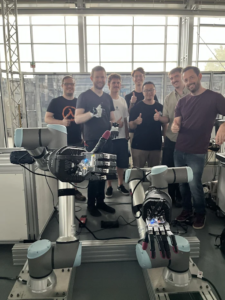
The project will demonstrate what can be achieved by combining dexterous hardware, tactile sensing and advanced software control, while identifying the engineering approaches, challenges, and costs that would need to be addressed to take such systems further.
Rather than humanoid robots, the project focuses on dexterous robotic hands for manipulation, mounted on conventional collaborative industrial robot arms within manufacturing environments. The partners will also explore the level of dexterity required for different tasks, including whether five-fingered hands are necessary for particular manufacturing applications.
“I’ve known the team at Fraunhofer IFF for over a decade through our euRobotics activities across European robotics. It’s a great pleasure – and super exciting – to finally work directly with them on a cutting-edge project like this, with the possibility to solve real manufacturing challenges,” said Rich Walker, Director of Shadow Robot and elected Director of euRobotics aisbl.
Shadow Robot’s dexterous hands are designed for complex manipulation and can incorporate tactile sensing, while its teleoperation technology enables intuitive human control of dexterous robotic systems. Fraunhofer IFF brings expertise in cognitive robotics, real-time robot control and industrial automation, supporting the investigation of flexible approaches to challenging manipulation tasks.
The project also aligns with the wider development of flexible, human-centric production environments, where robotics are intended to complement rather than simply replace human capabilities. This reflects the principles outlined in the euRobotics Vienna Statement, which highlights the role of humans within future production systems.
For both organisations, the project represents an opportunity to better understand the potential of dexterous manipulation and tactile sensing in manufacturing, while exploring the engineering requirements for bringing these capabilities into future real-world applications.