

Real-time monitoring and control are becoming increasingly important as manufacturers look to reduce downtime, improve energy efficiency, and make automated systems more reliable.
But adding AI to motor control systems has traditionally meant more processors and discrete components, increasing cost, complexity, and power consumption.
Highly integrated microcontrollers aim to address this problem by combining motor-control processing with Edge AI capabilities in a single device.
These include MCUs such as Texas Instruments’ AM13E230x family. The family includes the AM13E23019, which pairs an Arm Cortex-M33 core with an integrated TinyEngine NPU for real-time motor control, monitoring, and local AI inference.
This level of integration brings Edge AI functions to more motor-control systems, enabling features such as predictive fault detection, adaptive control algorithms, anomaly detection, and intelligent load balancing in applications where cost, size, and power considerations have traditionally limited the use of Edge AI.
These MCUs are also supported by TI’s CCStudio Edge AI Studio development environment, which provides graphical and command-line tools for developing Edge AI applications.
This article explores how AM13E230x MCUs can help designers address key challenges in humanoid robot actuators and smart home appliances.
Giving humanoid robots better motor awareness
Humanoid robots rely on multiple actuators working simultaneously to control movement and manipulation across many degrees of freedom. Motors must deliver high torque and respond quickly, while keeping noise and energy consumption under control.
This makes motor monitoring particularly important. Local AI models can analyse parameters such as torque, load, and current while the motor is operating, helping to identify abnormal behaviour before it develops into a failure.
Humanoid joints and fingers, with their high ranges of motion and multiple degrees of freedom, can benefit from locally run Edge AI models that detect when motors are operating outside their expected parameters, helping to prevent longterm damage and extend motor lifetimes.
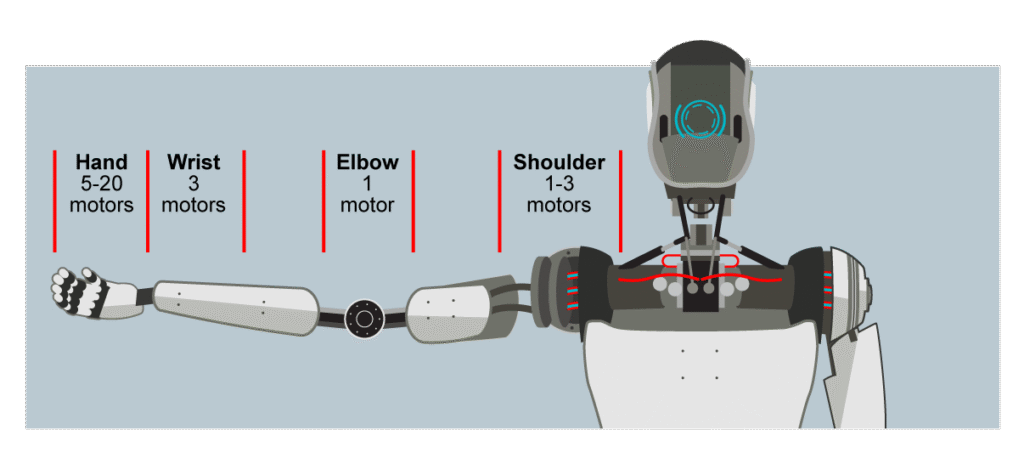
Figure 1 shows the number of motors in a typical humanoid robot hand, arm, and shoulder.
The AM13E230x MCUs are designed for applications where cost, compactness, and precision motor control are key design challenges.
Integration can also reduce the number of external components required around the motor control system, helping manufacturers address the tight space and cost constraints of humanoid robot joints.
The AM13E230x MCUs are available in a 7 × 7 mm package, helping to address space constraints in humanoid robot joint motors.
Bringing Edge AI to appliances
Motor control is also becoming more intelligent in domestic appliances, as manufacturers look to make machines quieter, more efficient, and responsive.
In washing machines, for example, AI could allow the system to continuously monitor motor load and adjust torque and speed according to the weight and distribution of the laundry. Running these models locally means the appliance can respond in real time without sending motor data to the Cloud.
Engineers can use AM13E230x MCUs to optimise washing machine motor-control designs by running AI models that monitor motor load and automatically adjust torque and speed profiles based on laundry weight, helping to prevent motor strain.
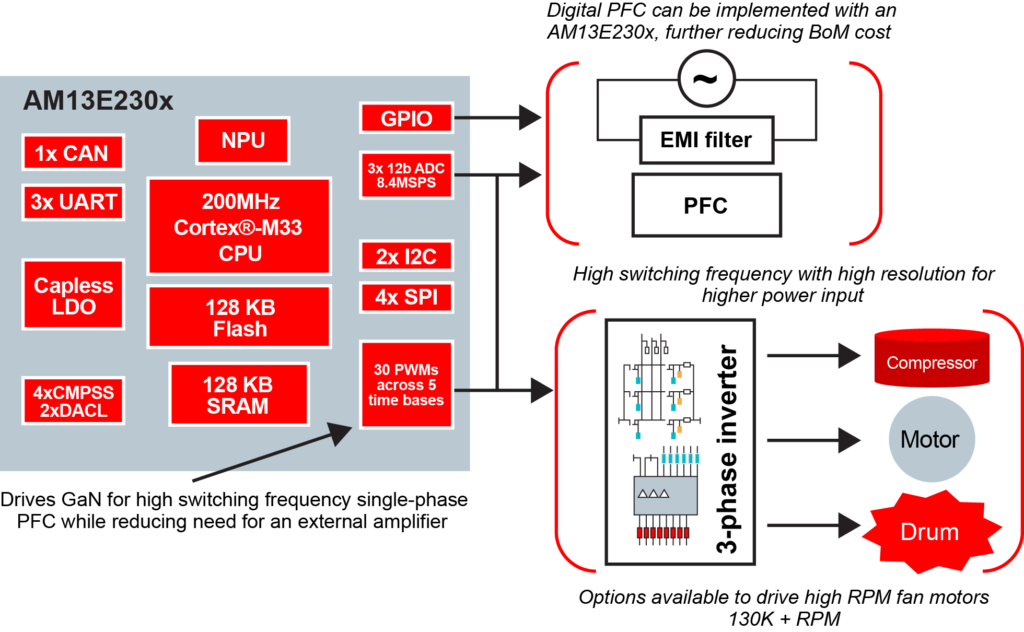
Figure 2 shows a simplified block diagram of a motor control system in a washing machine that uses an AM13E230x MCU.
Why Edge AI matters for automation
The NPU offloads AI workloads from the main CPU, helping to reduce processing latency and power consumption without the need for additional discrete components.
The move towards Edge AI is bringing more intelligence directly into motor-control systems. For applications such as humanoid robots and smart appliances, integrating AI processing with the motor control MCU could allow systems to detect problems earlier, adapt to changing conditions, and reduce the need for additional hardware.
As automated machines become more capable, putting intelligence closer to the motor could become an increasingly important part of their design.
This article originally appeared in the September/October issue of Automation News.