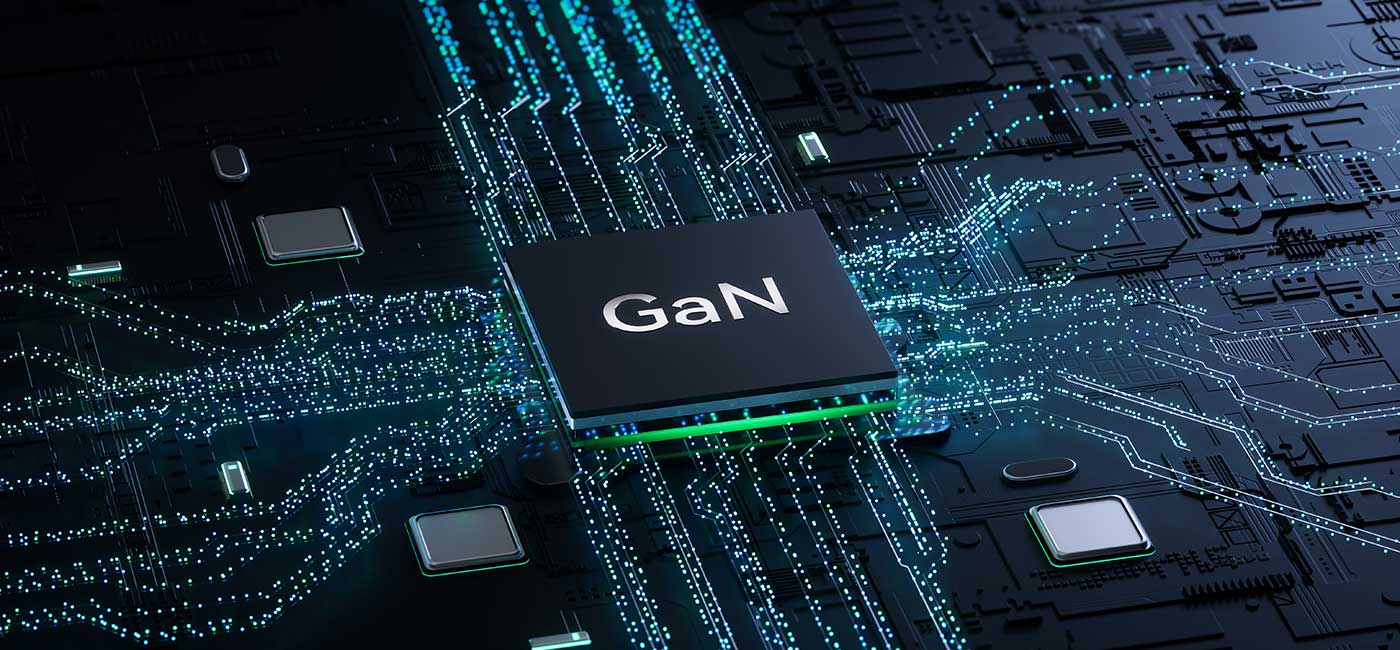

Elmo Motion Control is introducing gallium nitride (GaN) technology into its next generation of servo drives, targeting lower-voltage applications in robotics and industrial automation where reducing energy losses, heat generation and equipment size is increasingly important.
“We would like to be where motion control is very important, when you need very high accuracy, very high speed, and when you would like to reduce the size of your machine,” said Ronen Sadan, VP of Global Marketing at Elmo Motion Control, speaking at SPS 2026 in Nuremberg.
The Israeli motion control specialist is incorporating GaN into selected products within its Titanium servo-drive range, with further additions to the portfolio planned during 2027.
The move reflects growing interest in GaN as an alternative to conventional silicon-based power switching technology. By enabling faster switching between on and off states, GaN can reduce the energy lost during power conversion, limiting heat generation and improving efficiency.
For Elmo, the technology is particularly relevant to lower-voltage applications, including robotics and automated guided vehicles (AGVs). In battery-powered systems, reducing energy consumption can also help extend operating time.
However, GaN is not intended to replace conventional switching technology across Elmo’s entire portfolio. The company is taking a differentiated approach to semiconductor selection, using GaN primarily in lower-voltage applications of up to 100V, while silicon carbide (SiC) is intended for higher-voltage applications, typically above 200V. Some products will continue to use conventional metal-oxide-semiconductor field-effect transistor (MOSFET) technology.
Asked about the industry’s adoption of GaN, Sadan said Elmo had decided to introduce the technology in lower-voltage applications, particularly those used in robotics. The main motivation, he said, was to reduce switching times significantly.
The company cited switching times of around 280 nanoseconds for its existing technology, compared with 20 nanoseconds for one of the new products demonstrated at SPS. However, it acknowledged that faster switching does not come without engineering challenges.
Elmo is therefore retaining flexibility in its product configurations, allowing customers to opt for conventional MOSFET technology rather than GaN where they consider it more appropriate.
Smaller drives for robotics
GaN adoption forms part of a wider effort to reduce the size and improve the performance of Elmo’s servo drives. Its fourth-generation Titanium family also introduces dual-axis products, allowing two independent motors to be controlled by a single compact drive.
One of the products demonstrated at SPS was approximately the size of a matchbox, with the capability to handle up to 50A and 100V. Each axis can operate independently, with its own motion requirements and functional safety capabilities integrated into the drive.
The compact design is intended to address space and thermal constraints in applications such as robotic arms, where multiple motors must operate within a limited physical footprint.
Elmo also sees opportunities in battery-powered mobile robots, where reducing power losses can have a direct impact on operating time.
Bringing intelligence closer to the motor
The company’s focus on miniaturisation also reflects a wider shift towards decentralised machine architectures, with motion control electronics increasingly integrated closer to motors rather than housed in central control cabinets.
At SPS, Swiss industrial automation company Compact Motion demonstrated how it integrates Elmo’s miniature servo drives directly into its linear motor assemblies.
Michael Schmidt, CTO of Compact Motion, said the approach had enabled the company to reduce the size of machine control cabinets while bringing more intelligence into the machine itself.
“Usually the motor controller is so big and somewhere below the machine, and also the intelligence is below the machine,” he said. “We make it very small together with Elmo, and we have integrated it into the motor so that the drive cabinet can be much smaller.”
The architecture also allows motors to communicate and interact with one another, supporting flexible positioning and velocity profiles in automated machinery.
Elmo, which was acquired by Bosch Rexroth in 2022, employs around 400 people and has manufacturing facilities in Israel and Poland. Its wider servo-drive portfolio spans applications from low-voltage robotics to industrial equipment operating at up to 900V.