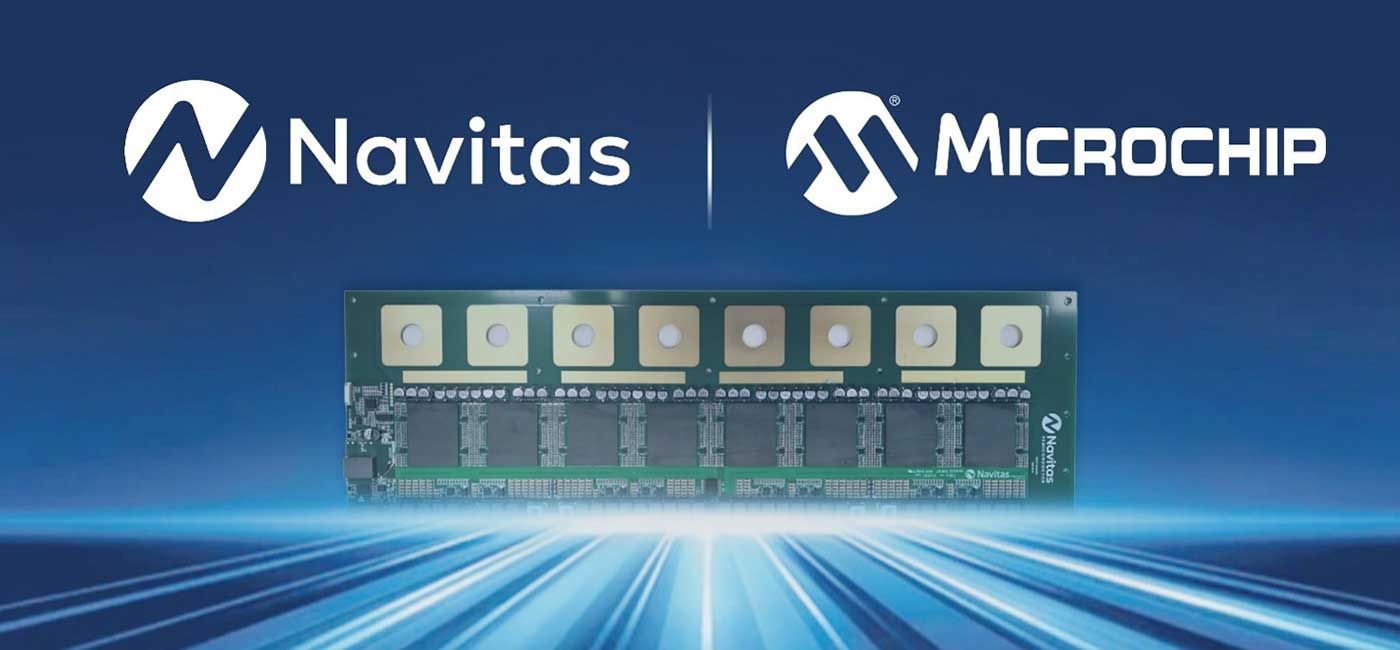

Microchip Technology and Navitas Semiconductor have developed an 800V DC-to-6V DC reference design aimed at helping data centre operators and equipment manufacturers develop higher-density power systems for AI infrastructure.
The companies said the design responds to a shift towards 800V DC rack architectures as AI workloads drive higher power requirements from GPU clusters. Higher-voltage distribution can reduce losses and enable greater power density compared with lower-voltage architectures, while supporting the power demands of next-generation servers.
The reference design combines Microchip’s digital power control and hardware security technologies with Navitas’ gallium nitride (GaN) power devices. It is intended to support power conversion designs aligned with the Open Compute Project’s (OCP) 800V DC architecture.
At the centre of the platform are Microchip’s dsPIC33AK digital signal controllers and TA100 security IC, alongside Navitas’ 650V GaNFast FETs.
The dsPIC33AK provides digital control for high-frequency DC/DC conversion, while the TA100 is designed to provide hardware-based security functions including authentication, secure boot and protected firmware updates.
The reference design uses 16 Navitas NV6034 650V GaN FETs in a stacked half-bridge configuration. The companies said the design targets peak efficiency of up to 96% at full load, operating at a switching frequency of 1MHz, with a power density of 2,100W/in³.
It also uses direct 800V-to-6V conversion, combining what would traditionally be separate 800V-to-50V and 50V-to-6V conversion stages into a single converter.
The design is intended to sit close to the GPU board, with the companies highlighting its low profile as a way of reducing the distance between power conversion and high-power compute hardware.
For industrial automation and data centre equipment manufacturers, the move towards higher-voltage DC distribution reflects a broader effort to manage the increasing electrical demands of AI infrastructure without allowing power conversion and distribution systems to become a constraint on rack density.